Andrea Bocelli and Katharine Mcphee – The Prayer (Live 2008) HD.
Great!!
Andrea Bocelli and Katharine Mcphee – The Prayer (Live 2008) HD.
Great!!
In defiance of most of its media, its former leaders, and the unanimous urging of Europe’s leaders, Greece has voted “Oxi” (pronounced “Ochi”), or “No”, in a decisive referendum on the proposed financial bailout.
Legally, the referendum carries almost no weight. But, politically, it may have changed the face of Europe.
What next? This is what we know – and what we don’t.
This is a triumph for Greece’s anti-austerity party Syriza
The referendum result allows Greece’s government to draw a line beyond which it simply cannot be pushed by the rest of Europe, and by lenders such as the European Central Bank and the International Monetary Fund.
This gives it power in Brussels. Syriza still cannot force Europe to offer a better deal, but Europe now knows: if there is not a better deal, there will be no deal.
Most commentators thought Syriza had shot itself in the foot by calling a referendum on the bailout package, then pushing hard for a “No”.
Its opponents claimed that “No” would mean leaving the euro; it would mean isolation, inflation, more unemployment, more recession.
A strong “Yes” vote would have sent the message that the voters believed this interpretation. It would have left Syriza practically spent as a political force: discredited and rejected.
But most “No” voters, according to polls, accepted Syriza’s version of the narrative: this was not a referendum on the euro.
It was a determination to return to Brussels and demand that, if there was to be a financial rescue, it would be on (or closer to) Greece’s terms.
Their message to Brussels was clear: find another way. Or we’ll just have to try it ourselves.
This is a disaster for Syriza’s opponents
Inside and outside Greece, many politicians and institutional leaders were dismissive of Syriza. They saw Greece’s government as amateur radicals, unprepared for the big stage. They bet the referendum would prove their undoing. They particularly wanted to see the back of Yanis Varoufakis, the arrogant, confrontational Finance Minister.
Their bluff has been called.
Inside Greece, the conservative former Greek prime minister Antonis Samaras has already fallen on his sword, stepping down as leader of the New Democracy party.
There is no “government-in-waiting” for those who hoped Syriza would be a short interregnum between centrist leaders.
Outside Greece, those who insisted that “No” would mean the end of efforts to prop up Greece’s economy now face a test: did they mean it?
It is still entirely within Europe’s power to release the funds promised to Greece, under more generous terms.
The negotiations over a rescue package will resume and so will the grandstanding on both sides.
But this time Syriza can play a stronger hand.
The chance of a “Grexit” is now much higher
Greece’s banks are on the brink of collapse, as money flees the country for safer harbours. The vote doesn’t change that.
There is no rescue deal, so there is no guarantee the European Central Bank will release funds to prop up the banks.
Until it does so, Greece has a crippling shortage of cash, which is needed to buy imports such as food and medicine, all of which makes the prospect of a Greek exit from the euro (or Grexit) more likely.
Sooner or later, without more euros, the country will have to create an alternative to the euro. It could be called a government IOU, or it could be called a drachma. Practically, the name doesn’t matter.
Without more cash from overseas, the Greek currency will have to change.
But is there really a possibility of a “Grexit?” Not likely! Membership of the European Union has often been likened to The Eagles “Hotel California”……”You can check-out any time you like, but you can never leave”.
The chance of debt relief is now much higher
The debate over the referendum, within and outside Greece, was partly over whether the current strategy for turning the country’s economy around was truly working.
But new IMF projections, released this week, could be translated as “tell ’em they’re dreaming”.
Very few economists convincingly argue that Greece can cover its debts, now or in the future.
And it is clear that, even if a more extreme austerity might put Greece on track for a long-term recovery without debt relief, its citizens simply will not accept that plan. The Greeks still want to retire at 50 with a full pension, have reasonable levels of GST/VAT, cheap utilities, but still fail to appreciate where the money is coming from to pay for this lifestyle. Greece has “little” in terms of heavy manufacturing industries; they don’t make cars or ships. They don’t have heavy steel or aluminium smelters. They rely on tourism as a major source of income, but outside of the EU, this tourism may become too costly.
This is what Syriza was trying to argue in Brussels, without success. It can now argue the case more forcefully, with fresh evidence. Debt relief is firmly on the table.
Nationalism is still on the rise
Anti-European voices are already claiming this as the moment the European project failed.
It’s too simplistic an interpretation. Many of the “No” voters in Greece still want to stay in Europe, and in the euro.
But, if this referendum wins debt relief, or a kinder rescue package for Greece, then countries such as Spain, Italy and Portugal will be asking: “What about us?”
The political calculus is clear: vote for radical populists, get a better deal. The next few years could see European federalism dealt a fatal blow.
However, this is just one interpretation. There is an alternative argument: that the case of Greece proves that the only way the euro can work is with tighter financial integration.
There are some in Greece – and elsewhere – who hope Europe will change fundamentally. There will be a “mutualisation” of debt, rather than continued rescue packages. The “ever closer union” will be accelerated rather than stalled.
Greece is going to face another tough week
Until Europe sorts out its response to the referendum, or the European Central Bank reverses its current policy, Greece’s long bank holiday will almost certainly continue.
ATM withdrawal limits are likely to fall again. The first reports of food shortages have already begun, they are likely to worsen. ERmpty shelves are seen in supermarkets. Imported medicines will be harder to come by for GPs and hospitals.
Many businesses have been paralysed by the restrictions on sending money overseas (ie, to buy imported goods), and by the reluctance of Greeks to spend the cash that is so hard to come by.
Tourists will think twice before going on holiday in a country where food and cash are reportedly in short supply. Greece is rapidly becoming a third world country, rather than the birthplace of democracy and civilisation.
Everyone is waiting to find out: what happens next.
Source: Nick Miller, The Newcastle Herald
With all the torremtial rain and high winds received on Australia’s east coast between Sydney and Newcastle, I found this photo showing the amount of rain pouring off the Sydney Harbour Bridge!
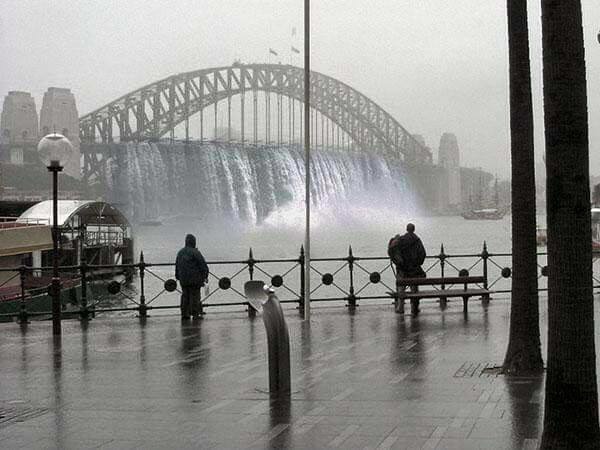
Rain cascading off the Sydney Harbour Bridge – 2015
We certainly do get extremes of climate here in Australia!
OK, OK I’ll ‘fess up and reveal that the photo is not all it seems to be. It is indeed a fake. Had you fooled, yes? But I did like the photo. Yes, we had a lot of rain, but not quite that much.
A severe (Category 2) cyclonic weather system has been in place for Sydney, Mid-North Coast, Hunter and Illawarra regions of NSW. There has been torrential rainfall (300mm/1ft in the last 24 hours) has been damaging and destructive winds gusting to over 160 kmh (100mph) and damaging surf in these regions.
Here are a number of photos of damage to property in the Hunter Region by fallen trees in my own street alone.

Newcastle Floods 2015 – A new river has “appeared” in the local park.
The weather for prognosis for today is cloudy. Very high (90%) chance of rain, locally heavy at times. The chance of thunderstorms. Winds S/SW 30 to 45 km/h decreasing to 25 to 35 km/h in the late evening. Large and powerful surf conditions in the afternoon and evening are expected to be hazardous for coastal activities such as rock fishing, swimming and surfing. However the winds and rain are expected to worsen upto Category 1 cyclone conditions again tonight until midnight before conditions are expected to ease.
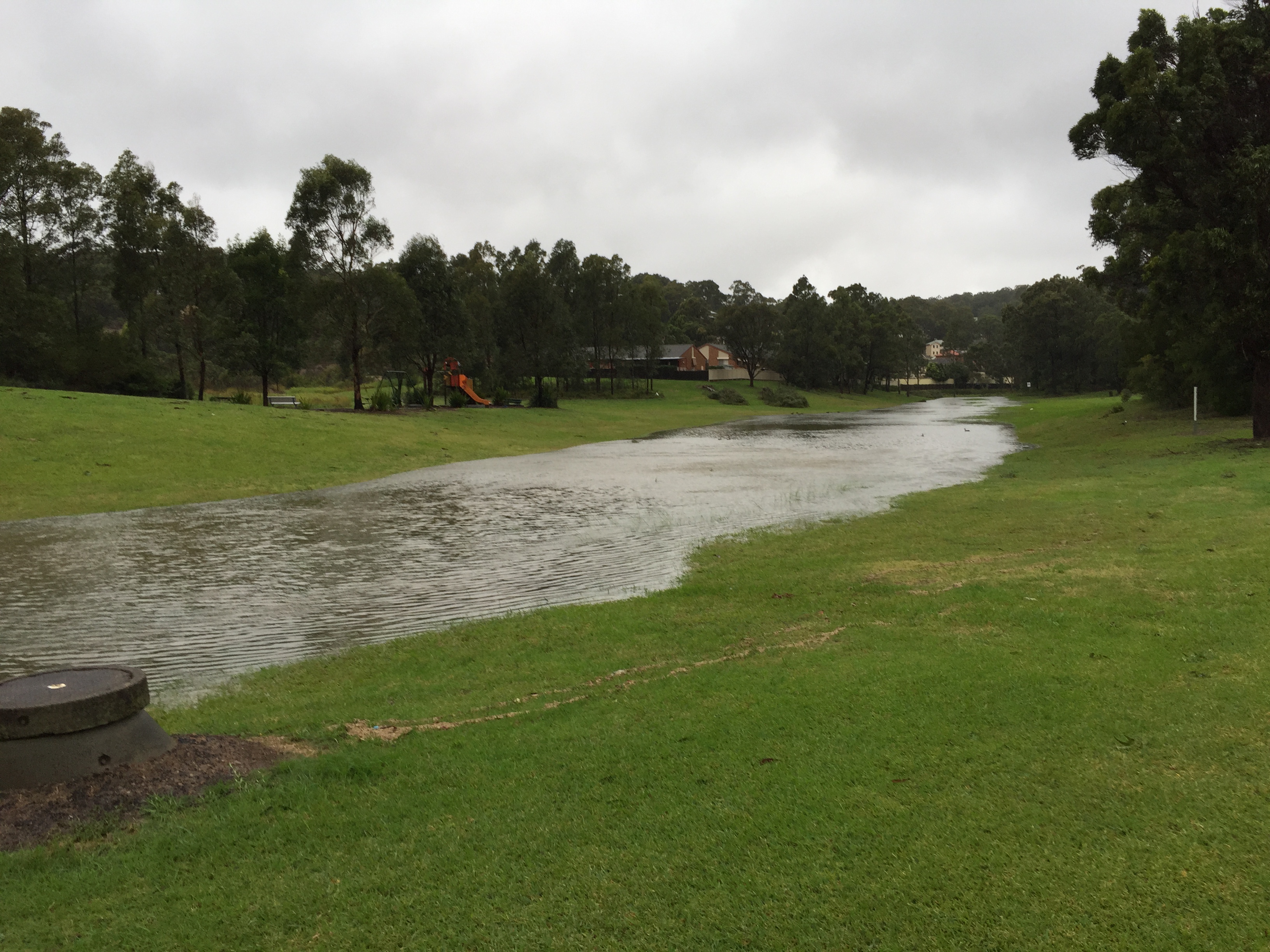
Newcastle Floods 2015 – Another view of the “new” river!

Newcastle Floods 2015 – Gum tree fallen onto house

Newcastle Floods 2015 – Another gum tree fallen onto another house

Newcastle Floods 2015 – A gum tree fallen across the road obstructing half the carriageway.
Here is a short video of various laocations around Newcastle, courtesy of Hunter TV.
The following picture is of the canal in Wallsend town. Although I use the term canal, it is not a canal in the British sense – meaning you cant sail a narrowboat down it – but it is rather a stormwater canal which is normally dry.
Its depth from the bank to the bottom of the canal is approximately 1.2m (4 feet) and it is 10m (32.8 feet), so you can judge how much rain has fallen.
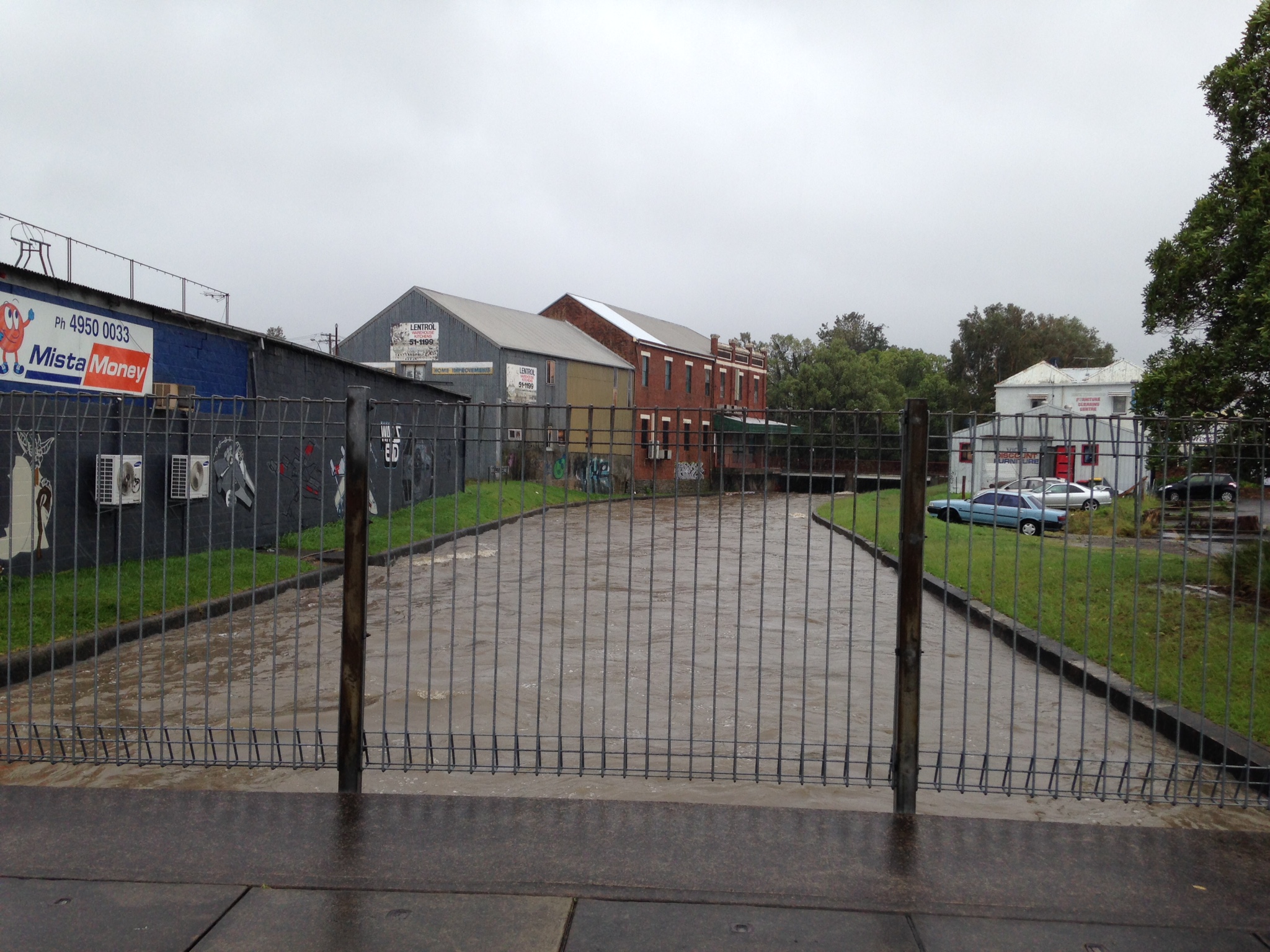
Wallsend Stormwater Canal – Photo courtesy Graham Thorpe.
The Australian Federal Government and QANTAS are considering changes to cockpit security following the Germanwings crash.
The Deputy Prime Minister said Australia’s aviation agencies were investigating if current cockpit safety requirements needed further strengthening. “The current regulations do not require airlines to replace a pilot who temporarily leaves the cockpit,” he said. This would mean at least three pilots on every flight as a pilot may need to leave the flight deck for “personal” reasons. Understanding the world-wide shortage of experienced airline pilots, this may not operationally feasible in the short to long term.
“Careful consideration needs to be made following thorough investigation to ensure that altering current procedures does not open other potential vulnerabilities.” One of these vulnerabilities could lead to the placement of inexperienced pilots onto the flight decks of commercial aircraft.
“Our two major international and domestic airlines are undertaking their own safety and security risk assessments of cockpit procedures following the recent tragedy.”
A Qantas spokesman said the airline was “monitoring the information coming out of the French investigation” and was considering whether any changes to its existing safeguards were needed.
Airlines including Norwegian Air Shuttle, Britain’s easyJet, Air Canada, Air New Zealand and Air Berlin all said they had introduced a requirement that two crew members must be in the cockpit at all times.
Regulations in the US already require that no pilot must ever be left alone at the controls and Canada has now followed suit.
Lufthansa said on Thursday that it did not see any reason to change its procedures, but later announced it would adopt new rules requiring two crew members to be in the cockpit at all times. “The passenger airlines of the Lufthansa Group will put this new rule into place as soon as possible in agreement with the relevant authorities,” Lufthansa said in a statement on Friday.
Source: http://www.msn.com

Ooops! Advertisement for Spotlight
In the Spotlight catalogue above, the Koo Elite Scarlett quilt set seems ideal for putting your feet up. All three of them. But look again carefully – although she only has two legs, the model has three right feet. This puts a new slant on never putting a foot wrong!

Ooops again, this ad is for Target
Take a look at this handy chap! He has one hand around his “wifes” shoulder, another around his “daughter” and one at his side! This picture appeared in a Target catogue in April 2012.

Three feet – or is that a yard?

Three hands/arms! Clever man!
Makes you wonder if anybody proof reads the copy before puiblication?
I found this interesting piece about what pilots do (or actually don’t do) in their down time between flights:
As my husband and I settled into a rare splurge on extra-legroom exit-row seats on an early morning flight from a Caribbean island, a pair of uniformed pilots slipped into the row across the aisle from us.
It was like sitting with the cool kids!
I excitedly awaited the opportunity to start a conversation and see what I could learn. After the drink cart passed, I prompted hubby to lean across the aisle and break the ice by asking where they had spent the night on an island where most accommodations limit regular travellers to weeklong stays.
He prefaced the question by telling them that we have been visiting the island for five years and that opened the door to a flood of questions, not from us, but from them! Here’s what we found out.
Pilots long to enjoy the destinations they fly us to
They wanted to know everything we knew about the island. They asked where we eat, where we stay, what our favourite dive sites are, and even what it costs for a week (excluding the cost of airfare, of course). One talked about bringing his wife; the other was scouting honeymoon destinations for his daughter.
It was only after more than an hour of asking questions that they got around to explaining the intricate details of pilot downtime rules that force the need for pilot rotations like the one they were on.
If the inbound flight the night before is delayed even a little, there could potentially not be enough official rest time before morning. (The downtime doesn’t start when the plane lands, but when they are “behind the hotel door.”) The inbound pilots would not be able to fly back out on schedule the next morning.
The guys sitting in coach with us had flown the plane in; a second crew was flying it home. So they often don’t have time to get to know the destination to which they are going.

Coming in for landing at Saint Maarten in the Caribbean. Source: Getty Images
Even pilots have travel bucket lists
It’s hard to believe that two pilots nearing the end of long careers flying the globe could have travel destinations yet to conquer, but both of these guys did. One wants to visit Ireland and has a trip planned there soon. The other confessed that when he travels for fun, it’s usually by car, but that he would love to spend time in Asia.

There are many places they haven’t seen yet. Source: Getty Images
Pilots judge other pilots on their flying skills
It’s like there’s some secret point system. We had an incident on our approach to landing during which both nonflying pilots sized up the guy actually flying the plane. Just as the tarmac appeared beneath our plane, the engines roared and we suddenly climbed hard and began banking. While everyone else craned to look out the windows for an explanation, I looked at the pilots.

Inspecting the plane. Source: Getty Images
The aisle pilot calmly said, “Oops.” The window pilot studied the runway, now far below us, before explaining that it looked like a plane on the ground had not quite cleared the runway while taxiing to its gate.
“No point lost for our guy,” he said. “It was a good call. He did the right thing.”
Pilots sometimes get annoyed with the control tower
The two pilots agreed that such conversations were likely taking place as we circled wide to get back into position again. Our plane actually had to be routed back into the line of planes waiting to land — at the end of the line, our pilots said. “Sometimes they (the tower) will work you into the middle of the line, but it depends on the stack.”
Pilots don’t always tell passengers the truth
Following our missed landing, the pilot flying our plane confirmed over the PA what our aisle buddies had already told us. There had been a taxiing plane not quite clear of our intended landing strip. But not every pilot feels the need to be forthcoming, particularly when they are at fault.
The aisle pilot told a story of a missed approach caused by pilot error. That pilot attempted to hide his mistake from passengers by blaming it on a non-existent plane on the runway. What he did not know was that he told his fictional story to the control tower (which knew better), not to the passengers. Bad piloting and a finger on the wrong communication button put him at the very end of the line for his retry.
Being a pilot can be lonely
My two pilots included their wives and families in every topic of conversation. Their job puts them in exotic destinations, far from their families, in the company of attractive co-workers, but for these two guys at least, it was just another day at the office with an eagerly anticipated return to home and family.

Pilots cherish the time they have with their families. Source: Getty Images
This story originally appeared on Yahoo.com and was republished via SmarterTravel.com.

9M-MRD as MH17 – Photo by Reuters
Despite two high profile crashes, the aviation industry recorded its safest year yet, according to the 2014 safety performance report issued by the International Air Transport Association on Monday.
“Any accident is one too many and safety is always aviation’s top priority. While aviation safety was in the headlines in 2014, the data show that flying continues to improve its safety performance,” said Tony Tyler, IATA’s Director General and CEO.
MH 370 and MH 17
The year 2014 will be remembered for two extraordinary and tragic events—MH 370 and MH 17. Although the reasons for the disappearance and loss of MH 370 are unknown, it is classified as a fatal accident—one of 12 in 2014. The aviation industry has welcomed the proposal by the International Civil Aviation Organization (ICAO) to move towards the adoption of a performance-based standard for global tracking of commercial aircraft, supported by multi-national operational assessments to evaluate impact and guide implementation.
The destruction of MH 17 by anti-aircraft weaponry, however, is not included as an accident under globally-recognized accident classification criteria. The four aircraft involved in the events of 11th September 2001 were treated in the same way.
“The shooting down of MH 17 took with it 298 lives in an act of aggression that is by any measure unacceptable. Governments and industry have come together to find ways to reduce the risk of over-flying conflict zones. This includes better sharing of critical information about security risks to civil aviation. And we are calling on governments to find an international mechanism to regulate the design, manufacture and deployment of weapons with anti-aircraft capabilities,” said Tyler.
“To the flying public an air tragedy is an air tragedy, regardless of how it is classified. In 2014 we saw a reduction in the number of fatal accidents—and that would be true even if we were to include MH 17 in the total. The greatest tribute that we can pay to those who lost their lives in aviation-related tragedies is to continue our dedication to make flying ever safer. And that is exactly what we are doing,” said Tyler.
2014 Safety by the numbers:
Jet hull loss rates by region of operator
Turboprop hull loss rates by region of operator
Source: Aviation Tribune
Andrew Doohan at Semper Quaerens offered these thouights on the Australian governmemt’s proposal to capture metadata from all Australian ISPs and thus every Australian inetrnet user. As I was unable to reblog the post by usual method, I offer it here duly credited.
The most condemning part of the current Federal Government’s proposed new metadata capturing and storage legislation is that they haven’t as yet made a case for why this gross invasion of the privacy of Australian citizens is warranted. If, as Chris Berg suggests, the best they can do is to have the head of the Australian Federal Police say “those with nothing to hide have nothing to fear” then have spectacularly failed to make their case.
The reality is that my privacy is not something the needs defending. Rather, it is an invasion of my privacy that requires defending and justification.
The attitude of the current Federal Government, aided and abetted to a large degree by the current Federal Opposition, is to trample all over the precious liberties and freedoms that they supposedly hold up as being defended. It is wrong. It is misguided. And is most definitely unAustralian.
Andrew offered further reference here: @chrisberg http://t.co/3KzGddewU8
My reply this outrageous proposal was thus:
Australia is a great place to live and work, to raise kids. Anybody can be anything they want to be if they are prepared to put in the graft to get there. It really is one the world’s great class-less societies.
But….. it’s also the most dangerous country in the world to live!
Seven of the top 10 most venomous snakes in the world live in Australia, and that’s 4 of the top 5! These include the death adder, taipan, tiger snake, eastern brown, king brown, fierce snake and copperhead. Then there are a number of other venomous snakes that don’t rate in the top 10 too! Add to that the large number of non-venomous tree snakes, pythons etc! Don’t get me wrong, the place is not crawling with snakes, but they are here! Half the deaths in Australia are caused by brown snakes.
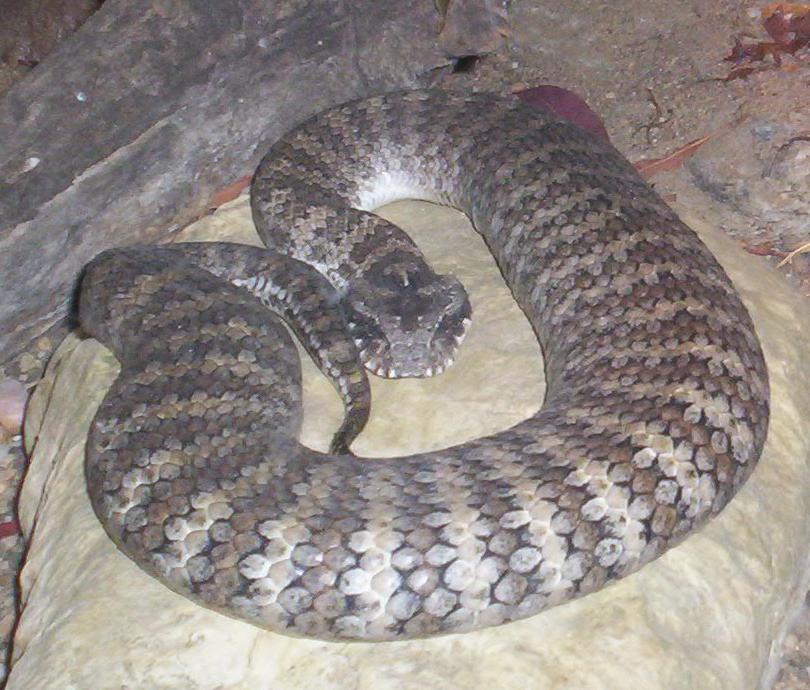
Death Adder (Acanthophis)
Then there are the spiders! The funnel-web, mouse , trap-door, red-back and wolf spiders rate in the top ten of the world’s deadliest spiders.
Fancy a swim in the ocean? Think again! The sea is the home of the box-jelly fsh, arguably the most venomous creature in the world, venomous sea snakes and of course, numerous types of sharks varying from harmless to man-eaters.
However, the Australian Saltwater crocodile is by far the most dangerous animals in Australia.
They are huge, aggressive, territorial, and plentiful across the north of the Australian Outback. Australian saltwater crocodiles are the largest reptile in the world in terms of mass they can be up to 2000kg, and the largest crocodile with a confirmed measurement was over 7 metres (21 ft). In real terms anything over 5 metres (15 ft) is rare, but these are still formidable creatures. Female rarely exceed 3 metres (10 ft).
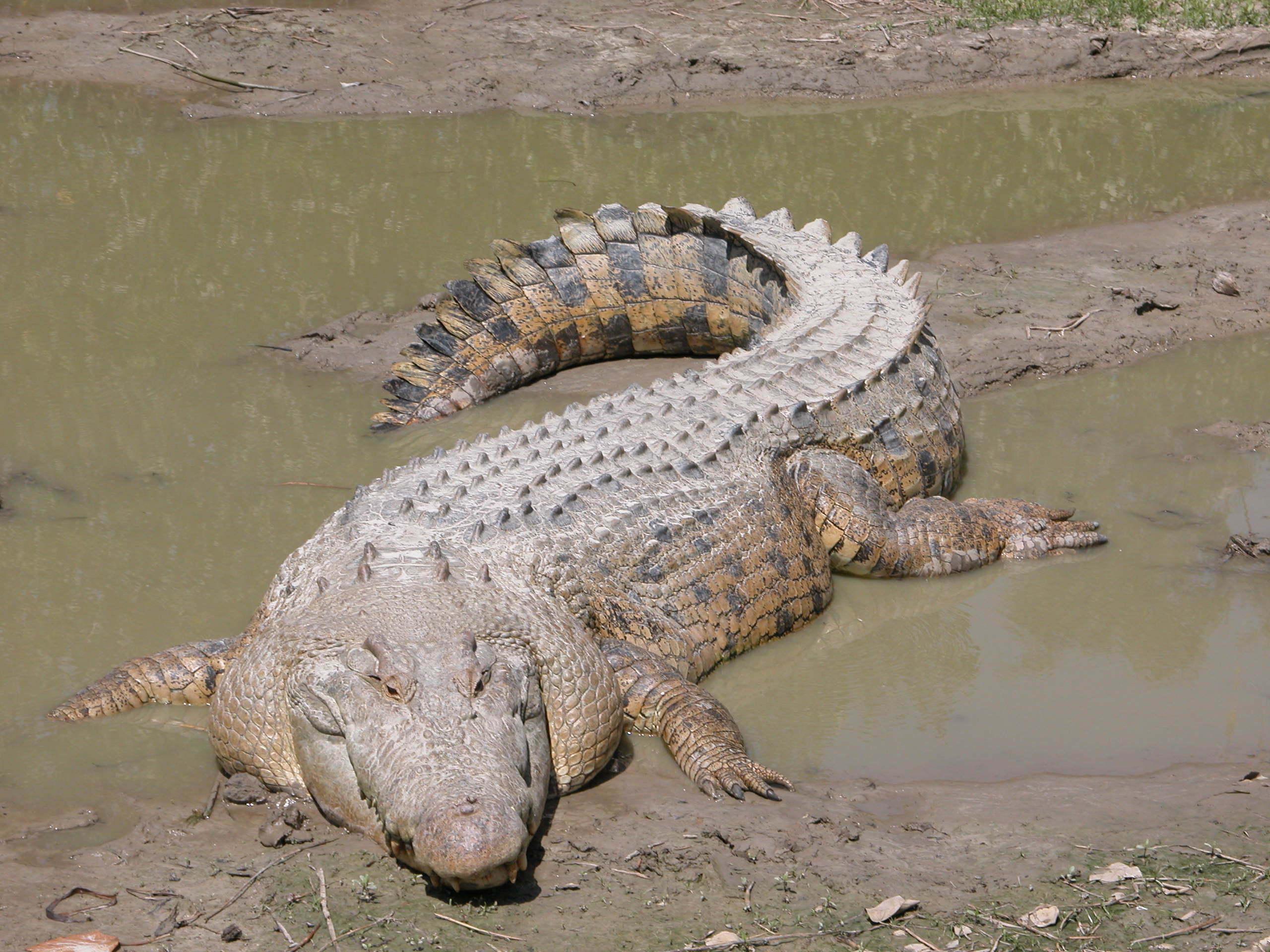
“Maximo”
The name saltwater crocodile is misleading. The crocodiles can live in the brackish waters along the coastlines but are just as happy in freshwater rivers, swamps and billabongs many hundreds of kilometres inland. Crocodile attacks DO happen in Australia on a regular basis. Most attacks are on animals and livestock, but unfortunately there also regular incidents involving humans, and about two per year are fatal. These attacks occur because:

Crocodile jumping while being fed on the Adelaide River
In fairness, it must be added that although there a large number of potentially dangerous animals, spiders and reptiles in Australia, the number of actual human fatalities are rare. Australians, in the main, are aware of the risk(s), and take due precautions when travelling in the bush. Crocodile attacks on humans often occur with overseas tourist who under estimate (or are oblivious to) the risk!
In defence of snakes, fatal bites are very, very rare in Australia and bites are often the fault of the person being bitten. Most bites occur when people are trying to kill a snake or show off. Most snakes would rather slither away from humans than fight them. Snakes don’t perceive humans as food and they don’t aggressively attack things that are not food, unless they are cornered, agitated or attacked. Human fatalities to snake bite are 4-6 annually.
George Brown is a decorated soldier and health professional and 40 year veteran in the field of emergency nursing and paramedical practice, both military and civilian areas. He has senior management positions in the delivery of paramedical services. Opinions expressed in these columns are solely those of the author and should not be construed as being those of any organization to which he may be connected.
He was born in the UK of Scottish ancestry from Aberdeen and a member of the Clan MacDougall. He is a member of the Macedonian community in Newcastle, and speaks fluent Macedonian. While this may seem a contradiction, it is his wife who is Macedonian, and as a result he embraced the Macedonian language and the Orthodox faith.
His interests include aviation and digital photography, and he always enjoys the opportunity to combine the two. Navigate to his Flickr site to see recent additions to his photo library.

Џорџ Браун е украсени војник и професионално здравствено лице и 40 годишен ветеран во областа на за итни случаи старечки и парамедицински пракса, двете воени и цивилни области. Тој има високи менаџерски позиции во испораката на парамедицински услуги. Мислењата изразени во овие колумни се исклучиво на авторот и не треба да се толкува како оние на било која организација тој може да биде поврзан.
Тој е роден во Велика Британија на шкотскиот потекло од Абердин и член на Kланот MacDougall. Тој е член на македонската заедница во Њукасл, и зборува течно македонски. Иако ова можеби изгледа контрадикција, тоа е неговата сопруга кој е македонски, и како резултат научил македонскиот јазик и ја примија православната вера.
Неговите интереси вклучуваат авијација и дигитална фотографија, и тој секогаш ужива во можност да се комбинираат двете. Отиди до неговиот Фликр сајт да видите последните дополнувања на неговата слика библиотека.


Emergency vehicle visibility and conspicuity research & comments for the Police, Fire, EMS and Ambulance: The AV Blog is written by John Killeen
Smile! You’re at the best WordPress.com site ever
Focus, Fun, and Creativity
I write, blog, vlog and poet...I wander, I ponder and I recollect ...DIGITAL NOMAD & PHILOSOPHER
Discussion on the law that applies to or affects Australia's emergency services and emergency management, by Michael Eburn, PhD, Australian Lawyer. Email: meburn@australianemergencylaw.com
The Butterfly counts not months but moments, and has time enough.
"Everything is possible to him who will try"
Thoughts on growing up and growing old in the digital age
Blog with Journalistic and Historical articles
Macedonian Orthodox communities in Australia
EVERYTHING AND ANYTHING
a Feminist Phenomenology (or something)
Oh, let's see...distinguished Gen-X'er, frustrated writer and mom living in the confines of a small town that thinks it's a big deal. And have I mentioned Walmart yet?
A Story Begins
Film, Life and Culture
The Diary of a Retiree

 Words, By George!