Words, By George!

Mundane Musings ­­║ Mindful Mutterings ║ Madcap Mischief

  • Welcome!
  • Main
    • PHOTO GALLERY
      • Avoca, Co. Wicklow
      • Bitola, Macedonia
      • Coventry, Warwickshire
      • Devizes, Wiltshire
      • Fishguard, South Wales
      • Liverpool, UK
      • Pontsycyllte Aqueduct
      • Prilep, Macedonia
      • Standedge Tunnels
  • Liked Links
  • About the Author
    • Contact the Author
    • Inspirations
  • Books I’ve Read
  • My Stories
    • 1%
    • A Meeting With Death
    • Rachel
    • The Holiday

Top Gear Hi-Jinx

Posted by George Brown on 21/12/2014
Posted in: Cars, Entertainment, Humour, Legal, Media, News, Opinion, Police, Travel, Views. Tagged: Argentina, BBC, BE11END, Belgrano, Falklands, H1VAE, H982FKL, Jeremy Clarkson, Top Gear. Leave a comment
 The presenters of the British motoring program Top Gear are said to have fled Argentina after being pelted with stones over a controversial licence plate on one of their cars.

The BBC confirmed on Friday that the presenters and crew had left the South American country but denied that the registration plate was intended as a deliberate provocation over the Falklands War.

Presenter Jeremy Clarkson was among those forced to abandon their vehicles after an angry crowd gathered and began throwing stones.

One of the vehicles – a Porsche – carried the plate H982 FKL, which local newspapers claimed was a reference to the 1982 conflict.

Patagonian daily newspaper Diario Jornada said: “Top Gear is filming in Patagonia and there’s controversy.”

“Even though the BBC authorities asked the popular presenter Jeremy Clarkson to behave himself during his time in Argentina, he chose to use the provocative number plate H982 FKL on his Porsche, in reference to the 1982 Falklands (Malvinas)” war, in which Britain defeated Argentina, it said.

But the BBC bosses said that the number plate was just a coincidence.

Executive producer Andy Wilman, said: “Top Gear production purchased three cars for a forthcoming program; to suggest that this car was either chosen for its number plate or that an alternative number plate was substituted for the original, is completely untrue.”

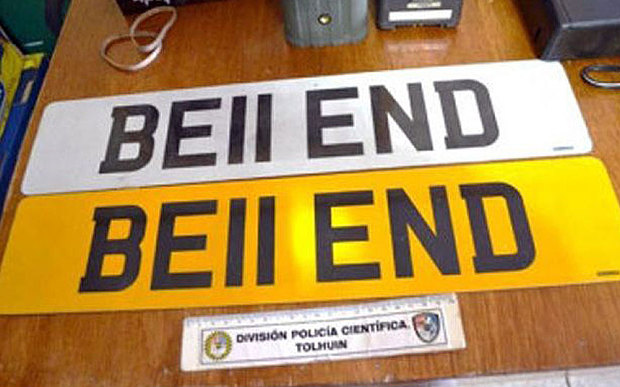
A substitute plate made for the Porsche, BE11END, was allegedly seized by Argentinian police after inspecting the abandoned Porsche near the Chilean border was found to be equally offensive to Argentinians as they believed it to refer to the end of the General Belgrano, an Argentinian battleship sunk during the Falklands war by the Royal Navy. Argentinian authorities also alleged that the vehicle carried a third set of plates H1 VAE.

BE11END

BE11END

Argentine officials and media seized on the discovery, insisting it was yet another indication of a pre-meditated BBC plot to mock the country over the 1982 Falklands War.

If this is not the case, it seems to me that a little more research and forethought on sensitive issues in Argentina should have been carried out by the BBC and the Top Gear production team. I see this as another example of the cavalier attitude so typically associated with this show and its popularity. Jeremy Clarkson would never deliberately antagonise the Argentinian authorities, would he?

3 sets of plates for one car? Why would this be so? Why would this be even necessary? Not to mention illegal! Or is this another example of an Argentinian beat up of the facts to continue popular ill-feeling against all things English/British?

The truth is probably somewhere in the middle!  We will have to wait to see the Top Gear Christmas special later in the month.


A Litany of Failure

Posted by George Brown on 20/12/2014
Posted in: Crime, Emergency Services, Law, Legal, Media, News, Opinion, Police, Public Opinion, Uncategorized, Views. Tagged: crime, failure, Man Haron Monis, Martin Place, Sydney Seige. Leave a comment

Man Haron Monis, the violent criminal involved in the Lindt Café hostage drama in Sydney last Monday and Tuesday was well known to Australian law enforcement and security agencies since 1996, when he arrived from Iran and was granted “political refugee” status.

He had a long history of violence, mental instability, religious extremism.  So how was it then that Monis was able to walk our streets and perpetrate the most heinous crime in Australia’s history?  And let’s get this right. His actions were not terrorism, but rather those of a deranged criminal who happened to be Muslim.  To their credit, Monis’ actions have been soundly denounced by the Australian Islamic community. To answer the above question, let’s take a look at Monis’ background and Australian security agencies failures in respect of that background

  1. FAILED – Granted Bail in Murder Charge – Monis was granted bail in December 2013 after being charged with being an accessory before and after the fact in the murder of his ex-wife.
  2. FAILED – Prevented from Extradition – In 2010, Iran requested the extradition of Monis to face fraud charges in Iran in respect of the travel agency he ran.  The request was refused as Australia had no extradition treaty with Iran.
  3. FAILED – Removed from Watch List – Monis dropped of the ASIO watch list in 2010.  if he had been on the watch list, bail would not have been granted.
  4. FAILED – Citizenship Granted – Monis was granted Australian citizenship in 2004 despite the Iranians having a warrant out for his arrest.  To be granted citizenship the applicant must be of “good character”.  Australian authorities seem to have overlooked his criminal history and unanswered charges in Iran and granted citizenship anyway.
  5. FAILED – Allowed to Enter Australia – Granted “political refugee” status in 1996, in full knowledge of his outstanding charges in Iran.
  6. FAILED – Given Legal Aid – He was able to access the High Court to attempt to have a trial aborted.  His action was dismissed.
  7. FAILED – Gun Licence – There seems to be some dispute as to whether Monis has held a gun licence in Australia
  8. FAILED – Allowed to Live on Welfare – Monis survived on the Australian welfare system for many years.
  9. FAILED – Multiple Identities – The use of numerous aliases led to some difficulties in tracking his criminal activities.
  10. FAILED – Allowed to Write Hate Mail – Monis wrote deplorable hate mail to families who had lost sons, husbands, brothers in the war in Afghanistan.  For this crime he received a minor sentence of “community service”.
  11. FAILED – Information Not Shared between Security Agencies – Decisions about Monis may have been made without having the information that other agencies knew!
  12. FAILED – Was Able to get a Firearm – Where did Monis get the pump-action shot gun that he used to murder two people in the Lindt Café?  Did he steal it, or was is supplied by an accomplice to his crimes?
  13. FAILED – Able to Register Extremist Company Names – Monis was able to register Hizbullah Australia and Dar El Fatwa Australia.  These names should have alerted security authorities to Monis’ possible criminal intent. Further he had a 1300 service number – 1300 4 JIHAD – which has since been disconnected.

It would appear that those red flags that should have been raised in respect of Monis’ activities were not raised, or if they were, they were indeed ignored.  This ultimately led to the horrific events which occurred in Martin Place and to the death of two innocent people.

Lax bail laws need to tightened, inter-agency cooperation and information sharing needs to be improved, and citizenship for those involved in jihadist and other criminal activities need to be annulled and those persons deported back to their country of origin. The Australian attitude of “She’ll be right, mate” is out of place in today’s times.  Its time to toughen up against all those who have demonstrated a behaviour of a violent, criminal or extremist nature.

Australia is a peaceful multi-cultural society with people from many countries and many faiths. There is however NO place for religiously motivated extremism and/or violence affecting the innocent members of the community going about their daily lives.

Macedonia Revisited

Posted by George Brown on 14/12/2014
Posted in: Humanity, Humour, Opinion, Tourism, Uncategorized, Views. Tagged: Bitola, Macedonia, Makedonija, mobile phone, pedestrian crossings. Leave a comment

It has been 4 years since I last visited Macedonia (MK), so I thought I’d like to give you my impressions on what is different, and (sadly or predictably) what has remained the same. This list is not meant to be critical of MK, but rather my observations after a 4 year absence.

What is different:

  • Everybody has a mobile phone, even the dedovci, babi (Grandpas and Grandmas) and that phone is usually glued to their ears.
  • Police have found hand-held speed guns. I got speed checked twice in the the first two days I was there. Once on the main road north of Prilep on the way to Bitola, and the next day on the way out of Bitola in the 50kmh zone before the turn-off to Mogila. For the record, no they didn’t get me as I’m still driving slowly while get used to driving on the right.
  • There seems to be more money around. The amount of new or near-new (European) cars is surprising (my son suggests they “all” have been stolen from all over Europe), although there are still plenty of old Yugos and Zastavas to be seen. It would appear that cars never get inspected for roadworthiness as there are some really old rusty jalopies around.
  • Lots of very nice new houses are being built, both privately and high-rise units. Two very nice apartment buildings going up on Partizanska – where the old army unit was based.
  • Credit cards are widely accepted, especially at the more progressive establishments, although I was advised to be cautious when using a card – no more so than at home however!
  • Parking zones and city parking officers (Gradski Parking) have been introduced, which appears to be just a revenue raising exercise on behalf of the local council. Parking is still difficult, in part because people still park anywhere (even on pedestrian crossings), and the parking officers don’t do their job, as they always seem to be just standing around with the obligatory mobile phone stuck to their ear. Upon reflection this point should probably be noted under “what is the same”, LOL!
  • All the young girls (and some of the older women) are wearing clothing that seems to be two sizes too small; (the tighter, the better?), they all use too much make-up and all chew gum. Did I mention they all have mobile phones glued to their ears?
  • I went up to Hotel Molika, arguably one of Macedonia’s premier hotels – it was deserted and appeared closed for business. Hotel booking web sites like Expedia still seem to be taking bookings though? Curious!
  • It seems like Makedonski biznis “love” using English words in the signage of their business. However they always seem to get the spelling and/or context wrong. I went to a coffee shop yesterday, and on the automatic sliding glass door of the shop it said “Activate your ‘sensors’ by tasting our premier ‘caffee’”. I’m still looking for those ‘sensors’.  I did pass by this business 4 days later and the sign had been changed to “senses”. ‘Caffee’ had not been changed!  Another business offers ‘Suprime’ quality!
  • Private business people are extremely polite and welcoming when you come to their store. However, don’t ask them to suggest another business where you might get what you want, if they don’t have it! I wanted to buy a 4XL “Makedonija” t-shirt which the trader did not have; but somehow the owner expected me to buy a 2XL instead. Do I fit into a 2XL? No! I did see a 4XL t-shirt somewhere, but do you think I can re-find the store?
  • There are cafes everywhere. Many of them seem to have no customers at all, so I’m not sure how they survive. Others appear to do very, very well.
  • A string of betting shops called “Sports Life” has sprung up. They seem to do OK too. I’m not sure how? In a country where the average monthly income is AU$665, and 30.4% of the population living below the poverty line, how can people afford to bet?
  • Gypsies begging in the city centre seem to have gone! Not sure why – but it was suggested that the council was behind it. When we were here in 2010, you could not move on the Shirok Sokak (Corzo) without being hit on by gypsies begging for money, ostensibly to buy bread, but more likely to go on beer and/or cigarettes!

What is the same:

  • There seems to be two prices for goods and services. One for the locals and one for tourists. The tourist price can be 25-35% higher. I circumvent this practice by only buying from businesses who display their prices openly. Seeing as MKD1 equals AU$0.02c, the increased margins are not great and won’t break the bank, however this practice is illegal in most other places in the world, and I was later to find out that the practice is illegal in MK, but not policed. The GST/VAT rate varties from 4% to 18% dependent on what it is you are buying. The interesting thing of note here is that most “tourists” in MK are returning ex-patriots with a familial tie to the country, so traders are in effect ripping off their fellow countrymen.  True tourists with no family link to the country number only 2% of total visitors to MK.
  • Policing is non-existent – other than the radar cops – which is not really policing any way, more like revenue raising. Police are seen around the town, they just don’t seem to do anything other than walk around with the obligatory mobile phone stuck to their ear! They do seem to have a fleet of new vehicles which is a change from 2010. Most Macedonians believe that corruption still exists within their police force, and that money fixes everything.
  • Public officials still excel in avoiding doing their jobs.
  • Or they are so officious and arrogant, dealing with them is a nightmare.  My wife holds a Macedonian passport. She was told by border police on exit that while she might be a citizen, she was not a resident! She reminded him (ever so nicely) that every citizen has the right of residency.
  • Speed limits are optional.
  • Driving on the right is also optional.
  • Taxis appear to be exempt from all road rules, and cause general traffic chaos.
  • Drivers stopping at pedestrian crossings is to be avoided at all costs.
  • Drivers pull out to overtake a vehicle as you approach them, causing you to have to take evasive action. Everybody on the road wants to get where they are going as quickly as possible, with scant regard for other road users.
  • Motor cycles, scooters and bikes are everywhere, but helmets are not used/worn.
  • Road markings are poor (paint must be expensive), and road signs are contradictory or vague at best.
  • There seems to be a competition between drivers to see who can recline back the furthest while driving.
  • The use of mobile phones whilst driving seems acceptable. It might be illegal, but again no policing occurs.
  • The local council has installed pedestrian crossings everywhere, but you still take your life in your hands trying to use one.
  • I was surprised at the general level of dilapidation of most public buildings. There seems to have been no repairs or maintenance carried out on them since they were erected back in socialist times.
  • The state of roads, footpaths, public utilities, driveways, stairways, power poles is dangerous at best.
  • Macedonia is an electrical nightmare! We were staying in a two-year-old unit. There were bare, exposed wires everywhere, even in the shower cubicle! Another bare wire was in contact with metal towel rail! I don’t know if these wires are live or not, because I can’t test them. However, we lost all power in our unit on day 2, due to a short circuit. I was unable to find the cause. I reset the circuit breakers to restore power, and during our five week stay this occurred 4 times. This is really unacceptable for a new building.
  • Street light poles often have their access hatches missing with bare wires exposed – not everywhere of course, but all too often.
  • The aggregate in the road surface is quartz which gets polished as car tyres roll over it, resulting in reduced traction and grip for those tyres, especially when the roads are wet.
  • EVERYBODY smokes! Considering that cigarettes are AU$2.25 a pack, it’s not surprising! It is illegal to smoke inside in cafes and restaurants, so they cater for smokers by having outside eating areas, to the extent that some restaurants do not like to open their inside (non-smoking) area. Needless to say I won’t eat in those establishments!
  • Everybody walks to where they want to go, which the makes the streets a very lively and exciting place. Everybody talks to everybody, certainly not like that in the United Kingdom or Australia.

Australia, The Monarchy and The Republic

Posted by George Brown on 10/12/2014
Posted in: Democracy, History, Monarchy, Opinion, Politics, Views. Tagged: Australia, Australian Republic, civil list, Constitutional Monarchy, history of the monarchy, Monarchy. Leave a comment

Throughout history, the British monarchy has been an integral part of that nation’s culture and history. As England’s oldest secular institution, it is intertwined with the nation’s identity and political culture. The monarchy embodies the best of British society. If abolished or radically changed, the nation would lose this essential element that solidifies its political system.

By virtue that Australia was claimed for Britain by James Cook in 1772, Australia became a British colony and thus it fell under the blanket of the British monarchy from that time. Although Australia became a self-governing country and member of the British Empire and later the Commonwealth of Nations, Australia remained a constitutional monarchy.

So what is the value of the monarchy? What do they do? The monarchy is a secular institution whereby one finds themselves in a position of “power”, influence and luxury by birth, rather than by “earning” that role through political ascension, or by the will of the people. From an Australian (or Canadian) point of view, what is the value of having the head of state being a resident of another country, represented in this country by a Governor-General? And in real terms, who is the Head of State, the Governor-General or the Prime Minister?

It has been suggested that the monarchy is:

  • A symbolic position, delicately balanced between governmental representation and participation.
  • An English institution, inspiring loyalty among the people. In this capacity, the monarchy functions as an “effective barrier” against non-democratic government.
  • Maintains a nonpartisan stance in its dealing with parliament offering a tempered view to insure its survival, as any active participation in governmental affairs could render the monarch vulnerable to criticism from Parliament. The Crown also acts as an “advisor” to parliament and the providing of “Royal Assent” for legislation. In real terms however, Royal Assent has not been withheld since 1705.
  • Performs duties as head of state, making overseas visits and entertaining foreign dignitaries.  To be able to do so, the monarch received an income under the Civil List. The Civil List was the name given to the annual grant that covered expenses associated with the Sovereign performing their official duties, including those for staff salaries, State Visits, public engagements, ceremonial functions and the upkeep of the Royal Households. The cost of transport and security for the Royal Family, together with property maintenance and other sundry expenses, were covered by separate grants from individual Government Departments. The Civil List was abolished under the Sovereign Grant Act 2011.
  • Acts as a ceremonial head and tourist attraction, but these benefits alone do not justify the monarchy’s existence. However, when they acquit themselves correctly, the Royal family embodies the English historical concept of all that is noble and good, providing the people with a virtuous ideal.

And this is all well and good for the English, but is it right for Australia?

To many younger Australians, the monarchy has become increasingly out-dated and irrelevant, while those over 65 years of age are more likely to support it.  At the last referendum in 1999 on the question of Australia becoming a Republic, was narrowly defeated 45% to 55% to retain the monarchy. One will note that the recent referendum on Scottish independence was also defeated by a similar margin.  This question was asked of the Australian people:

To alter the Constitution to establish the Commonwealth of Australia as a republic with the Queen and Governor-General being replaced by a President appointed by a two-thirds majority of the members of the Commonwealth Parliament

It has been suggested that many Australians voted No because they disagreed with the selection of the president by the Australian Parliament, in favour of selection by the people.  Election of the President by popular vote was not an option.  Had it been so, then it has been suggested that the yes campaign would have won significantly.

However, from a historical point of view most constitutional matters sent to referendum fail.  Since 1906, only eight of 44 proposals put to a referendum have been approved by the constitutionally required double majority. What this means is a majority in each of the six States, and a majority nationally.

If Australians for a Constitutional Monarchy are to be believed, support for a republic has fallen to 40%. It has been suggested that while young Australian may dislike the idea of the monarchy, they are mesmerised by the star power of the younger royals, in particular the Duke and Duchess of Cambridge, William and Kate, and Prince Harry.

So what is the future for a republic in Australia? That is a difficult question to answer.  There are staunch supporters on both sides of the question.  Recently, the Governor-General, Ms Quentin Brice, came out in the support of the Republican cause, which raised criticism from the monarchist camp.  While the republican cause maintains interest and support a further referendum is unlikely, especially as the Prime Minister, Tony Abbott remains a firm monarchist and is unlikely facilitate change.

An Australian republic? Not in my lifetime!
Stop Messing with Children’s Heads!

Posted by George Brown on 05/12/2014
Posted in: Media, News, Opinion, Politics, Views. Tagged: Australian Greens, Bill O'Chee, Christmas presents, domestic violence, gender-specific toys, Larissa Waters, Senator Larissa Waters. Leave a comment

The idiocy of some Australian politicians shows no bounds.  The ongoing flak created by the Australian Greens’s foray into children and their toys continues. How do they come up with this stuff?  And we pay these people?

Here is Bill O’Chee from the Brisbane Times view on this subject:

Some politics is a matter of personal preference, some a matter of ideology, and some is pure insanity or idiocy. The latter category must include the demand by a Greens senator that we not give little girls dolls, nor boys trucks, as Christmas presents.

The author of this nonsense is Senator Larissa Waters from Queensland.

And as if that was not enough, she went further, claiming on national television that giving children such toys was gender stereotyping, and that this was a “good indicator of domestic violence”.

Given that one in three victims of domestic violence is a man, I am not sure how giving girls dolls encourages them to one day commit domestic violence, but that is probably a separate issue. Let’s focus instead on the need for some people to subordinate even Christmas to their loopy social agendas.

When given the chance to climb out of the hole, the good senator dug further. This was all the fault of toy stores because they put all the trucks together, and all the dolls somewhere else. In her words, it was “the message that they’re sending; that some toys are for boys and some toys are for girls”.

No, Senator, they’re not sending you any messages. If you really think this, I’ll organise some aluminium foil to shield you from messages from the aliens as well.

Toy stores put trucks in one place and dolls in another for the same reason supermarkets put all the meat together and all the toilet cleaners somewhere else. It makes them easier to find.

The real issue here is the Greens and their fellow travellers meddling with children’s heads – and their happiness – in the name of social engineering.

Clearly this Senator hasn’t visited a childcare centre recently, or if she has, she didn’t pay much attention. Given a big pile of toys, boys gravitate to certain toys, and girls others. Children are entirely capable of figuring things out themselves. They don’t need the assistance of the Greens.

Because children know perfectly well what they like and don’t like, perhaps the real exponents of stereotyping are not parents or toy store owners, but the Greens. But it is a miserable exercise in which they are engaged.

Christmas is a time for love. As a Christian, I believe it begins with the redeeming love of God, but if you don’t share my faith you will still probably agree that Christmas without love is not Christmas at all.

I have no intention of spoiling Christmas for one of my children, nor any of my nieces and nephews, by giving them a present they’re not going to enjoy. It’s all about the love, Senator, not the politics.

Source: Bill O’Chee, Brisbane Times, 3/12/2014

I’ll have no truck with this princess nonsense

Posted by George Brown on 04/12/2014
Posted in: Uncategorized. Leave a comment

In a bizarre move, the Australian Greens party wants to ban gender specific toys because they say it could lead to domestic violence, sex stereotyping, pay inequality, male aggression and low self esteem.

I was particularly taken with the view expressed by Lisa Mayoh from the Daily Telegraph. I share it with you here.

So according to Greens Senator Larissa Waters, my young daughters are contributing to pay inequality and domestic violence because they like Barbie. And bright pink. And pretend jewellery (which is usually bright pink).

Isn’t that the most ridiculous thing you’ve ever heard, guys and gals? Oh sorry — can I call you that, or is that sexist?

Little girls like pink. Burly boys go for blue. ­Incredibly, toy stores cater for that demand by having — shock horror — girl’s aisles and boy’s aisles. And guess what? That’s life.

Are public toilets sexist? Does the fact we have ­clearly labelled “women’s’’ and “men’s’’ sections often highlighted in pink and blue further perpetuate the gender stereotype?

Oh please, show me one person who likes a unisex bathroom and I’ll show you how playing cops and ­robbers as a three-year-old will create an army of violent abusers decades down the track.

What you play with — and why — doesn’t mean anything for the future of your young people, no matter what spin the Play ­Unlimited’s No Gender ­December campaign and its supporters, like Waters, put on it.

Not every girl wants to wear a tiara and glittery high heels to kindy and not every boy wants a dump truck for his birthday.

I know girly girls who love fast toy cars as much as Barbie’s convertible, and I know little boys who aren’t shy to ask mum to paint their nails before taking Transformers to get muddy in the backyard.

Just recently I brought my daughter’s (male) bestie a Play Doh steamroller with tubs of brown, green and blue play doh for his fifth birthday.

“Ooohhh can Santa bring me that for Christmas?” my eldest asked, running her grubby little fingers all over it.

“Well we can ask Santa if you’re a good girl — but do you want the cupcake version with the pink and purple play doh?” I asked, fearing a poo-brown play doh meltdown on Christmas morning.

“Nope, I like that one. Girls can play with anything boys like, you know mum.”

How cool is that?

Kids don’t think about gender stereotypes, so why should we?

To say, like Waters did this week, that parents should boycott the evil marketing ploys selling trucks to boys and dolls to girls ­because it could lead to ­“serious social problems ­including domestic violence against women and children’’ is too ridiculous to properly dispute.

Can’t our kids play with whatever makes them happy without us scaremongering mums and dads into fearing for their future at every play date? I think it’s kind of cute that kids are almost born with a natural intuition to like what they like. My girls walk on their tip toes and have loved dancing since they could stand without falling over.

They love having tea parties and the way my two year-old pats her “bubba’’ before giving her a bottle and tucking her into bed is the cutest thing you’ll ever see — and the only thing that tells me about her ­future is that she’s going to be a beautiful, caring friend, and hopefully a lovely mother one day.

Their cousins of the same age may be of the ­opposite sex but they will absolutely sip a cup of tea and nibble some delicious pretend cake at our tea party — and then they’ll all go outside and play with the boy’s remote control cars and zoom through their super cool race track.

Boys dressing as super heroes will not turn them into aggressive men.

Girls growing up loving Barbie will not give them low self-esteem.

It’s our role as parents and mentors to make sure that common sense prevails and that doesn’t happen — and it’s a sad thing that gender is an issue we are forcing on to our unknowing kids. I love that my daughter wants to dress like Superman one day and Queen Elsa the next, and I love that my girls and all their friends know they can do anything boys can do — because they bloody well can — and having a Barbie or a Ninja Turtle isn’t going to change that.

Dolls are awesome. Trucks are fun. End of story.

Can we all just live happily ever after now?

Source: Lisa Mayoh, Sydney Daily telegraph 3/12/2014

The Genchi Genbutsu Philosophy

Posted by George Brown on 28/11/2014
Posted in: Manufacture, Quality, Uncategorized, Views. Tagged: gemba, Genchi Genbutsu, go and see, problem solving, Taiichi Ohno, Toyota Production System. Leave a comment

Taiichi Ohno, creator of the Toyota Production System is credited, perhaps of dubious authenticity, with taking new graduates to the shopfloor and drawing a chalk circle on the floor. The graduate would be told to stand in the circle and to observe and note down what he saw. When Ohno returned he would check; if the graduate had not seen enough he would be asked to keep observing. Ohno was trying to imprint upon his future engineers that the only way to truly understand what happens on the shopfloor was to go there. It was here that value was added and here that waste could be observed.

Genchi Genbutsu is therefore a key approach in problem solving. If the problem exists on the shopfloor then it needs to be understood and solved at the shopfloor.

Genchi Genbutsu is also called the Gemba attitude. Gemba is the Japanese term for “the place” in this case ‘the place where it actually happens’. Since real value is created at the shopfloor in manufacturing, this is where management need to spend their time.

It is sometimes referred to as “Getcha boots on” (and go out and see what is happening) due to its similar cadence and meaning. It has been compared to Peters and Waterman’s idea of “Management By Wandering Around“.  This concept quickly became so universal that new managers instinctively knew that they had to “walk around” to achieve high effectiveness levels. Whilst these ideas, with their associated lists of how-tos, are probably good ideas they may miss the essential nature of Genchi Genbutsu which is less to ‘visit’ and more to ‘know’ by being there. Toyota has high levels of management presence on the production line whose role it is to ‘know’ and to constantly improve.

“Gemba attitude” reflects the idea that whatever reports and measures and ideas are transmitted to management they are only an abstraction of what is actually going on in the gemba to create value. Metrics and reports will reflect the attitudes of the management questioner and the workplace responder as well as how the responder views the questioner. It also increases the chance that actual issues and unplanned events will be observed first hand and can be managed immediately; this includes issues that are not apparent to the gemba workforce.

Source: Wikipedia

The Philosophy of Kaizen

Posted by George Brown on 28/11/2014
Posted in: History, Manufacture, Quality, Technology, Uncategorized, Workplace. Tagged: business improvement techniques, continuous improvement, Japanese philosophy, kaizen, Maufacture, philosophy, productivity improvement, Toyota, TQM. Leave a comment

改善

The Japanese word “kaizen” simply means “good change“, with no inherent meaning of either “continuous” or “philosophy” in Japanese dictionaries or in everyday use. The word refers to any improvement, one-time or continuous, large or small, in the same sense as the English word “improvement”. However, given the common practice in Japan of labelling industrial or business improvement techniques with the word “kaizen” (for lack of a specific Japanese word meaning “continuous improvement” or “philosophy of improvement”), especially in the case of oft-emulated practices spearheaded by Toyota, the word Kaizen in English is typically applied to measures for implementing continuous improvement, or even taken to mean a “Japanese philosophy” thereof. The discussion below focuses on such interpretations of the word, as frequently used in the context of modern management discussions.

Kaizen is a daily process, the purpose of which goes beyond simple productivity improvement. It is also a process that, when done correctly, humanizes the workplace, eliminates overly hard work (“muri“), and teaches people how to perform experiments on their work using the scientific method and how to learn to spot and eliminate waste in business processes. In all, the process suggests a humanized approach to workers and to increasing productivity: “The idea is to nurture the company’s people as much as it is to praise and encourage participation in kaizen activities.” Successful implementation requires “the participation of workers in the improvement.” People at all levels of an organization participate in kaizen, from the CEO down to janitorial staff, as well as external stakeholders when applicable. The format for kaizen can be individual, suggestion system, small group, or large group. At Toyota, it is usually a local improvement within a workstation or local area and involves a small group in improving their own work environment and productivity. This group is often guided through the kaizen process by a line supervisor; sometimes this is the line supervisor’s key role. Kaizen on a broad, cross-departmental scale in companies, generates total quality management, and frees human efforts through improving productivity using machines and computing power.

While kaizen (at Toyota) usually delivers small improvements, the culture of continual aligned small improvements and standardization yields large results in terms of overall improvement in productivity. This philosophy differs from the “command and control” improvement programs (e g Business Process Improvement) of the mid-twentieth century. Kaizen methodology includes making changes and monitoring results, then adjusting. Large-scale pre-planning and extensive project scheduling are replaced by smaller experiments, which can be rapidly adapted as new improvements are suggested.

In modern usage, it is designed to address a particular issue over the course of a week and is referred to as a “kaizen blitz” or “kaizen event”. These are limited in scope, and issues that arise from them are typically used in later blitzes. A person who makes a large contribution in the successful implementation of kaizen during kaizen events is awarded the title of “Zenkai“.

Source: Wikipedia

The Toyota Business Principles

Posted by George Brown on 28/11/2014
Posted in: Cars, History, Opinion, Safety, Transportation, Views. Tagged: genbutsu, genchi, kaizen, Toyota, toyota motor corporation. Leave a comment

Toyota

I came across these principles of do business as used by the Toyota Motor Corporation in their manufacture of motor vehicles.

I found their view to doing business enlightening, thus I share those principles with you here.

  1. Base your management decisions on a long-term philosophy, even at the expense of short-term goals
  2. Create continuous process flow to bring problems to the surface
  3. Use “pull” systems to avoid overproduction
  4. Level out the workload
  5. Build a culture of stopping to fix problems, to get quality right the first time
  6. Standardized tasks are the foundation for continuous improvement and employee empowerment
  7. Use visual control so no problems are hidden
  8. Use only reliable, thoroughly tested technology that serves your people and processes
  9. Grow leaders who thoroughly understand the work, live the philosophy, and teach it to others
  10. Develop exceptional people and teams who follow your company’s philosophy
  11. Respect your extended network of partners and suppliers by challenging them and helping them improve
  12. Go and see for yourself to thoroughly understand the situation (genchi, genbutsu)
  13. Make decisions slowly by consensus, thoroughly considering all options; implement decisions rapidly
  14. Become a learning organization through relentless reflection and continuous improvement (kaizen)

Toyota has long been recognized as an industry leader in manufacturing and production. Three stories of its origin have been found, one that they studied Piggly-Wiggly’s just-in-time distribution system, one that they followed the writings of W. Edwards Deming, and one that they were given the principles of business from a WWII US government training program, Training Within Industry.

Which ever reference they used, they are the largest single manufacturer of vehicles in the world. They are doing something right!

Electronic Voting in Australia

Posted by George Brown on 28/11/2014
Posted in: Democracy, Opinion, Politics, Technology. Tagged: Australia, electronic voting, parliamentary committee, Tony Smith, Voting. Leave a comment

Australians wont be using computers to vote in federal elections any time soon.  That’s because it’s believed that it’s still not secret enough or as secure as casting it on a ballot paper, a parliamentary committee has concluded.  Committee chairman Tony Smith said today, “It is clear to me that Australia is not in a position to introduce any large-scale system of electronic voting in the near future without catastrophically compromising our electoral integrity.” The committee found that secrecy of ballots cast could not ensured if people cast them at home.

I believe that the committee has missed the point here. Casting your vote from home may not guarantee secrecy. However, casting your vote electronically from an official polling booth has to be more efficient, guaranteeing secrecy, and candidate total votes would be known immediately allowing polls to be declared sooner, and negating delays from counts and recounts after polling day.

As for security, surely encrypted data would be sent to electoral commission servers, again guaranteeing data integrity.

It is my opinion that the parliamentary committee has arrived at a poorly informed, narrow viewed conclusion on this matter.  I wonder if an independent review committee would have arrived at the same conclusion?

Of course the paper based method of exercising your democratic right has to be more costly than an equivalent electronic system.

Posts navigation

← Older Entries
Newer Entries →
  • Calender

    January 2026
    S M T W T F S
     123
    45678910
    11121314151617
    18192021222324
    25262728293031
    « Nov    
  • Visitors

    • 29,722 hits
  • Enter your email address to follow this blog and receive notifications of new posts by email.

    Join 167 other subscribers
  • Currently Reading

  • My Flickr

    VH-JQG
    More Photos
  • George’s Tweets

    Tweets by georgebrown99
  • Blogs I Follow

    • Ambulance Visibility Blog
    • ryanbreeding's Blog
    • As My Camera Sees It
    • Writings of a Mrs
    • Australian Emergency Law
    • Emerging
    • World Of Alexander The Great
    • Psyche's Circuitry
    • European Scientist
    • Macedonian Orthodox Church Property Trust Bill 2010
    • philosoffer
    • Permalife: an FPS
    • Fortyteen Candles
    • Jeyna Grace
    • About Film
    • onethousandsingledays.wordpress.com/
    • SimplePolitiks
    • retireediary
    • Semper Quaerens
  • This Is Me

    George Brown is a decorated soldier and health professional and 40 year veteran in the field of emergency nursing and paramedical practice, both military and civilian areas. He has senior management positions in the delivery of paramedical services. Opinions expressed in these columns are solely those of the author and should not be construed as being those of any organization to which he may be connected.

    He was born in the UK of Scottish ancestry from Aberdeen and a member of the Clan MacDougall. He is a member of the Macedonian community in Newcastle, and speaks fluent Macedonian. While this may seem a contradiction, it is his wife who is Macedonian, and as a result he embraced the Macedonian language and the Orthodox faith.

    His interests include aviation and digital photography, and he always enjoys the opportunity to combine the two. Navigate to his Flickr site to see recent additions to his photo library.

    Me

    Џорџ Браун е украсени војник и професионално здравствено лице и 40 годишен ветеран во областа на за итни случаи старечки и парамедицински пракса, двете воени и цивилни области. Тој има високи менаџерски позиции во испораката на парамедицински услуги. Мислењата изразени во овие колумни се исклучиво на авторот и не треба да се толкува како оние на било која организација тој може да биде поврзан.

    Тој е роден во Велика Британија на шкотскиот потекло од Абердин и член на Kланот MacDougall. Тој е член на македонската заедница во Њукасл, и зборува течно македонски. Иако ова можеби изгледа контрадикција, тоа е неговата сопруга кој е македонски, и како резултат научил македонскиот јазик и ја примија православната вера.

    Неговите интереси вклучуваат авијација и дигитална фотографија, и тој секогаш ужива во можност да се комбинираат двете. Отиди до неговиот Фликр сајт да видите последните дополнувања на неговата слика библиотека.

  • My Community

    • Unknown's avatar
    • Unknown's avatar
    • mc cezet's avatar
    • Somali K Chakrabarti's avatar
    • Unknown's avatar
    • Unknown's avatar
    • Unknown's avatar
    • danetigress's avatar
    • Erica's avatar
    • amateurairplanes's avatar
    • vidyasagar's avatar
    • Beejai's avatar
    • fitrichbitch's avatar
    • Gem Kalaw's avatar
    • Unknown's avatar
    • Copiousmorsels's avatar
    • Michael Lai's avatar
    • supranaturalone's avatar
    • honeypotted's avatar
    • Lilly's avatar
    • Unknown's avatar
    • Noah's avatar
    • Unknown's avatar
    • Shrey Srivastava's avatar
    • Unknown's avatar
    • Unknown's avatar
    • Unknown's avatar
    • texaslawstudent's avatar
    • Chris Nicholas's avatar
    • Cait's avatar
    • Unknown's avatar
    • Borderline and Me's avatar
    • Unknown's avatar
    • humanity777's avatar
    • Anna Powaska's avatar
    • Unknown's avatar
    • Unknown's avatar
    • A Wealth's avatar
    • kamalathompson's avatar
    • Unknown's avatar
    • Unknown's avatar
    • Unknown's avatar
    • Angelina's avatar
    • Unknown's avatar
    • Unknown's avatar
    • MovieBabble's avatar
    • Unknown's avatar
    • Unknown's avatar
    • Unknown's avatar
    • Unknown's avatar
Create a free website or blog at WordPress.com.
Ambulance Visibility Blog

Emergency vehicle visibility and conspicuity research & comments for the Police, Fire, EMS and Ambulance: The AV Blog is written by John Killeen

ryanbreeding's Blog

Smile! You’re at the best WordPress.com site ever

As My Camera Sees It

Focus, Fun, and Creativity

Writings of a Mrs

I write, blog, vlog and poet...I wander, I ponder and I recollect ...DIGITAL NOMAD & PHILOSOPHER

Australian Emergency Law

Discussion on the law that applies to or affects Australia's emergency services and emergency management, by Michael Eburn, PhD, Australian Lawyer. Email: meburn@australianemergencylaw.com

Emerging

The Butterfly counts not months but moments, and has time enough.

World Of Alexander The Great

"Everything is possible to him who will try"

Psyche's Circuitry

Thoughts on growing up and growing old in the digital age

European Scientist

Blog with Journalistic and Historical articles

Macedonian Orthodox Church Property Trust Bill 2010

Macedonian Orthodox communities in Australia

philosoffer

EVERYTHING AND ANYTHING

Permalife: an FPS

a Feminist Phenomenology (or something)

Fortyteen Candles

Oh, let's see...distinguished Gen-X'er, frustrated writer and mom living in the confines of a small town that thinks it's a big deal. And have I mentioned Walmart yet?

Jeyna Grace

A Story Begins

About Film

Film, Life and Culture

onethousandsingledays.wordpress.com/

SimplePolitiks

retireediary

The Diary of a Retiree

Semper Quaerens

Words, By George!
Blog at WordPress.com.
Privacy & Cookies: This site uses cookies. By continuing to use this website, you agree to their use.
To find out more, including how to control cookies, see here: Cookie Policy
  • Subscribe Subscribed
    • Words, By George!
    • Join 167 other subscribers
    • Already have a WordPress.com account? Log in now.
    • Words, By George!
    • Subscribe Subscribed
    • Sign up
    • Log in
    • Report this content
    • View site in Reader
    • Manage subscriptions
    • Collapse this bar
 

Loading Comments...