A pilot of an ultra-light found he had an extra and unexpected passenger soon after take off. The furry feline had decided to hitch a ride on the wing.
It could have had a “cat”astrophic result, but all ended safely.
“Cat”egorically, nothing beats a comprehensive pre-flight check!
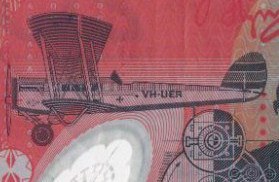
I have often noted the aircraft VH-UER depicted on the Australian $20, and have wondered what it’s history was.
VH-UER on the AU $20 note.
The aircraft was original registered G-AUER was a De Havilland D50A and was used for general aviation until 1928 when it was refurbished for use as the first air ambulance for the Australian Inland Mission (AIM) – as can be seen by the small Maltese Cross under the pilot’s cockpit. Upon starting service under contract for the AIM, The Rev John Flynn, the famous Flying Doctor, renamed it ‘Victory’.
The AIM was the founding organisation of the now Royal Flying Doctor Service, bringing medical services to remote Australian outback communities.
De Havilland D50A VH-UER
This De Havilland could carry a pilot and four passengers at a cruising speed of eighty miles per hour for a range of 500 to 600 miles. In those days, not much territory was charted, and so pilots were forced to navigate by river beds, fences, telegraph lines and other familiar landmarks. Despite these obstacles, in its inaugural year, the Aerial Medical Service (which changed its name to the Flying Doctor Service in 1942 and the Royal Flying Doctor Service in 1955) flew 50 flights to 26 destinations and treated 225 patients. Flynn’s dream had become a reality.
A Malaysia Airlines passenger plane enroute to Kuala Lumpur returned to Melbourne Airport after take-off after reports that an engine fire broke out.
The Airbus A330-323X (9M-MTE S/N1243) as MH 148 was placed in holding pattern over Point Cook airspace for the last 45 minutes to dump fuel before touching down without incident.
Aircraft instruments indicated that there had been a fire in the aircraft’s starboard engine.
The Melbourne Metropolitan Fire Brigade (MFB) said the fire was out and the aircraft had dumped fuel before making the emergency landing.
Emergency crews were called to the airport around 2:20pm.
“The plane landed safely,” an Airservices Australia spokesperson said. “The fire trucks were in attendance but were not needed.”
there was little interuption to other air services, and Melbourne Airport spokesperson stated operations were continuing as normal following the incident.
Malaysian Airlines has issued a statement saying that the plane had 300 passengers on-board, who disembarked safetly.
“Preliminary inspection reveals no physical evidence of fire externally, and further assessment is underway,” the statement said.
The Darjeeling Himalayan Railway once took precious tea from the foothills of the mountains to the teapots of the world. But it’s become a victim of the colossal inefficiency of the state-run system and is facing a slow extinction through neglect, says David Baillie.
The Darjeeling Himalayan Railway
When a man who grows tea that sells for more than $2,000 (£1,300) a kilogram offered me a breakfast cuppa, I expected the golden rules of warming the pot and using boiling water.
But even though Rajah Banerjee owns the exclusive Makaibari tea estate near Darjeeling, golden rules are not for him.
“Good tea is like good wine and needs oxygen to breathe,” he insists. “Boiling suffocates the flavour.” So Banerjee lets the water stand in a pot without a lid for several minutes before he eventually spoons in the tea.
My cup is filled several times from the lidless teapot as he expands on his personal philosophy of tea and life, an eclectic mix of Hinduism, Rudolf Steiner, and the Slow Food movement of distant Tuscany.
But Banerjee’s latest passion is the decaying Darjeeling Himalayan Railway – a narrow-gauge relic of the Raj that once took Makaibari tea from the Himalayan foothills to the Bengal Plains, from where it was shipped to the mainly lidded teapots of the world.
Built in 1879, the 48 mile (88km) line is now a loss-making anachronism that clings to life through the threads of its history and an aversion to the political bother of closure.
Looked down on by portraits of the four generations of his family who have nurtured the Makaibari estate, Banerjee is defiant. “Without investment it will die. But with investment it can strengthen tourism, and the whole community will benefit.” Jabbing the table with his finger he adds, “And I can make that investment.” Then the passion deflates. “But the government will not let me.”
Banerjee’s view is shared by many who know the region. There are a couple of token tourist steam services optimistically called the Joy Trains. The most popular shuttles back and forth along the five mile (7km) litter-strewn urban sprawl between Darjeeling and neighbouring Ghum.
The tatty cramped carriages have smoked plastic windows which have become so scratched as to be almost opaque. You can open them by sliding them back, but this merely adds your layer of scratched plastic to the already diminished view of a fellow passenger behind.
The steam locomotives thankfully have more charm than their carriages, but are now more than 100 years old and in need of expert and tender care rather than the desperate emergency repairs I witnessed involving the use of crowbars and sledge hammers.
A single loop in the Darjeeling Himalayan Railway, India, c 1910
An erratic diesel service, ironically with more tourist friendly windows, continues on a further 16 miles (26km) to the town of Kurseong but only one train a day makes the journey down to the plains and the connection to the main line.
This section had been closed for several years until March this year. The official reason was because of a landslide but everyone from the chief engineer to station masters gave me their own additional theories.
Even the security guard who frisked me as I left from nearby Bogdogra Airport had an explanation. He insisted, somewhat too cheerily, that it was because of the suicide of a fare-dodging passenger. Since the fare for the whole 48 miles is less than 48 pence and hardly worth dodging, let alone dying for, this seemed a little improbable.
The reality is that it is the railway that is committing suicide from a lack of investment. In the engineering workshop, ancient lathes and machine tools lie idle or broken as the skills to use them are lost with retiring workers, few of whom are replaced.
A diesel engine pulls the vintage ‘toy train’ running between the Himalayan hill station of Darjeeling and Siliguri
The most active engineering I witnessed was an earnest young man building a detailed model of one of the locos out of a sheet of tin.
So why is the Government Railway Board in distant Delhi so reluctant to hand the loss-making line to the likes of Rajah Banerjee, who would aim to offer tourists a ride along the whole 7,000ft (2,000m) climb into the mountains with hopefully a reasonable window to look out of?
Almost everyone I spoke to believed that the answer is the political cost of privatising even the tiniest outpost of India’s monolithic state-owned railway. More than a million people work for Indian Railways and their unions fiercely oppose any privatisation.
It’s a fight no-one has the stomach for, preferring instead eventual closure by the attrition of old age and retirement, of both people and locomotives.
Darjeeling Himalayan Mountain Railway steam train taking on water.
Back between Darjeeling and Ghum, tourist taxis wait impatiently as the Joy Train crosses the road they share, almost willing on the day when the railway will be gone, and with it Rajah Banerjee’s dream of a world-class tourist train with new dining cars and reopened station buffets, presumably with lidless teapots.
A South Korean court Friday suspended the prison term of the former Korean Air executive whose onboard “nut rage” tantrum delayed a flight last year, immediately ending her incarceration.
Cho Hyun-ah, who is the daughter of the Korean airline’s chairman, did not violate aviation security law when she ordered the chief flight attendant off a Dec. 5 flight, forcing it to return to the gate at John F. Kennedy Airport in New York, according to the Seoul High Court.
Photo: Associated Press
The upper court sentenced Cho to 10 months in prison and then suspended the sentence for two years. It said she was guilty of assault. A lower court had earlier sentenced Cho to a year in prison. She has been locked up since her December arrest.
She achieved worldwide notoriety after an onboard tantrum triggered when a first class flight attendant served her macadamia nuts in a bag instead of on a dish. Cho, head of the airline’s cabin service at the time, had a heated, physical confrontation with members of the crew.
Swarmed by reporters at the court, she made no comment in front of the TV cameras, bowing her head and burying her face in her hands as the media pressed in and yelled for her to say something.
The incident was a lightning rod for anger in a country where the economy is dominated by family-run conglomerates known as chaebol that often act above the law.
Kim Sang-hwan, head of the three judge upper court panel, said that even though Cho used violence against crew members, she should be given a second chance. The judge also cited her “internal change” since she began serving her prison term as a reason for lessening the sentence.
The upper court also took into consideration that Cho is the mother of 2-year-old twins and had never committed any offence before. She has resigned from her position at the airline.
And it seems that chaebol justice has prevailed yet again! Not only was her sentence reduced to 10 months, and then suspended for teo years, they cite that people using violence against others is OK, and should be given a second chance.
In Korea, as in Japan, the class system is alive and well. This judgement has shown once again that the upper classes, the chaebol, can do whatever they like and skirt around the judicial system with impugnity.
Had a lesser person carried out these acts, I’m sure they would be languishing in a U.S. Federal Prison for an undetermined period.
An Alaskan Airlines plane is forced to return to Seattle-Tacoma International Airport after taking off with a sleeping worker trapped in the cargo hold.
The Los Angeles-bound Alaska Airlines flight made an emergency landing at a Seattle-area airport on Monday afternoon (US time) after it took off with a worker trapped in a cargo area under the cabin, where he had fallen asleep, the US carrier said.
The pilot of Alaska Airlines flight 448 reported hearing banging from beneath the aircraft after take-off from Seattle-Tacoma International Airport, south of Seattle, the statement said.
When the aircraft returned after being in the air for 14 minutes, a ramp agent was found inside the pressurised and temperature-controlled front cargo hold, the statement said.
The pilot of Alaska Airlines Flight 448, bound for Los Angeles, reported hearing noises from beneath the aircraft within 14 minutes of taking off. Photo: Reuters
The pilot of Alaska Airlines Flight 448, bound for Los Angeles, reported hearing noises from beneath the aircraft within 14 minutes of taking off. After exiting, the Menzies Aviation employee told authorities he had fallen asleep, Alaska Airlines said in a statement.
How does one just fall asleep in the hold of an aircraft? Surely this has to be a deliberate action on the part of the employee? I would think dismissal is the only course of action Menzies Aviation can take in respect of this incident.
I found this article published by John D. Moore, PhD. I found that I agreed with the sentiment he expresses in his piece, and it is reproduced here at his request to share his post with others. Use the link at the bottom of the page to view his original article.
Many of us are just beginning to absorb the unthinkable loss that has happened as a result of the apparent actions of the co-pilot in command of the Germanwings Airbus 320 Flight 9525 from Barcelona to Dusseldorf.
For reasons we are may never truly understand, it appears this person made the decision to end his life and the lives of all 150 souls on board.
I’ve written about mass grief and public tragedy in the past. When horrific events occur like the one being discussed here, it touches all of to our core. The particulars of what may have led to this terrible incident are still being investigated. It may take some time for us to get a better ideal of the dynamics that were at play.
Sadly, we have seen similar incidents in the past, including the events of 9/11. Here are five you may not know about:
1. Silk Air Flight 186 (1997)
104 people perished after the plane crashed under a cloud of speculation that it was intentional. To this day, there remains dispute over what truly may have happened.
2. Egypt Air Flight 990 (1999)
217 people were killed after the aircraft plunged into the Atlantic Ocean. Speculation of pilot suicide remains a point of discussion for many impacted by the crash and in the aviation community.
3.Mozambique Airlines Flight 470 (2013)
The flight crashed en route from Angola to Mozambique. 33 people died. As time went on, information surfaced that suggested the crash may have been intentional.
4. Royal Air Morac Flight 630 (1994)
Flight 630 was a scheduled passenger flight from Agadir, Morocco to Casablanca using an ATR 42 type aircraft. It was determined by the commission investigating the crash which killed 40 that the pilot intentionally disconnected the auto-pilot system.
5. Pacific Airlines Flight 773 (1964)
This aircraft crashed en route from Reno to San Francisco killing 44 people. It was later determined the cause of this tragedy was a murder suicide. Investigators determined that the identified shooter, Francisco Paula Gonzales, purchased over $100,000 of life insurance the day prior to the incident.
Emotional loss
My purpose in writing this post is to simply speak to the unthinkable grief that has settled in among the family and friends of the passengers on-board flight 9525 and to the deep feelings of loss felt in Germany, here in the United States and around the world.
The emotional impact of this event reminds all of us of our very human vulnerability and that tomorrow is not promised. Life is such a precious gift – as are the people who touch our hearts each day.
Never forget this and be mindful of your relationships. All of us should hug our children today, our spouses, friends and other loved ones and remind them how important they are to us.
On Angels Wings
More information will no doubt become available over the next several days and weeks about Germanwings Flight 9525.
For now, I am lighting a symbolic candle here at home in memory of all who were lost on the flight and as a way of showing my support. Please do the same and feel free to share this post with others.
Truly, the innocent lives lost on flight 9525 are on angel’s wings.
It has been revealed that the co-pilot is believed to have deliberately crashed a Germanwings plane into the French Alps. It is believed that he had hidden an unspecified medical condition from his employer and had torn up recent documents in his home that certified that he was unfit to fly, German state prosecutors say.
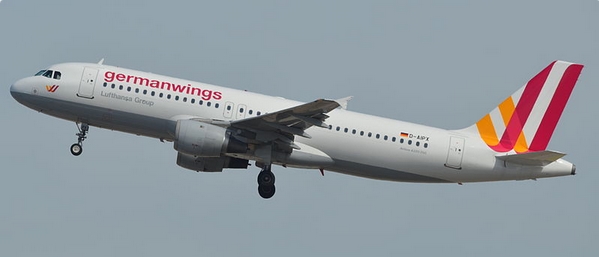
D-AIPX, the Airbus A320-200 involved in the accident. Image by Sebastien Mortier via Wiki Creative Commons.
One hundred and fifty people died when the plane slammed into the mountainside on Tuesday.
A French prosecutor said Andreas Lubitz, 28, deliberately crashed the Airbus A320, with the senior pilot locked out of the cockpit. He was a relatively junior FO with only 630 flying hours, and 100 hours on A320s.
After listening to the cockpit voice recorders, prosecutors in France offered no motive for why Lubitz would take the controls of the plane, lock the captain out and deliberately set it to veer down from its cruising altitude at a rate of 3,000 feet per minute.
German investigators carried out searches at the two homes of Lubitz, seizing documents and a computer. “Documents with medical contents were confiscated that point towards an existing illness and corresponding treatment by doctors,” the German prosecutor in Duesseldorf said. The documents were found in searches of Lubitz’s apartment in Dusseldorf and his parents’ home in the town of Montabaur.
“Sick notes saying he was unfit to work, were found torn up, which were recent and even from the day of the crime, supports the assumption based on the preliminary examination that the deceased had hidden his illness from his employer and his professional colleagues.” Germanwings said Lubitz had not submitted any sick note that would have grounded him on March 24, the day of the crash.
The German prosecutor’s office said the searches found no sign of political or religious motives, and no suicide note was found. The office said it would take some days to evaluate the documents seized.
The Australian Federal Government and QANTAS are considering changes to cockpit security following the Germanwings crash.
The Deputy Prime Minister said Australia’s aviation agencies were investigating if current cockpit safety requirements needed further strengthening. “The current regulations do not require airlines to replace a pilot who temporarily leaves the cockpit,” he said. This would mean at least three pilots on every flight as a pilot may need to leave the flight deck for “personal” reasons. Understanding the world-wide shortage of experienced airline pilots, this may not operationally feasible in the short to long term.
“Careful consideration needs to be made following thorough investigation to ensure that altering current procedures does not open other potential vulnerabilities.” One of these vulnerabilities could lead to the placement of inexperienced pilots onto the flight decks of commercial aircraft.
“Our two major international and domestic airlines are undertaking their own safety and security risk assessments of cockpit procedures following the recent tragedy.”
A Qantas spokesman said the airline was “monitoring the information coming out of the French investigation” and was considering whether any changes to its existing safeguards were needed.
Airlines including Norwegian Air Shuttle, Britain’s easyJet, Air Canada, Air New Zealand and Air Berlin all said they had introduced a requirement that two crew members must be in the cockpit at all times.
Regulations in the US already require that no pilot must ever be left alone at the controls and Canada has now followed suit.
Lufthansa said on Thursday that it did not see any reason to change its procedures, but later announced it would adopt new rules requiring two crew members to be in the cockpit at all times. “The passenger airlines of the Lufthansa Group will put this new rule into place as soon as possible in agreement with the relevant authorities,” Lufthansa said in a statement on Friday.
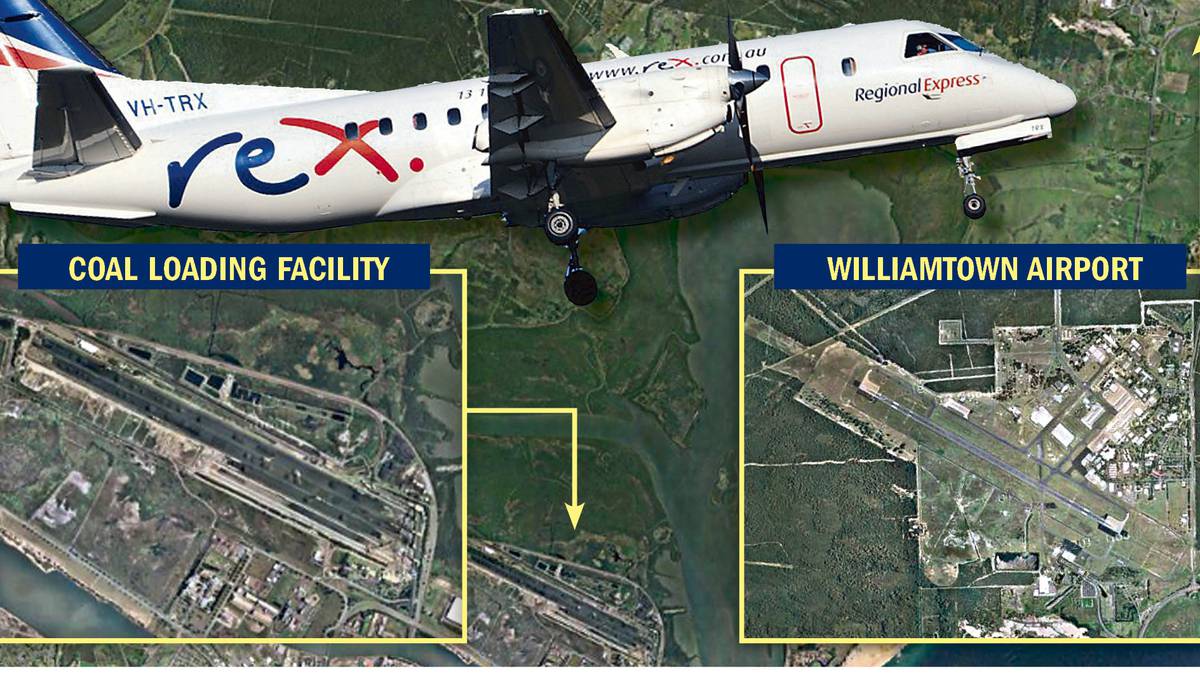
Regional airline Rex (Regional Express) has banned its pilots from relying on their sight to find their way to Newcastle Airport, after the crew of a passenger flight from Sydney mistook Kooragang Island’s coal loaders and stockpiles for the runway 11 kilometres away.
Air traffic controllers were forced to intervene and direct the plane back on course, according to an Australian Transport Safety Bureau report issued on Friday.
Regional Express pilots have been reminded to use navigation equipment to verify their position and have been banned from making visual approaches to the airport, following the incident on November 8, 2012.
The Bureau found the captain ‘‘misidentified’’ the Kooragang coal loaders and coal storage piles 11 kilometres south-west of Williamtown Airport, in the low evening light.
About 7.30pm, Williamtown air traffic control gave the plane’s crew clearance to approach the airport and advised they make contact when 19 kilometres away. Two passengers were on board.
The plane was then shown on radar to turn left after passing Nobbys Head and track along the Hunter River while descending.
The captain reported seeing buildings, believing them to be part of the airport.
The tower controller, using binoculars, saw the plane manoeuvring at a ‘‘greater distance than usual from the runway’’. Asked if they were ‘‘still visual’’, the crew said they had ‘‘lost’’ the runway and were turning right. The captain then took over the controls from the first officer.
Neither could see the runway but reported they had ‘‘formed a strong belief’’ they were near the airport.
However, the first officer told investigators he then noticed the aircraft was not in the right place, having ‘‘observed the lighting and width of the coal loading and storage facility’’, but did not tell the captain. Perhaps they need to educated in the benefits of CRM (command/crew resource management)! Air traffic controllers realised the crew did not know where they were and told them they were not at the airport. Radar was used to redirect them.
The plane landed about 7.35pm, and the crew told the air traffic controller they were unfamiliar with locating the airport at night.
The report said an opportunity was missed for the first officer to tell the captain they were in the wrong place. Air traffic controllers could have said ‘‘safety alert – low altitude warning’’ and told the crew to climb to 2100 feet, it said.
Rex had proactively issued advice to all of its crew after the incident, it concluded.
George Brown is a decorated soldier and health professional and 40 year veteran in the field of emergency nursing and paramedical practice, both military and civilian areas. He has senior management positions in the delivery of paramedical services. Opinions expressed in these columns are solely those of the author and should not be construed as being those of any organization to which he may be connected.
He was born in the UK of Scottish ancestry from Aberdeen and a member of the Clan MacDougall. He is a member of the Macedonian community in Newcastle, and speaks fluent Macedonian. While this may seem a contradiction, it is his wife who is Macedonian, and as a result he embraced the Macedonian language and the Orthodox faith.
His interests include aviation and digital photography, and he always enjoys the opportunity to combine the two. Navigate to his Flickr site to see recent additions to his photo library.
Џорџ Браун е украсени војник и професионално здравствено лице и 40 годишен ветеран во областа на за итни случаи старечки и парамедицински пракса, двете воени и цивилни области. Тој има високи менаџерски позиции во испораката на парамедицински услуги. Мислењата изразени во овие колумни се исклучиво на авторот и не треба да се толкува како оние на било која организација тој може да биде поврзан.
Тој е роден во Велика Британија на шкотскиот потекло од Абердин и член на Kланот MacDougall. Тој е член на македонската заедница во Њукасл, и зборува течно македонски. Иако ова можеби изгледа контрадикција, тоа е неговата сопруга кој е македонски, и како резултат научил македонскиот јазик и ја примија православната вера.
Неговите интереси вклучуваат авијација и дигитална фотографија, и тој секогаш ужива во можност да се комбинираат двете. Отиди до неговиот Фликр сајт да видите последните дополнувања на неговата слика библиотека.
Discussion on the law that applies to or affects Australia's emergency services and emergency management, by Michael Eburn, PhD, Australian Lawyer. Email: meburn@australianemergencylaw.com
Oh, let's see...distinguished Gen-X'er, frustrated writer and mom living in the confines of a small town that thinks it's a big deal. And have I mentioned Walmart yet?





 Words, By George!