
The Negativity Scene

The Negativity Scene
A classic piece of Australian humour by Austen Tayshus from 1983
It does help to be Australian to really appreciate the localisms contained in the piece!
Sittin’ at home last Sunday mornin’ me mate Boomer rang
Said he was havin’ a few people around for a barbie,
Said he might Kookaburra or two.
I said, “Sounds great, will Wallaby there?”
He said “Yeah and Vegemite come too”.
So I said to the wife “Do you wanna Goanna?”
She said “I’ll go if Dingos”.
So I said “Wattle we do about Nulla?”
He said “Nullabors me to tears, leave him at home.”We got to the party about two and walked straight out the kitchen to put some booze in the fridge.
And you wouldn’t believe it, there’s Boomer’s wife Warra sittin there tryin’ to Platypus!
Now, I don’t like to speak Illawarra, but I was shocked, I mean how much can a Koala bear?
So I grabbed a beer, flashed me Wangarratta and went out to join the party.
Pretty soon Ayers Rocks in and things really started jumpin’.
This Indian girl, Marsu, turns up, dying to go to the toilet but she couldn’t find it.
I said to me mate Al, “Hey, where can Marsupial?”
He said “She can go outback with the fellas, she’s probably seen a cockatoo”.Well just then Warra comes out of the kitchen with a few drinks for everybody.
Fair dinkum, you’ve never seen a Coolabah maid.
I grabbed a beer and said “Thanks Warra – tah”.A couple of Queenslanders at the party, one smellin’ pretty strongly of aftershave.
One of ’em sat down next to me and I turned to him and I said, “Ya know mate, Eureka Stockade!”It was a really hot day; Oscar felt like a swim.
He said to Ina, “Do you want a have a dip in the Riverina?”
She said “I haven’t got my Kosiosko”.
Well Bo says, “Come in starkers, Wattle they care!”
Ina says “What, without so much as a Thredbo?”
Ah, Perisher thought!
Has Eucumbine in yet?Well a few of the blokes decided to play some cricket.
Boomer says “Why doesn’t Wombat?”
“Yeah, and let Tenterfield”.
And he said I should have a bowl but I was too out of it to play cricket so I suggested a game of cards.
I said to Lyptus “Wanna game of Eucalyptus?”
He said “There’s no point mate, Darwins everytime.”Well Bill said he’d like a smoke.
Nobody knew where the dope was stashed.
I said “I think Merinos.” But I was just spinning a bit of a yarn.
Barry pulls a joint out of his pocket.
Bill says “Great, Barrier Reefer, what is it mate?”
“Noosa Heads of course. Me mate Adelaide ’em on me.”
And it was a great joint too, Blue Mountains away and his Three Sisters.
Well I thought I’d roll one meself, I said “Chuck us the Tally Hobart”.
He said “They’re out on the Laun, Ceston, can you get em for us?”
Burnie says “Its okay mate, she’s apples, I’ll get em for ya”
Just then Alice Springs into action, starts to pack Billabong.
And you wouldn’t believe it, the bongs broken. I said “Lord Howe!”
“Hay-man” somebody says “Will a Didgeridoo?”
I said “Hummmmm mummmm mummmmm mummmmm maybe it’ll have ta.”I look in the corner and there’s Bass sittin there, not getting into it, not getting out of it,
I said “What, is Bass Strait or somthin?”
Boomer says “As a matter a fact mate, he’s a cop” I said “Ya jokin’ mate, a cop,
I’m getting outta here, lets Goanna.” She said “No way, I’m hangin’ round till Gum leaves.
Besides, I dont wanna leave Jacaranda party on his own.
Have you seen him? I think he’s trying to crack on Toowoomba,
He’s already tried to Mount Isa And he’ll definitely try to lead you Australiana!”
The BBC confirmed on Friday that the presenters and crew had left the South American country but denied that the registration plate was intended as a deliberate provocation over the Falklands War.
Presenter Jeremy Clarkson was among those forced to abandon their vehicles after an angry crowd gathered and began throwing stones.
One of the vehicles – a Porsche – carried the plate H982 FKL, which local newspapers claimed was a reference to the 1982 conflict.
“Even though the BBC authorities asked the popular presenter Jeremy Clarkson to behave himself during his time in Argentina, he chose to use the provocative number plate H982 FKL on his Porsche, in reference to the 1982 Falklands (Malvinas)” war, in which Britain defeated Argentina, it said.
But the BBC bosses said that the number plate was just a coincidence.
Executive producer Andy Wilman, said: “Top Gear production purchased three cars for a forthcoming program; to suggest that this car was either chosen for its number plate or that an alternative number plate was substituted for the original, is completely untrue.”
A substitute plate made for the Porsche, BE11END, was allegedly seized by Argentinian police after inspecting the abandoned Porsche near the Chilean border was found to be equally offensive to Argentinians as they believed it to refer to the end of the General Belgrano, an Argentinian battleship sunk during the Falklands war by the Royal Navy. Argentinian authorities also alleged that the vehicle carried a third set of plates H1 VAE.
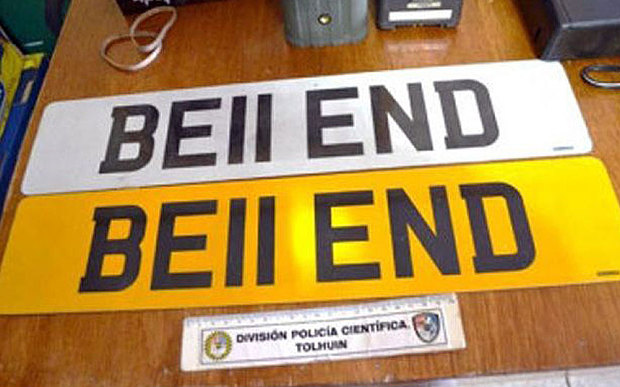
BE11END
Argentine officials and media seized on the discovery, insisting it was yet another indication of a pre-meditated BBC plot to mock the country over the 1982 Falklands War.
If this is not the case, it seems to me that a little more research and forethought on sensitive issues in Argentina should have been carried out by the BBC and the Top Gear production team. I see this as another example of the cavalier attitude so typically associated with this show and its popularity. Jeremy Clarkson would never deliberately antagonise the Argentinian authorities, would he?
3 sets of plates for one car? Why would this be so? Why would this be even necessary? Not to mention illegal! Or is this another example of an Argentinian beat up of the facts to continue popular ill-feeling against all things English/British?
The truth is probably somewhere in the middle! We will have to wait to see the Top Gear Christmas special later in the month.
Man Haron Monis, the violent criminal involved in the Lindt Café hostage drama in Sydney last Monday and Tuesday was well known to Australian law enforcement and security agencies since 1996, when he arrived from Iran and was granted “political refugee” status.
He had a long history of violence, mental instability, religious extremism. So how was it then that Monis was able to walk our streets and perpetrate the most heinous crime in Australia’s history? And let’s get this right. His actions were not terrorism, but rather those of a deranged criminal who happened to be Muslim. To their credit, Monis’ actions have been soundly denounced by the Australian Islamic community. To answer the above question, let’s take a look at Monis’ background and Australian security agencies failures in respect of that background
It would appear that those red flags that should have been raised in respect of Monis’ activities were not raised, or if they were, they were indeed ignored. This ultimately led to the horrific events which occurred in Martin Place and to the death of two innocent people.
Lax bail laws need to tightened, inter-agency cooperation and information sharing needs to be improved, and citizenship for those involved in jihadist and other criminal activities need to be annulled and those persons deported back to their country of origin. The Australian attitude of “She’ll be right, mate” is out of place in today’s times. Its time to toughen up against all those who have demonstrated a behaviour of a violent, criminal or extremist nature.
Australia is a peaceful multi-cultural society with people from many countries and many faiths. There is however NO place for religiously motivated extremism and/or violence affecting the innocent members of the community going about their daily lives.
It has been 4 years since I last visited Macedonia (MK), so I thought I’d like to give you my impressions on what is different, and (sadly or predictably) what has remained the same. This list is not meant to be critical of MK, but rather my observations after a 4 year absence.
What is different:
What is the same:
Throughout history, the British monarchy has been an integral part of that nation’s culture and history. As England’s oldest secular institution, it is intertwined with the nation’s identity and political culture. The monarchy embodies the best of British society. If abolished or radically changed, the nation would lose this essential element that solidifies its political system.
By virtue that Australia was claimed for Britain by James Cook in 1772, Australia became a British colony and thus it fell under the blanket of the British monarchy from that time. Although Australia became a self-governing country and member of the British Empire and later the Commonwealth of Nations, Australia remained a constitutional monarchy.
So what is the value of the monarchy? What do they do? The monarchy is a secular institution whereby one finds themselves in a position of “power”, influence and luxury by birth, rather than by “earning” that role through political ascension, or by the will of the people. From an Australian (or Canadian) point of view, what is the value of having the head of state being a resident of another country, represented in this country by a Governor-General? And in real terms, who is the Head of State, the Governor-General or the Prime Minister?
It has been suggested that the monarchy is:
And this is all well and good for the English, but is it right for Australia?
To many younger Australians, the monarchy has become increasingly out-dated and irrelevant, while those over 65 years of age are more likely to support it. At the last referendum in 1999 on the question of Australia becoming a Republic, was narrowly defeated 45% to 55% to retain the monarchy. One will note that the recent referendum on Scottish independence was also defeated by a similar margin. This question was asked of the Australian people:
It has been suggested that many Australians voted No because they disagreed with the selection of the president by the Australian Parliament, in favour of selection by the people. Election of the President by popular vote was not an option. Had it been so, then it has been suggested that the yes campaign would have won significantly.
However, from a historical point of view most constitutional matters sent to referendum fail. Since 1906, only eight of 44 proposals put to a referendum have been approved by the constitutionally required double majority. What this means is a majority in each of the six States, and a majority nationally.
If Australians for a Constitutional Monarchy are to be believed, support for a republic has fallen to 40%. It has been suggested that while young Australian may dislike the idea of the monarchy, they are mesmerised by the star power of the younger royals, in particular the Duke and Duchess of Cambridge, William and Kate, and Prince Harry.
So what is the future for a republic in Australia? That is a difficult question to answer. There are staunch supporters on both sides of the question. Recently, the Governor-General, Ms Quentin Brice, came out in the support of the Republican cause, which raised criticism from the monarchist camp. While the republican cause maintains interest and support a further referendum is unlikely, especially as the Prime Minister, Tony Abbott remains a firm monarchist and is unlikely facilitate change.
An Australian republic? Not in my lifetime!
The idiocy of some Australian politicians shows no bounds. The ongoing flak created by the Australian Greens’s foray into children and their toys continues. How do they come up with this stuff? And we pay these people?
Here is Bill O’Chee from the Brisbane Times view on this subject:
Some politics is a matter of personal preference, some a matter of ideology, and some is pure insanity or idiocy. The latter category must include the demand by a Greens senator that we not give little girls dolls, nor boys trucks, as Christmas presents.
The author of this nonsense is Senator Larissa Waters from Queensland.
And as if that was not enough, she went further, claiming on national television that giving children such toys was gender stereotyping, and that this was a “good indicator of domestic violence”.
Given that one in three victims of domestic violence is a man, I am not sure how giving girls dolls encourages them to one day commit domestic violence, but that is probably a separate issue. Let’s focus instead on the need for some people to subordinate even Christmas to their loopy social agendas.
When given the chance to climb out of the hole, the good senator dug further. This was all the fault of toy stores because they put all the trucks together, and all the dolls somewhere else. In her words, it was “the message that they’re sending; that some toys are for boys and some toys are for girls”.
No, Senator, they’re not sending you any messages. If you really think this, I’ll organise some aluminium foil to shield you from messages from the aliens as well.
Toy stores put trucks in one place and dolls in another for the same reason supermarkets put all the meat together and all the toilet cleaners somewhere else. It makes them easier to find.
The real issue here is the Greens and their fellow travellers meddling with children’s heads – and their happiness – in the name of social engineering.
Clearly this Senator hasn’t visited a childcare centre recently, or if she has, she didn’t pay much attention. Given a big pile of toys, boys gravitate to certain toys, and girls others. Children are entirely capable of figuring things out themselves. They don’t need the assistance of the Greens.
Because children know perfectly well what they like and don’t like, perhaps the real exponents of stereotyping are not parents or toy store owners, but the Greens. But it is a miserable exercise in which they are engaged.
Christmas is a time for love. As a Christian, I believe it begins with the redeeming love of God, but if you don’t share my faith you will still probably agree that Christmas without love is not Christmas at all.
I have no intention of spoiling Christmas for one of my children, nor any of my nieces and nephews, by giving them a present they’re not going to enjoy. It’s all about the love, Senator, not the politics.
Source: Bill O’Chee, Brisbane Times, 3/12/2014
Taiichi Ohno, creator of the Toyota Production System is credited, perhaps of dubious authenticity, with taking new graduates to the shopfloor and drawing a chalk circle on the floor. The graduate would be told to stand in the circle and to observe and note down what he saw. When Ohno returned he would check; if the graduate had not seen enough he would be asked to keep observing. Ohno was trying to imprint upon his future engineers that the only way to truly understand what happens on the shopfloor was to go there. It was here that value was added and here that waste could be observed.
Genchi Genbutsu is therefore a key approach in problem solving. If the problem exists on the shopfloor then it needs to be understood and solved at the shopfloor.
Genchi Genbutsu is also called the Gemba attitude. Gemba is the Japanese term for “the place” in this case ‘the place where it actually happens’. Since real value is created at the shopfloor in manufacturing, this is where management need to spend their time.
It is sometimes referred to as “Getcha boots on” (and go out and see what is happening) due to its similar cadence and meaning. It has been compared to Peters and Waterman’s idea of “Management By Wandering Around“. This concept quickly became so universal that new managers instinctively knew that they had to “walk around” to achieve high effectiveness levels. Whilst these ideas, with their associated lists of how-tos, are probably good ideas they may miss the essential nature of Genchi Genbutsu which is less to ‘visit’ and more to ‘know’ by being there. Toyota has high levels of management presence on the production line whose role it is to ‘know’ and to constantly improve.
“Gemba attitude” reflects the idea that whatever reports and measures and ideas are transmitted to management they are only an abstraction of what is actually going on in the gemba to create value. Metrics and reports will reflect the attitudes of the management questioner and the workplace responder as well as how the responder views the questioner. It also increases the chance that actual issues and unplanned events will be observed first hand and can be managed immediately; this includes issues that are not apparent to the gemba workforce.
Source: Wikipedia

I came across these principles of do business as used by the Toyota Motor Corporation in their manufacture of motor vehicles.
I found their view to doing business enlightening, thus I share those principles with you here.
Toyota has long been recognized as an industry leader in manufacturing and production. Three stories of its origin have been found, one that they studied Piggly-Wiggly’s just-in-time distribution system, one that they followed the writings of W. Edwards Deming, and one that they were given the principles of business from a WWII US government training program, Training Within Industry.
Which ever reference they used, they are the largest single manufacturer of vehicles in the world. They are doing something right!
Philae spotted after first landing on 67P
On Friday, the ESA published a series of remarkable NAVCAM images acquired by Rosetta as the orbiter monitored the intended landing point of Philae on 12 November from its orbit above Comet 67P/C-G. The images show what appears to be the shadow of a dust cloud kicked up when Philae made its first touch down on the surface of the comet at 15:35 UTC.

Philae lander on 67P. Credits: ESA/Rosetta/NAVCAM; pre-processed by Mikel Canania.
The images were provided by ESA’s Flight Dynamics team on Friday, who sent them to the web team to be published as soon as possible: we all wanted to make sure you saw them right away. Once we had convinced ourselves that the dark ‘splotch’ seen in the second of the images was almost certainly the tell-tale signature of Philae’s precise first touch-down and bounce, we put them out.
However, some careful work by a number of people in ESA’s Flight Dynamics team and by followers of our Rosetta blog has shown that these NAVCAM images show more, namely Philae itself, just after the bounce!
Philae touchdown site seen by Rosetta’s navigation camera. The first image in this sequence was taken on 12 November at 15:30 UTC, just before the lander’s first touchdown; the second image was taken at 15:35 UTC, right after touchdown. The large red circle indicates the position of the shadow of the dust cloud caused by the landing. The third image in the sequence is the same as the second, with the likely position of Philae and its shadow highlighted. Credits: ESA/Rosetta/NAVCAM; pre-processed by Mikel Canania
It appears as a couple of brighter pixels closely accompanied by its shadow in the form of a couple of darker ones just below, both to the right of the diffuse dust cloud shadow.
Credit for the first discovery goes to Gabriele Bellei, from the interplanetary division of Flight Dynamics, who spent hours searching the NAVCAM images for evidence of the landing.
Once the images were published, there was also quite some speculation by Rosetta blog readers in the comments section, wondering which features might be attributable to the lander. Martin Esser, Henning, and Kasuha in particular were among the first to make insightful observations on the topic, although many others have since joined in.
Last but not least, a careful independent review of the images was made by Mikel Canania from the earth observation division of Flight Dynamics, with the same conclusion. He also made the annotated animation shown here.
So very well done, Gabriele and Mikel from Flight Dynamics, as well as Martin, Henning, Kasuha, and everyone else from the blog: thank you from all of us for helping spot Philae!
P.S. Note that in our rush to share these exciting images with you on Friday, we made a couple of small errors in the labels and text; those have been updated now. In particular, the image that was indicated to have been taken at 15:30:32 UTC, just before touchdown, was actually an image taken at 16:30:32 UTC, about an hour after touchdown. This should indeed have been clear from the obviously changed illumination conditions, but the web team were very tired at the time.
Also, Flight Dynamics have clarified that the green spot on Friday’s images is actually the computed touchdown point based on data taken during the deployment and descent to the surface, not the originally intended landing point. Nevertheless, it’s still very close to the latter, again a testament to the excellent work done by Flight Dynamics.
George Brown is a decorated soldier and health professional and 40 year veteran in the field of emergency nursing and paramedical practice, both military and civilian areas. He has senior management positions in the delivery of paramedical services. Opinions expressed in these columns are solely those of the author and should not be construed as being those of any organization to which he may be connected.
He was born in the UK of Scottish ancestry from Aberdeen and a member of the Clan MacDougall. He is a member of the Macedonian community in Newcastle, and speaks fluent Macedonian. While this may seem a contradiction, it is his wife who is Macedonian, and as a result he embraced the Macedonian language and the Orthodox faith.
His interests include aviation and digital photography, and he always enjoys the opportunity to combine the two. Navigate to his Flickr site to see recent additions to his photo library.

Џорџ Браун е украсени војник и професионално здравствено лице и 40 годишен ветеран во областа на за итни случаи старечки и парамедицински пракса, двете воени и цивилни области. Тој има високи менаџерски позиции во испораката на парамедицински услуги. Мислењата изразени во овие колумни се исклучиво на авторот и не треба да се толкува како оние на било која организација тој може да биде поврзан.
Тој е роден во Велика Британија на шкотскиот потекло од Абердин и член на Kланот MacDougall. Тој е член на македонската заедница во Њукасл, и зборува течно македонски. Иако ова можеби изгледа контрадикција, тоа е неговата сопруга кој е македонски, и како резултат научил македонскиот јазик и ја примија православната вера.
Неговите интереси вклучуваат авијација и дигитална фотографија, и тој секогаш ужива во можност да се комбинираат двете. Отиди до неговиот Фликр сајт да видите последните дополнувања на неговата слика библиотека.


Emergency vehicle visibility and conspicuity research & comments for the Police, Fire, EMS and Ambulance: The AV Blog is written by John Killeen
Smile! You’re at the best WordPress.com site ever
Focus, Fun, and Creativity
I write, blog, vlog and poet...I wander, I ponder and I recollect ...DIGITAL NOMAD & PHILOSOPHER
Discussion on the law that applies to or affects Australia's emergency services and emergency management, by Michael Eburn, PhD, Australian Lawyer. Email: meburn@australianemergencylaw.com
The Butterfly counts not months but moments, and has time enough.
"Everything is possible to him who will try"
Thoughts on growing up and growing old in the digital age
Blog with Journalistic and Historical articles
Macedonian Orthodox communities in Australia
EVERYTHING AND ANYTHING
a Feminist Phenomenology (or something)
Oh, let's see...distinguished Gen-X'er, frustrated writer and mom living in the confines of a small town that thinks it's a big deal. And have I mentioned Walmart yet?
A Story Begins
Film, Life and Culture
The Diary of a Retiree

 Words, By George!