Words, By George!

Mundane Musings ­­║ Mindful Mutterings ║ Madcap Mischief

  • Welcome!
  • Main
    • PHOTO GALLERY
      • Avoca, Co. Wicklow
      • Bitola, Macedonia
      • Coventry, Warwickshire
      • Devizes, Wiltshire
      • Fishguard, South Wales
      • Liverpool, UK
      • Pontsycyllte Aqueduct
      • Prilep, Macedonia
      • Standedge Tunnels
  • Liked Links
  • About the Author
    • Contact the Author
    • Inspirations
  • Books I’ve Read
  • My Stories
    • 1%
    • A Meeting With Death
    • Rachel
    • The Holiday

Germanwings Crash – Airlines consider cockpit safety changes

Posted by George Brown on 29/03/2015
Posted in: Aviation, Crime, Opinion, Safety, Security, Transportation, Uncategorized, Views. Tagged: Aviation safety, cockpit, cockpit safety, domestic airlines, Germanwings crash, Norwegian Air Shuttle, The Australian Federal Government and Qantas, two pilot crewing. Leave a comment

The Australian Federal Government and QANTAS are considering changes to cockpit security following the Germanwings crash.

The Deputy Prime Minister said Australia’s aviation agencies were investigating if current cockpit safety requirements needed further strengthening.  “The current regulations do not require airlines to replace a pilot who temporarily leaves the cockpit,” he said.  This would mean at least three pilots on every flight as a pilot may need to leave the flight deck for “personal” reasons.  Understanding the world-wide shortage of experienced airline pilots, this may not operationally feasible in the short to long term.

“Careful consideration needs to be made following thorough investigation to ensure that altering current procedures does not open other potential vulnerabilities.” One of these vulnerabilities could lead to the placement of inexperienced pilots onto the flight decks of commercial aircraft.

“Our two major international and domestic airlines are undertaking their own safety and security risk assessments of cockpit procedures following the recent tragedy.”

A Qantas spokesman said the airline was “monitoring the information coming out of the French investigation” and was considering whether any changes to its existing safeguards were needed.

Airlines including Norwegian Air Shuttle, Britain’s easyJet, Air Canada, Air New Zealand and Air Berlin all said they had introduced a requirement that two crew members must be in the cockpit at all times.

Regulations in the US already require that no pilot must ever be left alone at the controls and Canada has now followed suit.

Lufthansa said on Thursday that it did not see any reason to change its procedures, but later announced it would adopt new rules requiring two crew members to be in the cockpit at all times.  “The passenger airlines of the Lufthansa Group will put this new rule into place as soon as possible in agreement with the relevant authorities,” Lufthansa said in a statement on Friday.

Source: http://www.msn.com

What’s all this then?

Posted by George Brown on 25/03/2015
Posted in: Uncategorized. Leave a comment
Ooops!

Ooops! Advertisement for Spotlight

In the Spotlight catalogue above, the Koo Elite Scarlett quilt set seems ideal for putting your feet up. All three of them. But look again carefully – although she only has two legs, the model has three right feet.  This puts a new slant on never putting a foot wrong!

Ooops again, this ad is for Target

Ooops again, this ad is for Target

Take a look at this handy chap! He has one hand around his “wifes” shoulder, another around his “daughter” and one at his side! This picture appeared in a Target catogue in April 2012.

Three feet - or is that a yard?

Three feet – or is that a yard?

three arms_1

Three hands/arms! Clever man!

Makes you wonder if anybody proof reads the copy before puiblication?

On the tip of your tongue

Posted by George Brown on 18/03/2015
Posted in: Health, Medicine, News, Software, Technology. Tagged: diabetes, diabetes research, glucose levels, Paul Dastoor, Professor Paul Dastoor, saliva test, semi-conductors. Leave a comment
Professor Paul Dastoor

Professor Paul Dastoor


Professor Paul Dastoor explained that he and his research team had developed paint with semi-conducting particles and this enabled them to download electronic designs that could be cheaply printed from an ink-jet printer onto a slip of plastic.

‘‘On this principle we have developed a saliva-based test of glucose levels for diabetic patients using a reel-to-reel printer, potentially making blood tests a thing of the past,’’ he said.

‘‘We print electrical components using an ink that is a semi-conductor, mixing in the enzyme which will detect the presence and level of glucose when a diabetic places a sample of saliva on the test.’’

By 2020 it is predicted there will be 500 million people with diabetes.

The usual way of testing for glucose relies on a finger prick to draw blood for testing, however many diabetics find needles unpleasant and can be tempted to avoid measuring their levels as often as they should.

‘‘The creation of the non-invasive test for diabetes has been described as the Holy Grail in diabetes research for decades,’’ Professor Dastoor said.

Each individual test is estimated to cost less than 1¢ to create and Professor Dastoor said he and his

He said one possibility was for people to buy a cartridge with the special ink and print their own tests from an ink-jet printer at home.

Professor Dastoor said eventually, as they made more advancements, it could be possible for a person to lick the device, which would then send their glucose reading to their mobile phone.

Professor Dastoor said their patented innovation, which took eight years to develop, had many other potential medical purposes.

He said they were looking at developing a test for stress by sampling a person’s sweat.

Source: Newcastle Herald 11/03/2015 & Photo

Plane in Loader of Trouble

Posted by George Brown on 17/03/2015
Posted in: Aviation, News, Safety, Transportation, Views. Tagged: air traffic controllers, Australian Transport Safety Bureau, aviation, command resource management, CRM, Kooragang Coal Loader, Newcastle Airport, Regional Express, REX, Williamtown airport. Leave a comment
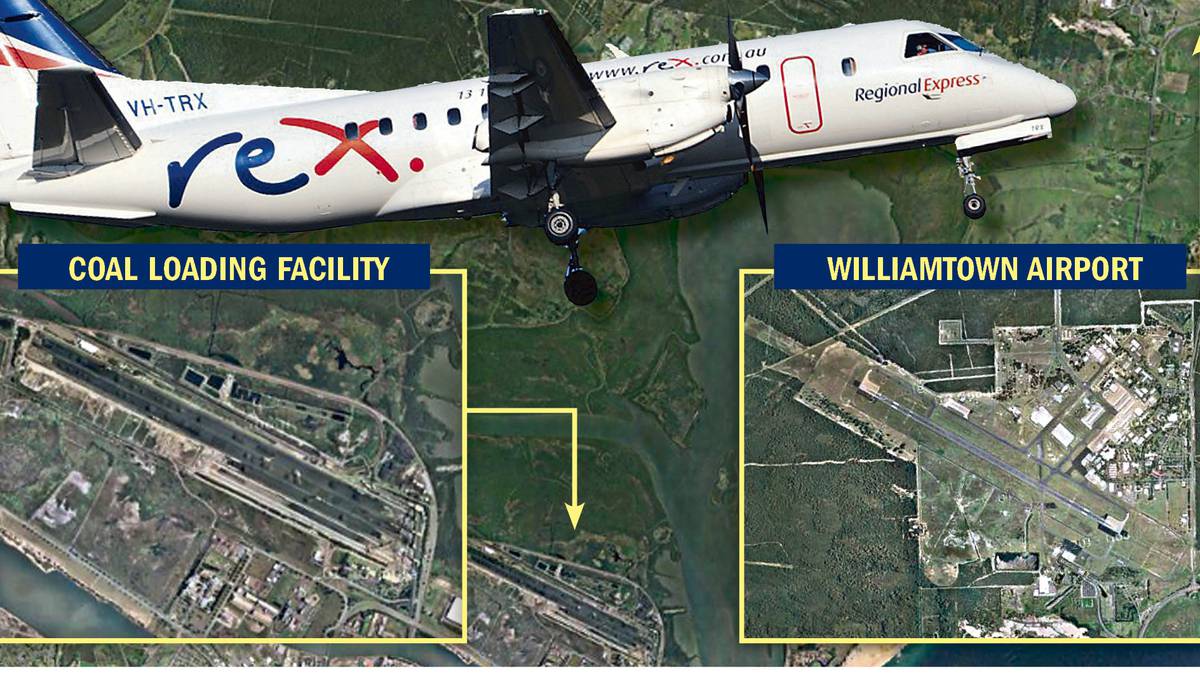
Kooragang Coal Loader and Williamtown Airport

Kooragang Coal Loader and Williamtown Airport

Regional airline Rex (Regional Express) has banned its pilots from relying on their sight to find their way to Newcastle Airport, after the crew of a passenger flight from Sydney mistook Kooragang Island’s coal loaders and stockpiles for the runway 11 kilometres away.

Air traffic controllers were forced to intervene and direct the plane back on course, according to an Australian Transport Safety Bureau report issued on Friday.

Regional Express pilots have been reminded to use navigation equipment to verify their position and have been banned from making visual approaches to the airport, following the incident on November 8, 2012.

The Bureau found the captain ‘‘misidentified’’ the Kooragang coal loaders and coal storage piles 11 kilometres south-west of  Williamtown Airport, in the low evening light.

About 7.30pm, Williamtown air traffic control gave the plane’s crew clearance to approach the airport and advised they make contact when 19 kilometres away. Two passengers were on board.

The plane was then shown on radar to turn left after passing Nobbys Head and track along the Hunter River while descending.

The captain reported seeing buildings, believing them  to be part of the airport.

The tower controller, using binoculars, saw the plane manoeuvring at a ‘‘greater distance than usual from the runway’’. Asked if they were ‘‘still visual’’, the crew said they had ‘‘lost’’ the runway and were turning right. The captain then took over the controls from the first officer.

Neither could see the runway but reported they had ‘‘formed a strong belief’’ they were near  the airport.

However, the first officer told investigators he then noticed the aircraft was not in the right place, having ‘‘observed the lighting and width of the coal loading and storage facility’’, but did not tell the captain. Perhaps they need to educated in the benefits of CRM (command/crew resource management)! Air traffic controllers realised the crew did not know where they were and told them they were not at the airport. Radar was used to redirect them.

The plane landed about 7.35pm, and the crew told the air traffic controller they were unfamiliar with locating the airport at night.

The report said an opportunity was missed for the first officer to tell the captain they were in the wrong place. Air traffic controllers could have said ‘‘safety alert – low altitude warning’’ and told the crew to climb to 2100 feet, it said.

Rex had proactively issued advice to all of its crew after the incident, it concluded.

Source: Newcastle Herald 14/03/2015 (including picture)

Confessions of an Airline Pilot

Posted by George Brown on 13/03/2015
Posted in: Aviation, News, Opinion, Safety, Tourism, Transportation, Uncategorized, Workplace. Tagged: airline pilot, confessions of an airline pilot, off duty pilots, pilot downtime. Leave a comment

I found this interesting piece about what pilots do (or actually don’t do) in their down time between flights:

As my husband and I settled into a rare splurge on extra-legroom exit-row seats on an early morning flight from a Caribbean island, a pair of uniformed pilots slipped into the row across the aisle from us.

It was like sitting with the cool kids!

I excitedly awaited the opportunity to start a conversation and see what I could learn. After the drink cart passed, I prompted hubby to lean across the aisle and break the ice by asking where they had spent the night on an island where most accommodations limit regular travellers to weeklong stays.

He prefaced the question by telling them that we have been visiting the island for five years and that opened the door to a flood of questions, not from us, but from them! Here’s what we found out.

Pilots long to enjoy the destinations they fly us to

They wanted to know everything we knew about the island. They asked where we eat, where we stay, what our favourite dive sites are, and even what it costs for a week (excluding the cost of airfare, of course). One talked about bringing his wife; the other was scouting honeymoon destinations for his daughter.

It was only after more than an hour of asking questions that they got around to explaining the intricate details of pilot downtime rules that force the need for pilot rotations like the one they were on.

If the inbound flight the night before is delayed even a little, there could potentially not be enough official rest time before morning. (The downtime doesn’t start when the plane lands, but when they are “behind the hotel door.”) The inbound pilots would not be able to fly back out on schedule the next morning.

The guys sitting in coach with us had flown the plane in; a second crew was flying it home. So they often don’t have time to get to know the destination to which they are going.

Coming in for landing in the Caribbean.

Coming in for landing at Saint Maarten in the Caribbean. Source: Getty Images

Even pilots have travel bucket lists

It’s hard to believe that two pilots nearing the end of long careers flying the globe could have travel destinations yet to conquer, but both of these guys did. One wants to visit Ireland and has a trip planned there soon. The other confessed that when he travels for fun, it’s usually by car, but that he would love to spend time in Asia.

There are many places they haven’t seen yet.

There are many places they haven’t seen yet. Source: Getty Images

Pilots judge other pilots on their flying skills

It’s like there’s some secret point system. We had an incident on our approach to landing during which both nonflying pilots sized up the guy actually flying the plane. Just as the tarmac appeared beneath our plane, the engines roared and we suddenly climbed hard and began banking. While everyone else craned to look out the windows for an explanation, I looked at the pilots.

Inspecting the plane.

Inspecting the plane. Source: Getty Images

The aisle pilot calmly said, “Oops.” The window pilot studied the runway, now far below us, before explaining that it looked like a plane on the ground had not quite cleared the runway while taxiing to its gate.

“No point lost for our guy,” he said. “It was a good call. He did the right thing.”

Pilots sometimes get annoyed with the control tower

The two pilots agreed that such conversations were likely taking place as we circled wide to get back into position again. Our plane actually had to be routed back into the line of planes waiting to land — at the end of the line, our pilots said. “Sometimes they (the tower) will work you into the middle of the line, but it depends on the stack.”

Pilots don’t always tell passengers the truth

Following our missed landing, the pilot flying our plane confirmed over the PA what our aisle buddies had already told us. There had been a taxiing plane not quite clear of our intended landing strip. But not every pilot feels the need to be forthcoming, particularly when they are at fault.

The aisle pilot told a story of a missed approach caused by pilot error. That pilot attempted to hide his mistake from passengers by blaming it on a non-existent plane on the runway. What he did not know was that he told his fictional story to the control tower (which knew better), not to the passengers. Bad piloting and a finger on the wrong communication button put him at the very end of the line for his retry.

Being a pilot can be lonely

My two pilots included their wives and families in every topic of conversation. Their job puts them in exotic destinations, far from their families, in the company of attractive co-workers, but for these two guys at least, it was just another day at the office with an eagerly anticipated return to home and family.

 
Pilots cherish the time they have with their families.

Pilots cherish the time they have with their families. Source: Getty Images

This story originally appeared on Yahoo.com and was republished via SmarterTravel.com.


2014 – The Safest Year for Flying

Posted by George Brown on 12/03/2015
Posted in: Aviation, Education, Government, News, Safety, Technology, Transportation, Uncategorized. Tagged: air safety, fatal accident, fatal accidents, flight safety figures, hull loss accidents, hull loss rate, Safest Year for Flying. Leave a comment
2014 jet accident rate lowest in history, IATA says

9M-MRD as MH17 – Photo by Reuters

Despite two high profile crashes, the aviation industry recorded its safest year yet, according to the 2014 safety performance report issued by the International Air Transport Association on Monday.

  • The 2014 global jet accident rate (measured in hull losses per 1 million flights) was 0.23, which was the lowest rate in history and the equivalent of one accident for every 4.4 million flights. This was an improvement over 2013 when the global hull loss rate stood at 0.41 (an average of one accident every 2.4 million flights) and also an improvement over the five-year rate (2009-2013) of 0.58 hull loss accidents per million flights jet.
  • There were 12 fatal accidents involving all aircraft types in 2014 with 641 fatalities, compared with an average of 19 fatal accidents and 517 fatalities per year in the five-year period (2009-2013).
  • The 2014 jet hull loss rate for members of IATA was 0.12 (one accident for every 8.3 million flights), which outperformed the global average by 48% and which showed significant improvement over the five-year rate of 0.33.

“Any accident is one too many and safety is always aviation’s top priority. While aviation safety was in the headlines in 2014, the data show that flying continues to improve its safety performance,” said Tony Tyler, IATA’s Director General and CEO.

MH 370 and MH 17

The year 2014 will be remembered for two extraordinary and tragic events—MH 370 and MH 17. Although the reasons for the disappearance and loss of MH 370 are unknown, it is classified as a fatal accident—one of 12 in 2014. The aviation industry has welcomed the proposal by the International Civil Aviation Organization (ICAO) to move towards the adoption of a performance-based standard for global tracking of commercial aircraft, supported by multi-national operational assessments to evaluate impact and guide implementation.

The destruction of MH 17 by anti-aircraft weaponry, however, is not included as an accident under globally-recognized accident classification criteria. The four aircraft involved in the events of 11th September 2001 were treated in the same way.

“The shooting down of MH 17 took with it 298 lives in an act of aggression that is by any measure unacceptable. Governments and industry have come together to find ways to reduce the risk of over-flying conflict zones. This includes better sharing of critical information about security risks to civil aviation. And we are calling on governments to find an international mechanism to regulate the design, manufacture and deployment of weapons with anti-aircraft capabilities,” said Tyler.

“To the flying public an air tragedy is an air tragedy, regardless of how it is classified. In 2014 we saw a reduction in the number of fatal accidents—and that would be true even if we were to include MH 17 in the total. The greatest tribute that we can pay to those who lost their lives in aviation-related tragedies is to continue our dedication to make flying ever safer. And that is exactly what we are doing,” said Tyler.

2014 Safety by the numbers:

  • More than 3.3 billion people flew safely on 38.0 million flights (30.6 million by jet, 7.4 million by turboprop)
  • 73 accidents (all aircraft types), down from 81 in 2013 and the five-year average of 86 per year
  • 12 fatal accidents (all aircraft types) versus 16 in 2013 and the five-year average of 19
  • 16% of all accidents were fatal, below the five-year average of 22%
  • 7 hull loss accidents involving jets compared to 12 in 2013 and the five-year average of 16
  • Three fatal hull loss accidents involving jets, down from six in 2013, and the five-year average of eight
  • 17 hull loss accidents involving turboprops of which nine were fatal
  • 641 fatalities compared to 210 fatalities in 2013 and the five-year average of 517

Jet hull loss rates by region of operator

  • All regions but one showed improvement in 2014 when compared to 2013. The exception is Europe which maintained the rate of 0.15 jet hull losses per 1 million sectors.
  • All regions saw their safety performance improve in 2014 compared to the respective five-year rate 2009-2013 as follows:
    • Africa (from 6.83 to 0.00)  ;
    • Asia-Pacific (from 0.63 to 0.44);
    • CIS (from 2.74 to 0.83);
    • Europe (from 0.24 to 0.15);
    • Latin America and the Caribbean (from 0.87 to 0.41);
    • Middle East-North Africa (1.82 to 0.63);
    • North America (from 0.20 to 0.11)
    • North Asia (from 0.06 to 0.00).
  • CIS had the worst performance (0.83) among regions, but it showed strong improvement over three consecutive years: 6.34 (2011), 1.91 (2012), 1.79 (2013).

Turboprop hull loss rates by region of operator 

  • The world turboprop hull loss rate improved to 2.30 hull losses per million flights in 2014 compared to 2.78 in the five years 2009-2013.
  • The following regions saw their turboprop safety performance improve in 2014 when compared to the respective five-year rate: Asia-Pacific (from 2.16 to 0.00); CIS (from 12.12 to 11.95); Europe (from 1.46 to 0.71); Latin America and the Caribbean (from 4.53 to 1.21); Middle East-North Africa (from 7.91 to 7.17).
  • Africa had the worst performance (14.13 hull losses per million flights) in 2014 for turboprop hull losses, which exceeded the region’s five-year rate of 9.62. There are relatively few turboprop operations in North Asia so the single turboprop hull loss experienced in the region in 2014 caused the turboprop hull loss rate to rise to 11.28 compared to the five-year rate of. 2.41. North America also saw a deterioration in 2014 compared to the preceding five years (1.19 vs. 1.02).

Source: Aviation Tribune

Last flight of QANTAS Boeing 747-400 VH-OJA

Posted by George Brown on 12/03/2015
Posted in: Aviation, History, News, Transportation. Tagged: Albion Park Rail, Boeing 747, HARS, Historical Aircraft Restoration Society, Illawarra, Illawarra Regional Airport, QANTAS, Shellharbour, VH-OJA. Leave a comment

QANTAS’ first Boeing 747-400, celebrated for having flown the longest commercial flight in history, made its shortest and final journey when it landed at Illawarra Regional Airport, where it is set to become the Illawarra’s first jumbo tourist attraction.

After less than 15 minutes in flight, the specially numbered QANTAS Flight ‘7474’, scheduled to touch down at 7:47 am, was delivered to its new home at YWOL with the Historical Aircraft Restoration Society (HARS) where it will become the only B747-400 in the world to be put on public display. QANTAS Chief Executive Officer Alan Joyce said donating the aircraft to the HARS museum will provide not only a great tourist attraction for the Illawarra region, but also an opportunity to preserve an important piece of QANTAS’ and aviation history.

“Having graced the pages of the record books, revolutionised air travel for Australians, marked a huge technical feat for QANTAS and carried millions of passengers on their global adventures and home again, our B747-400 “City of Canberra” is very deserving of a graceful retirement as the star attraction at one of Australia’s most prestigious aviation museums,” said Mr Joyce.

“As she takes her rightful place in aviation’s hall of fame at HARS we’ll be reminded of her lasting legacy as a great aviation pioneer, a legacy that continues to inspire and drive Qantas’ spirit of innovation and world class airmanship and engineering today.”

Bob De La Hunty, President of the Historical Aircraft Restoration Society, said HARS was honoured to receive the jumbo gift from QANTAS and excited to have such an icon as part of its collection.

“Our members will be very proud to look after VH-OJA, particularly as so many of them have been part of the QANTAS family too. We look forward to preserving this piece of QANTAS history for future generations and have set our sights on building another hanger for it.”

Shellharbour Mayor, Marianne Saliba said, “It is a fantastic opportunity for the community to have this aircraft positioned near the northern entrance to our city – a signpost for the initiative and drive of our residents, particularly the outstanding efforts of HARS in preserving such a broad scope of aviation history.

“I commend everyone involved in the safe arrival of this aircraft and look forward to seeing the flow on effects to our city and business community.”

The delivery flight from Sydney International Airport to Illawarra Regional Airport was the first time a Boeing 747 has landed at the regional port. The QANTAS pilots operating the final flight worked with industry stakeholders on a number of approvals and training procedures given the flight was outside normal QANTAS operations to a non-QANTAS port. A number of considerations were factored in to the preparations including ensuring the appropriate ground handling equipment were positioned at Illawarra Regional Airport for the arrival and giving the aircraft livery a “Permaguard” coating to protect the paintwork for many years to come.

The aircraft interior was also given a full “spruce up” with the only items removed from the aircraft being the QANTAS Flight Operations manuals in the cockpit, the galley carts that store in-flight meals and the fresh flowers in the lavatory. Three of OJA’s Rolls Royce engines still have significant life left in them and will be used on other QANTAS B747s. One engine will be left on OJA, with QANTAS and HARS working on sourcing suitable replacements over time.

Over the past few years, QANTAS has been gradually retiring its older B747s. Nine of its newest jumbos, the last of which was delivered in 2003, have been refurbished and will continue flying into the future. Since 2008, the QANTAS Group has taken delivery of almost 150 new aircraft, lowering its fleet age to an average of just over seven years.

The aircraft will join an impressive lineup of famed aircraft located at HARS including a Lockheed Super Constellation, Catalina, Douglas DC3 and DC4 and a Desert Storm US Army Cobra.

The Cardinal of Luxury

Posted by George Brown on 12/03/2015
Posted in: News, Religion, Views. Tagged: Cardinal George Pell, Pope Francis, The Cardinal of Luxury, Vatican. 1 Comment

Pope Francis has ­questioned Australian cardinal ­George Pell’s spending, ­at least according to Italy’s prestigious L’Espresso magazine.

The current affairs magazine has branded Cardinal Pell “the “Cardinal of Luxury’’, claiming he last year spent half a million euros ($720,000) in six months setting up his new office after the Pope appointed him to reform Vatican finances.

His Eminence Cardinal George Pell

His Eminence Cardinal George Pell

It claims the Pope questioned Cardinal Pell about the cost, which included furniture, rugs, made-to-measure clothing and business-class flights.  The article also states the Pope was critical of an under-sink storage unit that cost €4,600 and asked: “What, is it made of solid gold? Can you tell me how you managed to spend half a million euros?’’

According to the magazine, Cardinal Pell replied: “Your Holiness, trust me. I have purchased only what is needed. I know what I’m doing.’’

L’Espresso says Cardinal Pell — the former archbishop of Sydney — hired his “personal bursar’’, fellow Australian Danny Casey, on a tax-free monthly salary of €15,000.

“The monsignore wants the best for his protege,’’ the article says. “He even rented an apartment for €2,900 per month in Via dei Coronari and has paid for quality furnishings for the office and the residence.’’

The bill, according to the ­report, included €33,000 for minor renovations, €7,292 for “tapezzeria’’ (wallpaper or upholstery), and nearly €47,000 for furniture and wardrobes.

Mr Casey previously worked as the business manager for the Archdiocese of Sydney, organised World Youth Day 2008 in Sydney and managed the purchase and restoration of a pilgrim house, Domus Australia, in Rome. In his new Vatican position, Mr Casey is in charge of Cardinal Pell’s project management office.

At the time of his appointment last June, he said it had “taken many hours of prayer and reflection before making the decision to relocate to Rome’’.

L’Espresso says the expenditure — which includes computers and office equipment — is “not bad for an entity that is not yet ­operational’’.

It says that in comparison, another Vatican office with five times more staff members spent €95,000 in the same period.

The article claims that Cardinal Pell regularly flies business class and spent $US1,103 ($1,585) on a flight from Rome to London last year.

“His travelling companion, the Australian priest Mark Withoos, paid only €274 for a seat on the same flight,’’ it says.

Cardinal Pell also allegedly billed the Vatican €2,508 for custom-made clerical clothing from the famed Gamarelli tailor — L’Espresso noted that the clergy usually “pay from their own ­pocket’’.

L’Espresso says the spending is notable given that Cardinal Pell has ordered a spending review across the Vatican to ensure money is spent helping the poor.

Cardinal Pell ruffled feathers in December when he boasted that he had “discovered’’ hundreds of millions of euros that the Vatican had “tucked away’’.

The Vatican refused to comment on the L’Espresso article.

MH-370 – Another Conspiracy Theory?

Posted by George Brown on 08/03/2015
Posted in: Aviation, Crime, Media, News, Opinion, Technology, Transportation, Travel, Views. Tagged: conspiracy theory, Jeff Wise, Kazakhstan, MH-370, Russia. Leave a comment

ONE year on from the disappearance Malaysia Airlines flight MH370, the world is still no closer to knowing for sure what happened to the ill-fated plane.

Despite the Australian Government committing $89.9 million to the search, a mission to scour the ocean floor west of Perth has failed to uncover any evidence pointing to the location of the passenger jet.

Now, a far-out theory from one of CNN’s chief commentators on the aviation disaster, science journalist Jeff Wise, has been circulated worldwide — and has more credibility than you might think, – or does it?

Wise’s theory is that the Russian government (indirectly) or FSB ordered the hijacking of the Boeing 777 and landed it in Kazakhstan.

Electronic signals or “pings” led investigators to believe that the plane flew south and crashed into the Indian Ocean, west of Perth.  But Wise suggests that the pings detected off the coast of Australia had in fact been tampered with and that the plane instead flew north.  He believes hijackers could have accessed the plane’s electronics and equipment bay (E/E bay) in the first-class cabin and messed with the burst frequency offset (BFO) data to throw investigators off the trail.  “That would require an almost inconceivably sophisticated hijack operation, one so complicated and technically demanding that it would almost certainly require state-level backing,” Wise wrote in a New York magazine piece last week that has been circulated widely online.

Wise explained that a curious part of the plane’s footprint was that its satellite communications system disconnected and then came back online three minutes later, which he suggests was done on purpose by hijackers.  “They turned on the satcom in order to provide a false trail of breadcrumbs leading away from the plane’s true route,” he wrote.

Wise believes the plane ended up in an airstrip in Kazakhstan, which Russia leased for its space program, but he offers no explanation about what happened to the plane after it landed.

He said that Russia had the satellite and aviation technology capabilities to pull off such a feat.

One reason Putin may have wanted to steal the plane would be to hurt the West and its allies, Wise wrote, particularly because the US had imposed punitive sanctions on Russia the day before MH370 disappeared.

“Maybe what he was really after were the secrets of one of the plane’s passengers. Maybe there was something strategically crucial in the hold. Or maybe he wanted the plane to show up unexpectedly somewhere some day, packed with explosives. There’s no way to know,” Wise wrote.

Sound like a crackpot conspiracy theory? Well, even Wise himself admits that he’s an MH370 “obsessive” and that his idea sounds crazy.  He acknowledges in the New York magazine that his idea is “true conspiracy-theory material” and sounds like a “fantasist’s dream”.  “That’s the thing about MH370 theory-making: It’s hard to come up with a plausible motive for an act that has no apparent beneficiaries,” he wrote.  Wise told news.com.au that the positive reaction to his theory had been “mind-boggling”.  “I spent a lot of time researching this topic, boring people to death, there were a lot of rolled eyes but now that the seabed has been searched, it makes sense we would be ready for this,” he said.

“There are two types of theories: The official scenario, which is pretty bare bones and doesn’t tell you why or who did it, and very elaborate conspiracy theories, but they don’t have any data,” Wise told news.com.au.  “I think the appeal of my theory is it has data but it also has that satisfying thing of ‘Here’s who did it, here’s where it went and why’ and all that.

When solving any mystery – if you eliminate the impossible; what ever is left, however implausible, is possible.

While Wise, who is also a pilot, is considered an authority on the disaster, his notions have not necessarily found favour with other experts. He has written two articles on what he proposes could have happened to MH370

Read “The Spoof” here and “What Was Going On at Yubileyniy?” here.

Observations:
After reading these two articles, I believe there are a number of issues with this theory as I see it.  While the circumstances included in the article “The Spoof” may be technically possible, the chance of getting away with it would be slim in the extreme.

However, I consider that there are other physical factors which make this scenario unlikely, and in the main it is around the suggestion that the B777 auto-landed in Yubileyniy Airport Cosmodrome (UAON) north of Baikonur in Kazakhstan.

Consider the following if you will:

  • The Boeing B777-200ER has a maximum take-off weight (MTOW) of 656,000 lbs./297,550 kg.
  • A B772’s maximum fuel load is 302,974lbs./135,660 kg. For it’s flight to Beijing, a distance of 2,500 miles, the fuel load is likely to be in the vicinity of 124,671 lbs./56,670 kg. with a duration of just over 7 hours.
  • The zero fuel weight (ZFW) of a B772 is 304,500lbs./138,100kg. I will get to why these weights are mentioned here shortly.
  • The flight to Kazakhstan would be just on or near the duration offered by it’s fuel load in Kuala Lumpur.
  • An instrument landing system (ILS) is a ground-based instrument approach system that provides precise lateral and vertical guidance to an aircraft approaching and landing on a runway, using a combination of radio signals and, in many cases, high-intensity lighting arrays to enable a safe landing during instrument meteorological conditions (IMC), such as low ceilings or reduced visibility due to fog, rain, or blowing snow.
  • Auto-land may be used for any suitably approved Instrument Landing System (ILS) or Microwave Landing System (MLS) approach, and is sometimes used to maintain currency of the aircraft and crew, as well as for its main purpose of assisting an aircraft landing in low visibility and/or bad weather. Yubileyniy is not so rated.  Auto-land also needs to be supervised by pilots should anything go wrong.
  • Yubileyniy Airport has no ILS facilities, no runway side lighting, no runway centre line lighting and no approach lighting.  The airport has not been used since the demise of the Russian space shuttle program in 1989.
  • Wise postulates that MH370 was hijacked and flown to Kazakhstan and landed at Yubileyniy at night, using the aircraft’s auto-land facility.  Clearly, with no ground based ILS facilities, an ILS approach, and thus auto-land cannot be used.
  • Without runway lighting available, any approach at night is suicidal.  But is that a consideration?
  • A visual approach, if possible, would need to be carried out by qualified pilots.
  • The surface of the runway at UAON is equally dilapidated, rough and uneven and even if a landing had been attempted, the ability to use the runway is questionable.
  • Supposing that the B772 did land, there is one final consideration.  The location were Wise states that bulldozing had been carried out, and the aircraft possibly “hidden”, is 3km from the runway. This area is accessed by narrow roads of dubious quality and road surface, which would appear to be not wide enough or able to support a aircraft weighing in excess of 140,000 kg.
  • Burying a Boeing 777 would be an enormous undertaking and not something that can be done in a couple of days.  Any hole in which to bury the aircraft would need to be 60ft./20m deep to hide the tail – unless it was removed!
  • Surely somebody located or serving at the nearby Gagarin Space Port would have seen something?  How do you keep any number of people quiet? To keep a secret, the less people who know, the better!
  • This leads me to my last observation.  If the aircraft was hijacked and flown to Yubileyniy; how was it auto-landed without ground based ILS equipment, without lighting, on a runway not used for over 25 years.
  • Then, on an area as open and barren as Yubileyniy, where was the aircraft “hidden”?
  • Lastly, who benefitted from this? And why? And what is the point of carrying off an incident like this if you can’t gloat or claim responsibility for it?
  • As I’ve stated before, the simplest causes and explanations are the most likely!

Source: news.com.au

Al-Jazeera English v Al-Jazeera Arabic

Posted by George Brown on 03/03/2015
Posted in: Media, News, Opinion, Politics, Views. Tagged: Al-Jazeera Arabic, Al-Jazeera English. 1 Comment
Al-Jazeera

Al-Jazeera

In light of US criticism that Al-Jazeera network is biased in its coverage against the United States by aiding the terrorist cause and the fact that most of the accusations of bias continue to be based on the claim that Arab media such as Al-Jazeera Arabic include the language of terror organizations, while its English-language counterpart, Al-Jazeera English,is being cleansed by changes and omissions, research sought to investigate whetherthese claims could be validated. Examining online coverage of the US/Al Qaeda conflict inthe Arabic-language Al-Jazeera website, these claims were measured against online coverage of the conflict in the English-language Al-Jazeera website. By content analyzing prominence of news stories (frequency and placement), use of sources and tone of coverage, the research demonstrates a significant difference regarding the placement of news stories between the English and Arabic-language Al-Jazeera websites, but nofurther differences were found. The overwhelming majority of attributed sources werefrom the United States and its allies. Furthermore, results revealed Al-Jazeera websites did not shy away from negative coverage regarding all those involved in the conflict. By and large in a highly competitive media environment, our findings suggest that in reporting the US/Al Qaeda conflict Al-Jazeera websites did not provide different perspectives of the war to Arabic- and English-language online users.

Source: Shahira Fahmy, School of Journalism, Department of Near Eastern Studies, College of Social and BehavioralSciences, The University of Arizona, sfahmy@email.arizona.edu

Posts navigation

← Older Entries
Newer Entries →
  • Calender

    January 2026
    S M T W T F S
     123
    45678910
    11121314151617
    18192021222324
    25262728293031
    « Nov    
  • Visitors

    • 29,721 hits
  • Enter your email address to follow this blog and receive notifications of new posts by email.

    Join 167 other subscribers
  • Currently Reading

  • My Flickr

    VH-JQG
    More Photos
  • George’s Tweets

    Tweets by georgebrown99
  • Blogs I Follow

    • Ambulance Visibility Blog
    • ryanbreeding's Blog
    • As My Camera Sees It
    • Writings of a Mrs
    • Australian Emergency Law
    • Emerging
    • World Of Alexander The Great
    • Psyche's Circuitry
    • European Scientist
    • Macedonian Orthodox Church Property Trust Bill 2010
    • philosoffer
    • Permalife: an FPS
    • Fortyteen Candles
    • Jeyna Grace
    • About Film
    • onethousandsingledays.wordpress.com/
    • SimplePolitiks
    • retireediary
    • Semper Quaerens
  • This Is Me

    George Brown is a decorated soldier and health professional and 40 year veteran in the field of emergency nursing and paramedical practice, both military and civilian areas. He has senior management positions in the delivery of paramedical services. Opinions expressed in these columns are solely those of the author and should not be construed as being those of any organization to which he may be connected.

    He was born in the UK of Scottish ancestry from Aberdeen and a member of the Clan MacDougall. He is a member of the Macedonian community in Newcastle, and speaks fluent Macedonian. While this may seem a contradiction, it is his wife who is Macedonian, and as a result he embraced the Macedonian language and the Orthodox faith.

    His interests include aviation and digital photography, and he always enjoys the opportunity to combine the two. Navigate to his Flickr site to see recent additions to his photo library.

    Me

    Џорџ Браун е украсени војник и професионално здравствено лице и 40 годишен ветеран во областа на за итни случаи старечки и парамедицински пракса, двете воени и цивилни области. Тој има високи менаџерски позиции во испораката на парамедицински услуги. Мислењата изразени во овие колумни се исклучиво на авторот и не треба да се толкува како оние на било која организација тој може да биде поврзан.

    Тој е роден во Велика Британија на шкотскиот потекло од Абердин и член на Kланот MacDougall. Тој е член на македонската заедница во Њукасл, и зборува течно македонски. Иако ова можеби изгледа контрадикција, тоа е неговата сопруга кој е македонски, и како резултат научил македонскиот јазик и ја примија православната вера.

    Неговите интереси вклучуваат авијација и дигитална фотографија, и тој секогаш ужива во можност да се комбинираат двете. Отиди до неговиот Фликр сајт да видите последните дополнувања на неговата слика библиотека.

  • My Community

    • Unknown's avatar
    • Ruben Arribas | Gamintraveler's avatar
    • honeypotted's avatar
    • Unknown's avatar
    • Unknown's avatar
    • MaitoMike's avatar
    • Shrey Srivastava's avatar
    • Alex Markovich Art's avatar
    • Unknown's avatar
    • Unknown's avatar
    • EZEACHIKULO KELECHI's avatar
    • Unknown's avatar
    • Unknown's avatar
    • Unknown's avatar
    • Unknown's avatar
    • The MIND of RD REVILO's avatar
    • mc cezet's avatar
    • Somali K Chakrabarti's avatar
    • amateurairplanes's avatar
    • Rabia 🌿's avatar
    • artisticeden's avatar
    • vidyasagar's avatar
    • Unknown's avatar
    • Unknown's avatar
    • Unknown's avatar
    • Beejai's avatar
    • Unknown's avatar
    • beautybeyondbones's avatar
    • Arnold's avatar
    • Anna Powaska's avatar
    • Unknown's avatar
    • Angelina's avatar
    • Unknown's avatar
    • Unknown's avatar
    • legalandimportant's avatar
    • Noah's avatar
    • Unknown's avatar
    • eustat's avatar
    • Unknown's avatar
    • Unknown's avatar
    • fitrichbitch's avatar
    • Borderline and Me's avatar
    • Unknown's avatar
    • Unknown's avatar
    • Unknown's avatar
    • writeforthemasses's avatar
    • Unknown's avatar
    • theearthofbrain's avatar
    • Unknown's avatar
    • PHOTO KING's avatar
Create a free website or blog at WordPress.com.
Ambulance Visibility Blog

Emergency vehicle visibility and conspicuity research & comments for the Police, Fire, EMS and Ambulance: The AV Blog is written by John Killeen

ryanbreeding's Blog

Smile! You’re at the best WordPress.com site ever

As My Camera Sees It

Focus, Fun, and Creativity

Writings of a Mrs

I write, blog, vlog and poet...I wander, I ponder and I recollect ...DIGITAL NOMAD & PHILOSOPHER

Australian Emergency Law

Discussion on the law that applies to or affects Australia's emergency services and emergency management, by Michael Eburn, PhD, Australian Lawyer. Email: meburn@australianemergencylaw.com

Emerging

The Butterfly counts not months but moments, and has time enough.

World Of Alexander The Great

"Everything is possible to him who will try"

Psyche's Circuitry

Thoughts on growing up and growing old in the digital age

European Scientist

Blog with Journalistic and Historical articles

Macedonian Orthodox Church Property Trust Bill 2010

Macedonian Orthodox communities in Australia

philosoffer

EVERYTHING AND ANYTHING

Permalife: an FPS

a Feminist Phenomenology (or something)

Fortyteen Candles

Oh, let's see...distinguished Gen-X'er, frustrated writer and mom living in the confines of a small town that thinks it's a big deal. And have I mentioned Walmart yet?

Jeyna Grace

A Story Begins

About Film

Film, Life and Culture

onethousandsingledays.wordpress.com/

SimplePolitiks

retireediary

The Diary of a Retiree

Semper Quaerens

Words, By George!
Blog at WordPress.com.
Privacy & Cookies: This site uses cookies. By continuing to use this website, you agree to their use.
To find out more, including how to control cookies, see here: Cookie Policy
  • Subscribe Subscribed
    • Words, By George!
    • Join 167 other subscribers
    • Already have a WordPress.com account? Log in now.
    • Words, By George!
    • Subscribe Subscribed
    • Sign up
    • Log in
    • Report this content
    • View site in Reader
    • Manage subscriptions
    • Collapse this bar
 

Loading Comments...