
The captain of flight MH370 was facing serious family problems, including separation from his wife and problems with another woman he was seeing, according to a long-time associate who believes he may have taken the Boeing 777 for a “last joyride” before crashing into the Indian Ocean.
The fellow pilot has revealed to The New Zealand Herald that Captain Zaharie Ahmad Shah’s world was crumbling and he was in no state of mind to fly the day the Malaysia Airlines jet disappeared.
Speaking on condition of anonymity, the man told the newspaper he believed Captain Zaharie, who had been left “terribly upset” when his wife told him she was leaving, may have decided to take the airliner with 239 people on board to a part of the world he had never flown.
“He’s one of the finest pilots around and I’m no medical expert, but with all that was happening in his life Zaharie was probably in no state of mind to be flying,” the friend said.
The background of the captain and his co-pilot, Fariq Abdul Hamid, continue to be investigated by authorities struggling to determine what caused the plane to turn dramatically off its flight path and head to the southern Indian Ocean where it is believed to have crashed.
Britain’s Daily Telegraph reported yesterday that senior investigators believed the plane had been crashed deliberately in a suicide mission.
The unnamed friend of Captain Zaharie told The New Zealand Herald he spoke with the pilot several times when they met through work.
He claimed Captain Zaharie spent hours using his home-made flight simulator – which was last week seized to be analysed by the FBI – for a variety of situations he wouldn’t experience at the controls of a commercial airline, such as flying at the highest and lowest possible altitudes.
“It is very possible that neither the passengers nor the other crew on-board knew what was happening until it was too late,” the man said.
Source: The New Zealand Herald.
Is this a plausible explanation, or is this another attempt to make news when there is none?
A colleague sent me this article by email today.

Bogus copy supposedly from MAS

Original MAS advertising copy for A380
The modification the of ad to depict the B777 and the change of the text therein, is done by somebody with far too much time on their hands, and under the present circumstances with the aircraft still missing, is in extremely poor taste!
Low cloud and rain has hindered Australian efforts to find debris seen yesterday 2,500km south-west of Perth, that may be linked to the missing Malaysia Airlines Flight 370. A pilot returning from the search zone described the weather conditions as “extremely bad”.
The Australian Maritime Safety Authority (AMSA) is intensifying their efforts to identify two objects seen on an commercial satellite images in a remote area of the southern Indian Ocean, 2,500 kilometres south-west of Perth.
The large objects, which were spotted by satellite five days ago, are the most promising find in days as searchers scour a vast area for flight MH370, which is lost with 239 people on board, including six Australians.
An RAAF Orion plane was unable to locate the debris overnight because of limited visibility from cloud and rain. “The weather conditions were such that we were unable to see for very much of the flight today but the other aircraft that are searching, they may have better conditions,” Flight Lieutenant Chris Birrer told reporters.
A reporter aboard a US Navy aircraft told America’s ABC network that their sweeps of the area yesterday only turned up a freighter and several pods of dolphins.
“This is a plane that gets very close to the water, most of the time we were skimming at about 300 feet (about 90 metres) above the water – you could see a basketball if it were in the water,” he said.
“Plus they had high-tech radar, sweeping 16 miles (about 25km) on each side of the plane. If there was something there, this plane surely would have spotted it.”

Hoegh St. Petersburg – courtesy Hoegh Autoliners
Australian search planes will continue the hunt for the debris today, along with aircraft from the US and New Zealand. Also, a Norwegian ship the Hoegh St Petersburg (a RO-RO car carrier) has arrived in the 23,000-square-km search zone last night after diverting its route from Port Louis in Mauritius to Melbourne, after responding to an Australian request for assistance. The ship will travel back and forth over a set route in an attempt to identify the objects seen by the sattelite. The ship however does not have capacity to lift any found objects out of the sea.
Another merchant ship is travelling to the area, one of six involved in the search since a shipping broadcast was issued last Monday night.
The search is continuing.
Two objects that may possibly be wreckage from missing Malaysia Airlines Flight MH370 have been spotted floating in the southern Indian Ocean.
The Australian government released pictures taken by satellite on March 16 of possible plane debris seen around 2,500km (1,500miles) southwest of Perth – one of the most remote areas of the planet that’s a four-hour flight from the Australian coast.
One of the objects is estimated to be 24m/78ft in size, the other 5m/15ft, and the sighting of the objects was said by Australian Prime Minister Tony Abbott to be ‘credible and potentially important’.


Pulau Langkawi 13,000 foot runway.
A lot of speculation has happened about MH370. Terrorism, hijack, meteors, aliens. I cannot believe the analysis on CNN – almost disturbing. I tend to look for a more simple explanation of this event. A loaded B772 departs midnight from Kuala Lumpur to Beijing. Hot night. Heavy aircraft. About an hour out across the gulf towards Vietnam the plane goes dark meaning the transponder goes off and secondary radar tracking goes off. Two days later we hear of reports that Malaysian military radar (which is a primary radar meaning the plane is being tracked by its reflection rather than by transponder interrogation response) has tracked the plane on a southwesterly course back across the Malay Peninsula into the straits of Malacca. When I heard this I immediately brought up Google Earth and I searched for airports in proximity to the track towards southwest. The left turn is the key here. This was a very experienced senior Captain with 18,000 hours. Maybe some of the younger pilots interviewed on CNN didn’t pick up on this left turn. We old pilots were always drilled to always know the closest airport of safe harbour while in cruise. Airports behind us, airports abeam us and airports ahead of us. Always in our head. Always. Because if something happens you don’t want to be thinking what are you going to do – you already know what you are going to do. Instinctively when I saw that left turn with a direct heading I knew he was heading for an airport. Actually he was taking a direct route to Palau Langkawi with a 13,000 foot strip with an approach over water at night with no obstacles. He did not turn back to Kuala Lampur because he knew he had 8,000 feet ridges to cross. He knew the terrain was friendlier towards Langkawi and also a shorter distance. Take a look on Google Earth at this airport.Langkawi Intl Airport – Google Maps
This pilot did all the right things. He was confronted by some major event onboard that made him make that immediate turn back to the closest safe airport. For me the loss of transponders and communications makes perfect sense if a fire. There was most likely a fire or an electrical fire. In the case of fire the first response if to pull all the main busses and restore circuits one by one until you have isolated the bad one. If they pulled the busses the plane indeed would go silent. It was probably a serious event and they simply were occupied with controlling the plane and trying to fight the fire. Aviate, Navigate and lastly Communicate.There are two types of fires. Electrical might not be as fast and furious and there might or might not be incapacitating smoke. However there is the possibility given the timeline that perhaps there was an overheat on one of the front landing gear tyres and it blew on takeoff and started slowly burning. Yes this happens with underinflated tyres. Remember heavy plane, hot night, sea level, long run takeoff. There was a well known accident in Nigeria of a DC8 that had a landing gear fire on takeoff. A tyre fire once going would produce horrific incapacitating smoke. Yes, pilots have access to oxygen masks but this is a no no with fire, as oxygen potentiates fire. Most have access to a smoke hood with a filter but this will only last for a few minutes depending on the smoke level. (I used to carry one of my own in a flight bag and I still carry one in my briefcase today when I fly). What I think happened is that they were overcome by smoke and the plane just continued on the heading probably on autopilot until either fuel exhaustion or fire destroyed the control surfaces and it crashed. I said four days ago you will find it along that route – looking elsewhere was pointless.This pilot, as I say, was a hero struggling with an impossible situation trying to get that plane to Langkawi. No doubt in my mind. That’s the reason for the turn and direct route. A hijack would not have made that deliberate left turn with a direct heading for Langkawi. It would probably have weaved around a bit until the hijackers decided on where they were taking it. Surprisingly none of the reporters , officials, other pilots interviewed have looked at this from the pilot’s viewpoint. If something went wrong where would he go? Thanks to Google Earth I spotted Langkawi in about 30 seconds, zoomed in and saw how long the runway was and I just instinctively knew this pilot knew this airport. He had probably flown there many times. I guess we will eventually find out when you help me spread this theory on the net and some reporters finally take a look on Google Earth and put 2 and 2 together.Also a look at the age and number of cycles on those nose tires might give us a good clue too. Fire in an aircraft demands one thing – you get the machine on the ground as soon as possible. There are two well remembered experiences in my memory. The AirCanada DC9 which landed I believe in Columbus Ohio in the eighties. That pilot delayed descent and bypassed several airports. He didn’t instinctively know the closest airports. He got it on the ground eventually but lost 30 odd souls. In the 1998 crash of Swissair DC-10 off Nova Scotia was another example of heroic pilots. They were 15 minutes out of Halifax but the fire simply overcame them and they had to ditch in the ocean. Just ran out of time. That fire incidentally started when the aircraft was about an hour out of Kennedy. Guess what? The transponders and communications were shut off as they pulled the busses.Get on Google Earth and type in Pulau Langkawi and then look at it in relation to the radar track heading. 2+2=4 That for me is the simple explanation why it turned and headed in that direction.Smart pilot. Just didn’t have the time.Source: Chris Goodfellow

It has been publicised that Captain Zaharie Ahmad Shah had an expensive Flight Simulator set up in his home. This equipment was seized by Malaysian police as part of the ongoing investigation into the loss of MH370.
Malaysian police later revealed that Captain Zaharie Ahmad Shah had stored simulated flights into airports in the Indian Ocean with short runways. Of course, the way this was reported by the media would lead a person to think that must be what he did to his RW aircraft.
To me this means nothing of the sort.
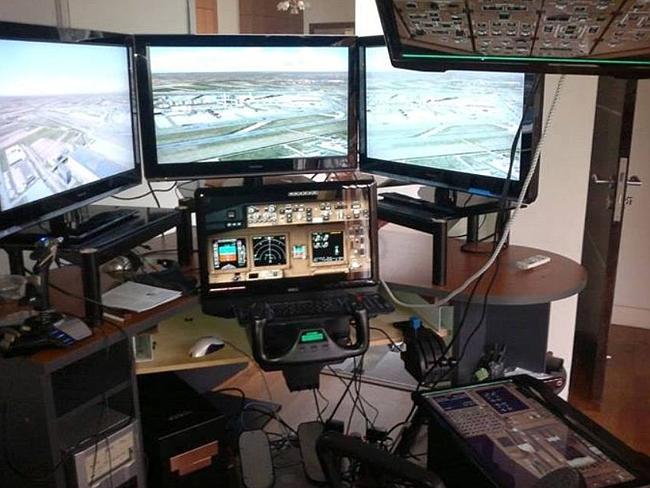
Captain Shah’s personal flight simulator. Source: Facebook
I too use Flight Simulator for my hobby. I too fly into remote Indian Ocean destinations. These destinations have included:
- Diego Garcia
- The Maldives
- Cocos (Keeling) Island
- Christmas Island
- Seychelles
- Mauritius
- Reunion Island
Why? These exotic locations are those that I am unlikely to ever see in real-life. Simple as that!
Nothing more should be read into Captain Zaharie’s Indian Ocean destinations on his flight simulator, other than a man pursuing his hobby!
I have stated all the way through the mystery that MH370 has become, that terrorism was unlikely. I still maintain that view. That’s not to say that human intervention is written all over this incident. I had initially believed that explosive decompression or gross mechanical failure of power plants and possible consequent damage to control surfaces was likely to be the cause of the loss of MH370, but the longer the aircraft remains unlocated the less likely hull or mechanical failure are the cause of the loss.
Then the Malaysian Prime Minister Najib Razak announced that the ACARS and transponders on flight MH370 had been deliberately disabled and the plane diverted off its published FP towards the southern Indian Ocean off the West Australian coast or north-west towards Kazakhstan, which suggests influence or action one or both of the pilots, or with a cockpit incursion by one or more of the passengers was responsible for the loss of the aircraft.
This new Malaysian information release again raised the possiblity of terrorism. Terrorism still cannot be completely ruled out, but seems less likely than other possibilities. Terrorism is always politically motivated with a specific or strategic outcome sought. One would expect if terrorism was involved, that the perpetrators would have claimed responsibility and already used the plane as a weapon against a possible target immediately. One would expect that political demands would have been made, or there would have been an attempt to put pressure on their selected target government.
It has been suggested that terrorist groups do not always claim responsibility for their acts, but that is more likely to be true when there is little doubt about who the perpetrators are and what they want. There seems little point in terrorists hijacking MH370 if no one knows why they did it or what they are seeking to achieve by doing so.
I would appear that the most likely cause for the MH370 diversion seems to be a mental illness on the part of one of the pilots, or perhaps a passenger as a result of a sucessfulcockpit incursion and was able to force a pilot to fly a particular direction to a pre-planned destination – or indeed was able to fly the aircraft himself. But what became of the pilots if the aircraft was taken over by another.
The MH370 incident highlights a number of aviation security problems that will need to be addressed.
- Airport security – Lax passport checking against the Interpol stolen passport database allowed two persons with stolen passports to board the aircraft. These person were probably seeking illegal entry into Europe so are probably innocent in respect of the takeover of the aircraft itself. All passports must be checked against Interpol stolen passport lists.
- Management of the incident information was poor. The lack of a central command centre or spokesperson allowed many agencies to release erronious information which raised hopes of family members then dashed them again, which led to confusion about what could be believed and what could not. For example, for several days it was publicised by Malaysian Airlines that there were a number of no-shows for flight, and whose baggage had been offloaded. Malaysian police stated later this was incorrect and there were no no-shows. The Malaysian government withheld the vital loss of ACARS and transponder information, that could have helped the countries searching for the aircraft. International media did not assist efforts by continually publicising advice from technical experts, academics, leaks from inside the investigation, and their attempts to make news when there was no news.
- The security of cockpit door. Reinforcing the door was good to prevent hijackers entering the flight deck, but is diminished by the door needing to be opened for personal, refreshment and crew handover needs in flight. Perhaps personal and refreshment facilities need to be located on the cockpit side of the door for added security. It is possible for somebody on the cockpit side of the door to keep out a returning pilot/co-pilot from regaining access to the cockpit area. On the 17/02/2014 the co-pilot of an Ethiopian Airlines plane flying from Addis Ababa to Rome locked the pilot out of the cockpit and then flew the plane to Switzerland on his own to seek asylum.
- Diversion from FP – unauthorised and unexpected diversions from a published FP should identified and investigated immediately.
- Air security officers or flight marshals. Many governments, including Australia’s, have been reducing funding in this area and it is probable now that not more than 5 per cent of international flights have air security officers on board. This is due in part to the vast reduction in hijacking and attempted hijecking world-wide. An officer on Flight MH370 may have made a difference – provided of course he or she was able to open the cockpit door, and was not incapicitated during the climb to FL450 in a possible depresurisation attempt to overcome the passengers.
- Pilot mental health. This needs to be regularly reviewed. Long haul flying can be extremely boring and mind-numbing which can lead to stress problems. Flying has been described as 99% boredom and 1% sheer terrror! Are there current studies into the effects on mental health of frequent long-haul flights on pilots and flight crew?
- Transponders, ACARS and communications equipment. No one on an aircraft should be able to disable the ACARS or transponder whilst the aircraft is in flight. This equipment must be fitted in a secure area.
- Ground crew. Ground crew screening needs to be more thorough as they have complete and often unsupervised access to all areas of the airport and to aircraft. A respondent to one of my earlier posts an ATP pilot (thank you, Ingrid) suggested persons could be secreted into a hold container, loaded into the aircraft in a full forward position, from where upon exiting the container, they would have full access to the main electronics bay (MEB) below the flight deck – and to the flight deck itself. Once in the MEB, the intruders would have full access to the communications systems of the B777-2H6 and thus be able to disable them.
I came across this article today which seemed to give a plausible, non-emotive explanation of what may have happened to MH370, quoting apparently legitimate sources. See what you think:
Has anyone considered if the below FAA Airworthiness Directive could be a clue the MH370 investigation?
A November 2013 FAA Airworthiness Directive for the Boeing 777 at the below web address:
http://www.gpo.gov/fdsys/pkg/FR-2013-09-26/html/2013-23456.htmSUMMARY: We propose to adopt a new airworthiness directive (AD) forcertain The Boeing Company Model 777 airplanes. This proposed AD was prompted by a report of cracking in the fuselage skin underneath the satellite communication (SATCOM) antenna adapter. This proposed AD
would require repetitive inspections of the visible fuselage skin and doubler if installed, for cracking, corrosion, and any indication of contact of a certain fastener to a bonding jumper, and repair if necessary. We are proposing this AD to detect and correct cracking and
corrosion in the fuselage skin, which could lead to rapid decompression and loss of structural integrity of the airplane.
Update 3/12, 16:43:
[Here was an earlier anonymous tip I received saying that the AD did not apply to MH370].
Update 3/13 0:00:
I got an email from a reporter suggesting that the AD did, in fact apply to MH370.
Update 3/13 2:36:
Latest statement, straight from a Boeing spokesperson:
“The antenna covered by the pending AD was not installed on MH370, so that airplane is not subject to the AD or the related Service Bulletin”.
So, it has been determined that the AD was not relevant to this plane. However, it served as the key inspiration for an alternative explanation.New Summary:
There’s a chance that MH370 flew for hours on autopilot after we lost radar contact with it. The idea is that some kind of decompression event incapacitated the passengers and crew, while also somehow disabling Satellite and Radar communication systems.If such a decompression were caused by a rupture in the skin of the fuselage, there’s a chance satellite and/or radar antennas would have suffered direct physical damage from the blowout.Original Summary:
When I first wrote this, it seemed likely that a fuselage section near the SATCOM antenna adapter failed, disabling satellite based – GPS, ACARS, and ADS-B/C – communications, and leading to a slow decompression that left all occupants unconscious. If such decompression left the aircraft intact, then the autopilot would have flown the planned route or otherwise maintained its heading/altitude until fuel exhaustion.
A slow decompression (e.g. from a golfball-sized hole) would have gradually impaired and confused the pilots before cabin altitude (pressure) warnings sounded. There’s also the possibility of an extremely-rapid decompression, and it’s described toward the end of this post.Hypothesized Chain of events:
- Likely fuselage failure near SATCOM antenna adapter, disabling some or all of GPS, ACARS, ADS-B, and ADS-C antennas and systems.
- Thus, only primary radars would detect the plane. Primary radar range is usually less than 100nm, and is generally ineffective at high altitudes.
If the decompression was slow enough, it’s possible the pilots did not realize to put on oxygen masks until it was too late. (See Helios 522)
- Also explains why another Pilot thirty minutes ahead heard “mumbling” from MH370 pilots.
- (VHF comms would be unaffected by SATCOM equipment failure.)
With incapacitated pilots, the 777 could continue to fly on Autopilot – programmed to maintain cruise altitude and follow the programmed route. Using the Inertial Reference System (gyroscope based), the plane could navigate without needing GPS.
Other thoughts:
- The plane was [UPDATE: WAS NOT] equipped with cellular communication hardware, supplied by AeroMobile, to provide GSM services via satellite. However this is an aftermarket product; it’s not connected through SATCOM (as far as I know).
- [UPDATE]: However, if the plane flew over or near land, then cellular connectivity is still possible.
- Interestingly, 19 families signed a statement alleging they were able to call the MH370 passengers and get their phones to ring, but with no response.
- When Malaysian Airlines tried to call the phone numbers a day later, the phones did not ring. By this time, fuel would have been exhausted.
Note: 777 Passenger Oxygen masks do not deploy until cabin altitude reaches 13,500. Passengers were likely already unconscious by then, if it was a slow decompression. Also remember that this flight was a red-eye, most passengers would be trying to sleep, masking alarming effects of oxygen deprivation. No confirmed debris has been found in the search area, consistent with the plane having flown for hours after it lost radar contact.
[UPDATE 3/12]:
Issues of Decompression:
Whatever type of decompression happened, it was likely a non-catastrophic decompression that incapacitated the crew. It could have been a slow decompression. (This scenario is more likely if the “mumbles” observed by another MH pilot are legitimate.) It could have also been an extremely rapid decompression, forcing the lungs to exhale more rapidly than they are capable of. Either type of decompression makes it difficult for the crew to respond before becoming incapacitated.This table from Carlyle shows that after a moderately rapid (2-6 second) decompression at MH370’s cruise altitude, the crew would have had only 30-45 seconds of useful consciousness unless they started oxygen breathing soon enough.
For all 3 types of (slow, moderate, extremely-rapid) decompression, there is substantial danger to the crew and passengers. I was recently asked via Facebook, “Do any alarms go off when unexpected decompression occurs?” Yes. An alarm in the flight deck is triggered if cabin altitude exceeds 10,000. However, reacting to it (with quick judgement, reasoning, and execution) is far more difficult than it would seem. An “obvious” first thought might seem to “throttle back and configure the autopilot to start descending now; to get to safe altitude.”However that first instinct is completely wrong. It takes a surprising amount of training to instill into pilots that what they *need* to do first is put on oxygen masks. To train airline pilots, we often put them into a pressure deprivation chamber, simulate a gradual decompression, and follow up with oxygen breathing from a bottle. Many pilots say they notice an astounding difference in mental performance once they start the oxygen.If handling decompression incidents was so trivial and obvious, why else would there be such drastic training
Historical note: The 777 had an early history of decompressions when the first planes were rolling off the assembly line in 1995, however the incidents were managed safely.
strong>So why does all this matter?
The aircraft may be at the floor of the East China Sea, Sea of Japan, or the Pacific Ocean thousands of miles northeast from the current search zone.Recommendations:
- Investigators should obtain data logsfromprimary radars throughout mainland China that would have been along the planned route. They may be the best clue as to the trajectory of the aircraft.
- Investigators should obtain all passengers’ cell phone log and location data. The timing of the last successful cellular connection (ring/SMS/data-packet) can predict how long the plane was in the air. iPhone/iOS location (GPS) data may be available from Apple if subpoenaed. Android location data may be available from Google.
- Add a secondary search space to include a 300nm+ radius around Beijing, focusing on surrounding bodies of water. Using planned routing trajectory, known autopilot logics, fuel quantities, and weather patterns, it may be possible to define a smaller 50nm * 50nm search space. Consider running the above scenario in MH’s 777-200ER full flight simulator.
- Boeing should provide expertise about fuselage/antenna design and autopilot/navigation logic, so as to help plot this second search space.
Source: http://mh370lost.tumblr.com/
The following article reflects the growing concern that MH-370 has been “hijacked” or subjected to cockpit intrusion and piracy. This edited press release below is from the UK’s Guardian newspaper. Is this a credible theory, or just another deparate attempt to explain the loss of this aircraft? Areas searched now include the Gulf of Thailand, the Straits of Malacca, the Andaman Sea and now the Bay of Bengal. If as suggested there has been human intervention, and the aircraft has been flown elsewhere it could be anywhere with in a 7 hour 30 minute radius of Kuala Lumpur – assuming that Beijing is 6 hours flying time from Malaysia plus a 1 hour fuel reserve.
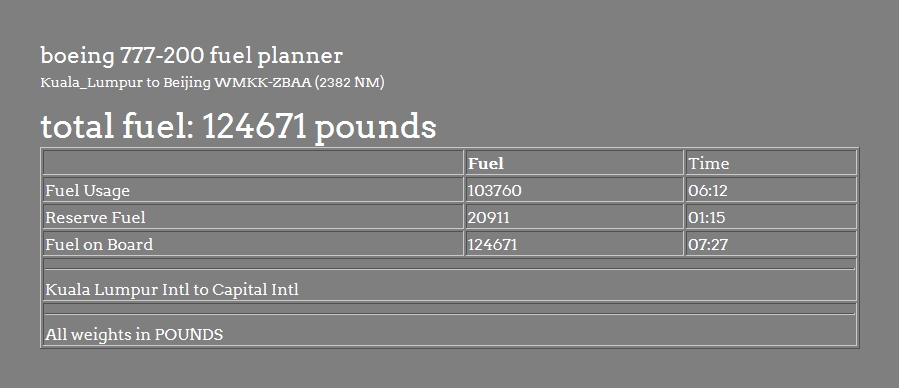
Estimated B772 fuel load (WMKK-ZBAA). Courtesy fuelplanner.com
In a previous post on the web site, I stated that I thought terrorism, cockpit intrusion or piracy to be unlikely. I still remain unconvinced at this point. However, this will only be confirmed if and when the aircraft is found.
- Investigators are now convinced the missing Malaysia Airlines plane was hijacked by one or more people with significant flying experience, who switched off communications and diverted the flight, an “official” involved in the investigation said on Saturday. But they do not know the motive or where the plane was taken, the unnamed source told Associated Press. “It is conclusive,” said the Malaysian official, who spoke anonymously because he is not authorised to brief media. This would suggest that a commercial pilot would have to had been involved in the “hijack”, as significant flying experience in this aircraft type can only be gained by actual hands on flying.
- The huge multinational search was focused on the Bay of Bengal early on Saturday, one week after flight MH370 vanished, as US officials confirmed they had directed surveillance aircraft to patrol the area for debris. There were reports that Malaysian military radar indicated the plane made at least two distinct changes of course after apparently turning back from its route towards Beijing. US officials indicated that they believed the plane had crashed in the Indian Ocean and said that an aerial search of the area would begin on Saturday.
- The Malaysian official said it had been established with a “more than 50 percent” degree of certainty that military radar had picked up the missing plane after it dropped off civilian radar.
- The New York Times reported that radar signals recorded by the Malaysian military appear to show the plane ascending to 45,000 feet and making a sharp turn to the right not long after it disappeared from civilian radar. This is a curious observation as the service ceiling for a B777-200 is 41,300 feet (13,140 metres). an aircraft can climb above it’s service and certified ceiling. It’s not advisable but it is possible.. This information comes from “a preliminary assessment by a person familiar with the data”, the paper said. The same data suggests the plane descended to 23,000 feet as it approached the Malaysian island of Penang, but then re-ascended and flew northwest over the Straits of Malacca.
- CNN is reporting that authorities think the plane may have gone in one of two directions after it passed through the Straits of Malacca: either northwest, towards the Bay of Bengal and the coast of India, or southwest, out into the expanse of the Indian Ocean.
- If the missing airliner crashed in the Indian Ocean, which plunges to depths of 7,000m (23,000ft), it would mean a significant escalation in scale of the challenge facing investigators. Any debris could have been swept far from the original crash site.
- The last communication with the crew was made at around 1.20am, 40 minutes into the flight, as it headed east over the South China Sea towards Vietnam. The plane had enough fuel to fly for another five hours – meaning its potential range was enormous.
- Investigators believe that one or more people switched off communications devices and steered the plane off course, according to the AP source.
- Both military radar readings and the plane’s automatic attempts to establish contact with satellites have offered key clues to its whereabouts, suggesting it flew for four to five hours and was last seen heading north-west towards the Andaman Islands.
- Experts say that while changes in altitude could be caused by fuel burning off, they would not account for the changes in direction. The New York Times also reported that the changes appear to have taken the plane both above and below usual cruising levels for a Boeing-777 at various points in its journey, with it climbing to 45,000 feet before turning west and descending to 23,000 feet as it approached Penang.
- Earlier, an American official told AP that investigators are examining the possibility of “human intervention” in the plane’s disappearance, adding it may have been “an act of piracy.”
- The official suggested a key piece of evidence suggesting intentional interference with communications was that that contact with the Boeing 777’s transponder stopped about a dozen minutes before a messaging system on the jet quit – making it less likely a sudden catastrophic failure was to blame. Some experts have said sequential failures due to technical problems were not impossible – for example if there was a fire – though they would be unusual. It also appeared to be steered to avoid radar detection. The Wall Street Journal reported that manually dismantling communications systems – such as the transponder, which communicates the aircraft’s position, speed and call sign to air traffic control radar – would have required detailed knowledge of the workings of the Boeing-777. It said investigators are also trying to determine why the plane stopped pinging satellites after five hours while apparently cruising over the Indian Ocean. That could be caused by disconnecting the system – an extremely complex task – or by something catastrophic happening to the flight, an expert told them.
- Malaysian police said earlier this week they would be investigating the backgrounds of two pilots, ten crew members and all 227 passengers.
Meanwhile an extraordinary claim has suggested the jetliner may have flown to a position off the west coast of Australia. This extraordinary claim a source cited by Bloomberg news agency, said the last satellite transmission from the airliner has been traced to the Indian Ocean off Australia, 1,ooo kilometres to the west of Perth!
The other thing that continues to puzzle me here is at the time of writng this post, no credible source has come out and confirmed the “hijack” officially. Terms like “a Malaysian official who spoke anonymously”, “an American official”, “experts say” and “a source cited by Bloomberg news agency” are used in the above article, with no official statement from the Malaysian government or the airline. Too many anonymous sources! This smacks of media hype and the need to report something, when there is nothing to report.
Is this a credible story, or is this another example of the wild speculation and conspiracy theories that have surrrounded the disappearance of MH370? You be your own judge.
Time will tell!
The disappearance of Malaysia Airlines Flight MH370 (B777-2H6 – 9M-MRO – cn28420) is the kind of mystery that’s not supposed to happen. In the age of control, surveillance, electronic interconnectedness, cloud computing, GPS, the loss of an aircraft transmitting ACARS data, ADS-B signals and squawk codes should be unheard of.

9M-MRO – the B777-200 aircraft involved in the crash
However even with this tracking technology Flight MH370 disappeared so suddenly and without a trace so suddenly and without a trace that it might as well have flown into the Twilight Zone.
Sattelites, search aircraft and ships from many nations have searched on both sides of the Malay Peninsula, in the Gulf of Thailand and the Straits of Malacca. However satellite coverage of the planet isn’t as complete as security agencies and the media would have people believe.
The pilots of Flight MH370 never communicated a distress call. There was no SOS sent, and no distress squawk codes activated. No sign of the aircraft has been found, no debris or fuel slick. The signal from the aircraft’s CVR/FDR has not been picked up.
Conspiracy theories abound:
- Did the plane disintegrate at 35,000 feet from a catastrophic hull failure, mechanical failure or sudden decompression? This is possible but unlikely. The aircraft was only 11 years old and with an impeccable safety record. Introduced in June 1995, out of 1544 aircraft produced by Boeing, there have only been 3 hull-loss incidents.
- Did the pilot commit suicide by flying it straight down into the sea? While this is not unheard of, this scenario too is unlikely. The PIC was a senior and well-respected member of the MAS flight team with more than 18,000 flight hours. The FO had nearly 3000 hours.
- Did terrorists blow it up? This is possible but also appears unlikely. The prescence of passengers travelling on false passports leans more toward illegal entry to the EU than terrorist plot
- Did a passenger plant a bomb so that his family would collect life insurance? This is certainly not likely. An everyday person is unlikely to have access to bomb-making materials, the technical ability to create a device, and then get the device onto an aircraft without detection
- Was the plane shot down by the military? Unlikely but again this is not unheard of. Korean Airlines Flight 902 was shot down over Murmansk in Soviet airspace on 20/04/1978, and then Korean Airlines Flight 007 was shot down near Sakhalin Island in Soviet airspace on 1/09/1983 with the loss of all 269 passengers on board. In both these incidents, Soviet authorities admitted to the action, if not immediately. If this is a possibility, which country would be responsible?
- Did the aircraft fly to North Korea? I would put this suggestion in the realm of pure fantasy. How would the aircraft fly from near Ca Mau in Vietnam to Pyongyang with all it’s ID equipment turned off without being tracked on civilian and military radar and without attracting the attention of a country’s military as it flew over?
- Could it have crash-landed in a jungle somewhere, where the passengers are now fighting to survive? This is possible but again unlikely. A crash on land would be associated with fire and smoke. Somebody would have seen it and reported it. Furthermore, the signal from the CVR/FDR would have been activated and picked up by searching aircraft.
There are a number of possibilities from the unlikely to the extremely far-fetched, however what actually happened to Flight MH370 will emerge eventually.
There are only four likely and credible explanations:
- Catastrophic hull failure or explosive depressurisation. This will include door failure, hold door failure or bulkhead failure.
- Gross mechanical failure of engines and/or flight surfaces.
- Pilot error.
- Terrorism, incuding bomb detonation, cockpit intrusion, forced diversion or piracy after manipulation of on-board tracking systems.
What ever the cause was, it happened with such impact and urgency that the flight crew were unable to trnasmit a distress call or SOS, which leads me to believe that option 1 and 2 above are the most likely causes of the loss of MH370.
There were media reports quoting Malaysia’s air force chief, General Rodzali Daud, saying that military radar picked up the aircraft Saturday flying far off-course, to the west, far from its flight path. That would suggest foul play such as cockpit intrusion and forced diversion. But these reports still do not reveal where the plane is, whether it crashed on land or at sea, or is intact somewhere. Later General Daud retracted this statement stating that he had been misquoted by the media.
This flight is similar to that of Air France Flight 447, which crashed into the Atlantic in 2009 killing all 228 people aboard. In this case, when air-speed measurements failed and led pilots to put the plane into an aerodynamic stall to which the flight crew failed to respond correctly. However, data was being received showing inflight errors at the Airbus operations centre in France before the plane disappeared. Wreckage was spotted shortly after the crash, and most of the passengers bodies were recovered, although it took two years for the FDR to be retrieved from the sea floor.
The missing aircraft remains a mystery, but it will be found. The aircraft is out there somewhere.
My Flickr
This Is Me
George Brown is a decorated soldier and health professional and 40 year veteran in the field of emergency nursing and paramedical practice, both military and civilian areas. He has senior management positions in the delivery of paramedical services. Opinions expressed in these columns are solely those of the author and should not be construed as being those of any organization to which he may be connected.
He was born in the UK of Scottish ancestry from Aberdeen and a member of the Clan MacDougall. He is a member of the Macedonian community in Newcastle, and speaks fluent Macedonian. While this may seem a contradiction, it is his wife who is Macedonian, and as a result he embraced the Macedonian language and the Orthodox faith.
His interests include aviation and digital photography, and he always enjoys the opportunity to combine the two. Navigate to his Flickr site to see recent additions to his photo library.

Џорџ Браун е украсени војник и професионално здравствено лице и 40 годишен ветеран во областа на за итни случаи старечки и парамедицински пракса, двете воени и цивилни области. Тој има високи менаџерски позиции во испораката на парамедицински услуги. Мислењата изразени во овие колумни се исклучиво на авторот и не треба да се толкува како оние на било која организација тој може да биде поврзан.
Тој е роден во Велика Британија на шкотскиот потекло од Абердин и член на Kланот MacDougall. Тој е член на македонската заедница во Њукасл, и зборува течно македонски. Иако ова можеби изгледа контрадикција, тоа е неговата сопруга кој е македонски, и како резултат научил македонскиот јазик и ја примија православната вера.
Неговите интереси вклучуваат авијација и дигитална фотографија, и тој секогаш ужива во можност да се комбинираат двете. Отиди до неговиот Фликр сајт да видите последните дополнувања на неговата слика библиотека.
My Community


 Words, By George!