Now the French really know how to turn on a parade.
Note the particularly slow marching pace of the Foreign Legionnaires. In comparison to the 116-step-per-minute pace of other French units, the Foreign Legion has an 88-step-per-minute marching speed. It is also referred to by Legionnaires as the “crawl“. Because of the impressively slow pace, the Foreign Legion is always the last unit marching in any parade.
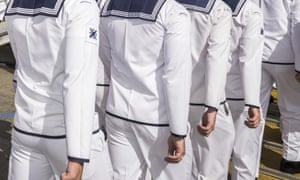
Two hundred and twenty current and former personnel join class action claiming negligence and breach of contract
Photograph: MediaServicesAP/Demotix/Corbis
The sailors were among 320 men and women who enlisted between 2010 and 2012 on contracts that reportedly said they would receive training to get a certificate IV in engineering in four years.
Sailors who enlisted on the promise of trade qualifications are suing the Royal Australian Navy for failing to deliver, with 220 current and former naval personnel joining a class action claiming negligence and breach of contract.
The sailors were among 320 men and women who enlisted between 2010 and 2012 on contracts that reportedly said they would receive training to get a certificate IV in engineering in four years under the marine technician 2010 category career continuum program, or MT2010.
The lead plaintiff, Clayton Searle, told the ABC the training was never delivered. “At the four-year mark they were offering new courses to act as compensation for where they had gone wrong, but it was still three years before we’d receive a lesser qualification than what we were scheduled to have,” he said.
Jon Henderson, who joined at the same time, told the ABC it was “quite obvious” the recruits were never going to get the promised training and said they were instead frequently left with nothing to do.
“I was basically warehoused in a site called PSU, or personnel support unit, where numerous sailors basically sit around, read the paper, go online,” Henderson said.
“Kids are going in there at 17, 18 and leaving with nothing. There are guys who’ve been in there 10 years and are coming out and having to do excess training just to get a qualification to get a civilian job.”
Stewart Levitt, the lead lawyer on the case, said the sailors were “effectively conned into enlistment”. “They were effectively misled and strung along and left in a position where they were asked to do either other duties or no duties at all,” he said.
Levitt said some had been placed in a room and told they couldn’t leave until they signed a waiver of the training agreement. Three years in, the sailors were reportedly told they could get a certificate III in engineering, a lesser qualification, if they signed on for another term.
“Overwhelmingly they don’t want to remain in the navy because the navy has done the wrong thing by them,” Levitt said.
Levitt told Guardian Australia he had been contacted by recruits in other navy and defence force programs who said they had also not received promised training.
“They say that this is the tip of the iceberg and asked us to take on their cases, which they describe as very similar,” he said.
“It’s wasteful not only in terms of taxpayer dollars but in terms of human resources – there are 320 people who are in the prime of their lives in terms of employability who are frustrated and denied their ability to contribute as taxpayers who are actively participating.”
According to a 2014 report by the Australian National Audit Office, the navy had a “critical” shortfall of 370 qualified marine technicians, or 23.5% of their required taskforce, in June 2014.
That report said the MT2010 program had been intended to address “career dissatisfaction” among marine technicians, concern about their qualifications and “lack of meaningful shore-based jobs”. It said the chief of navy, Vice Admiral Tim Barrett, had ordered the training of junior marine technicians be prioritised.
The class action is scheduled for the New South Wales supreme court on 20 May.
Some of the legal decisions that come out of the USA, never cease to amaze me. Now a US federal court has ruled that it is OK to wear military medals that you did not earn, and to lie about earning those medals. The wearing of an unearned medal, in my opinion, dilutes the intent conveyed by the medal, thus making the public skeptical when accepting the legitimacy of any medal. That said, the sheer number of medals (144 at last count) available to US servicemen and women, for all aspects of service, weapons handling etc., serves to foster that dilution on its own.
Consider this:
A federal law that prohibited people from wearing military medals they didn’t earn is unconstitutional for the same reason as a law that made it a crime to lie about earning a medal, a US federal appeals court ruled on Monday. It’s a falsehood that is protected by freedom of speech.
In an 8-3 ruling, the Ninth U.S. Circuit Court of Appeals in San Francisco said the now-repealed law against wearing unearned military decorations was a ban on a type of “symbolic speech.” Although the government can forbid falsehoods that cause tangible harm, like fraud or perjury, the Constitution restricts government regulation of expression based solely on its content, the court said.
“Suppressing a symbolic communication threatens the same First Amendment harm as suppressing a written communication,” Judge Sandra Ikuta said in the majority opinion. “Wearing a medal has no purpose other than to communicate a message.”
She cited the U.S. Supreme Court’s ruling in 2012 striking down a related law that prohibited lying about receiving a military honor. That 5-4 decision said the law punished speech without requiring proof of intent to defraud, and that the government had other ways of protecting the public from deception — for example, an easily accessible database of legitimate medal recipients.
A year after that ruling, Congress enacted a revised law that makes it a crime to lie about military honors, but only if the liar intended to profit or defraud someone. The new law does not punish someone solely for wearing an unearned medal.
Dissenters from Monday’s ruling said falsely wearing medals is conduct, not speech, and is potentially more harmful than lying about them.
“The wearing of an unearned medal dilutes the message conveyed by the medal itself,” making the public less likely to accept the legitimacy of any medal, said Judge Jay Bybee, who was joined by Judges N. Randy Smith and Paul Watford. “The lie here is told in a more effective way.”
The ruling came in the case of Elven Swisher, an Idaho man who served in the Marines from 1954 to 1957. In 2001, Swisher filed a claim for Post-Traumatic Stress Disorder benefits, saying he had been wounded and traumatized in a secret combat mission in North Korea in 1955, two years after the Korean War ended. He said an unnamed captain had awarded him a Purple Heart and told him he was entitled to other service medals.
After initially rejecting his claim, the government reversed itself and granted Swisher benefits in 2004 for PTSD from the secret mission. The government canceled the benefits in 2006 after concluding that Swisher’s claims about the mission, the harm he suffered and the medals he earned were fraudulent.
In the meantime, Swisher wore his unearned Purple Heart when he testified as a prosecution witness against David Hinkson, convicted in 2005 of plotting to murder three people, including a federal judge. Despite learning of Swisher’s apparent deception, the appeals court later upheld Hinkson’s convictions.
Swisher, who has never recanted his claims, was convicted of the false-medal charge and three other crimes and has served his one-year sentence. His lawyer, Joseph Horras, said Monday’s ruling was a worthwhile expansion of First Amendment protections.
Bob Egelko, San Francisco Chronicle, Published: January 12, 2016
A day ahead of the August 15, 2015, seventieth anniversary of the end of World War II, Prime Minister Abe Shinzō issued his statement to mark the milestone date.
The statement spells out the Abe administration’s historical take on Japan’s role in the war and its seven decades as a pacifist nation since then, touching on the vocabulary many viewed as required in any statement released on this occasion—“colonial rule,” “aggression,” and, most importantly, “deep remorse” and “apology”—reiterating that the position expressed by previous administrations “will remain unshakable into the future.”
Previous administrations have also made statements to mark milestone anniversaries. In August 1995, Prime Minister Murayama Tomiichi issued a statement 50 years after the end of the war admitting that Japan, “through its colonial rule and aggression, caused tremendous damage and suffering to the people of many countries, particularly to those of Asian nations.” Ten years later, an August 2005 statement by Prime Minister Koizumi Jun’ichirō largely followed in the footsteps of the Murayama statement.
Prime Minister Abe, meanwhile, opened his speech by stressing its broader focus on the past, present, and future courses Japan has and will take: “we must calmly reflect upon the road to war, the path we have taken since it ended, and the era of the 20th century. We must learn from the lessons of history the wisdom for our future.”
In late February, the prime minister commissioned an advisory panel headed by Nishimuro Taizō, chairman of Japan Post, to help him craft his statement. On August 6 this group delivered its final report, which expanded on the “aggression” concept, noting that Japan “caused much harm to various countries, largely in Asia, through a reckless war.”
Abe’s seventieth anniversary statement drew on this report to an extent, seeking in particular to make use of the four key phrases that had appeared in the statements one and two decades earlier: “colonial rule,” “aggression,” “remorse,” and “apology.” Going a step further in the vocabulary department, the Abe statement also touched on 悔悟 (kaigo, “repentance” or “contrition”) to clarify Japan’s historical stance. It remains to be seen, though, how these terms will be evaluated in the less strenuously apologetic context in which they appeared.
Prime Minister Abe stressed Japan’s pacifist history since the war’s end and its peace-oriented diplomatic outlook for the future when he moved on from the historical portion of his speech. “We must never again repeat the devastation of war,” he spoke. “Incident, aggression, war—we shall never again resort to any form of the threat or use of force as a means of settling international disputes.” With this, he stressed the country’s intent to engage in forward-looking diplomacy aimed at its “proactive contribution to peace.”
Taking questions from the press after giving his statement, Abe commented on the lack of positive recent developments in Japan’s relations with China and Korea. He expressed his hope that the Chinese side would “accept the statement in the spirit in which it was offered,” looking forward to the chance for a third formal summit meeting with Chinese Premier Xi Jinping.
In the Korean connection, meanwhile, the prime minister touched obliquely on the “comfort women” issue, noting: “We must never forget that there were women behind the battlefields whose honor and dignity were severely injured.”
Prime Minister Abe went on in words he no doubt hoped his listeners would take to heart: “Upon the innocent people did our country inflict immeasurable damage and suffering. History is harsh. What is done cannot be undone. Each and every one of them had his or her life, dream, and beloved family. When I squarely contemplate this obvious fact, even now, I find myself speechless and my heart is rent with the utmost grief.”
Prime Minister Shinzo Abe’s speech:
Statement by Prime Minister Shinzo Abe
Friday, August 14, 2015
On the seventieth anniversary of the end of the war, we must calmly reflect upon the road to war, the path we have taken since it ended, and the era of the twentieth century. We must learn from the lessons of history the wisdom for our future.
More than 100 years ago, vast colonies possessed mainly by the Western powers stretched out across the world. With their overwhelming supremacy in technology, waves of colonial rule surged toward Asia in the nineteenth century. There is no doubt that the resultant sense of crisis drove Japan forward to achieve modernization. Japan built a constitutional government earlier than any other nation in Asia. The country preserved its independence throughout. The Japan-Russia War gave encouragement to many people under colonial rule from Asia to Africa.
After World War I, which embroiled the world, the movement for self-determination gained momentum and put brakes on colonization that had been underway. It was a horrible war that claimed as many as 10 million lives. With a strong desire for peace stirred in them, people founded the League of Nations and brought forth the General Treaty for Renunciation of War. There emerged in the international community a new tide of outlawing war itself.
At the beginning, Japan, too, kept steps with other nations. However, with the Great Depression setting in and the Western countries launching economic blocs by involving colonial economies, Japan’s economy suffered a major blow. In such circumstances, Japan’s sense of isolation deepened and it attempted to overcome its diplomatic and economic deadlock through the use of force. Its domestic political system could not serve as a brake to stop such attempts. In this way, Japan lost sight of the overall trends in the world.
With the Manchurian Incident, followed by the withdrawal from the League of Nations, Japan gradually transformed itself into a challenger to the new international order that the international community sought to establish after tremendous sacrifices. Japan took the wrong course and advanced along the road to war.
And, 70 years ago, Japan was defeated.
On the seventieth anniversary of the end of the war, I bow my head deeply before the souls of all those who perished both at home and abroad. I express my feelings of profound grief and my eternal, sincere condolences.
More than 3 million of our compatriots lost their lives during the war: on the battlefields worrying about the future of their homeland and wishing for the happiness of their families; in remote foreign countries after the war, in extreme cold or heat, suffering from starvation and disease. The atomic bombings of Hiroshima and Nagasaki, the air raids on Tokyo and other cities, and the ground battles in Okinawa, among others, took a heavy toll among ordinary citizens without mercy.
Also in countries that fought against Japan, countless lives were lost among young people with promising futures. In China, Southeast Asia, the Pacific islands and elsewhere that became the battlefields, numerous innocent citizens suffered and fell victim to battles as well as hardships such as severe deprivation of food. We must never forget that there were women behind the battlefields whose honor and dignity were severely injured.
Upon the innocent people did our country inflict immeasurable damage and suffering. History is harsh. What is done cannot be undone. Each and every one of them had his or her life, dream, and beloved family. When I squarely contemplate this obvious fact, even now, I find myself speechless and my heart is rent with the utmost grief.
The peace we enjoy today exists only upon such precious sacrifices. And therein lies the origin of postwar Japan.
We must never again repeat the devastation of war.
Incident, aggression, war—we shall never again resort to any form of the threat or use of force as a means of settling international disputes. We shall abandon colonial rule forever and respect the right of self-determination of all peoples throughout the world.
With deep repentance for the war, Japan made that pledge. Upon it, we have created a free and democratic country, abided by the rule of law, and consistently upheld that pledge never to wage a war again. While taking silent pride in the path we have walked as a peace-loving nation for as long as seventy years, we remain determined never to deviate from this steadfast course.
Japan has repeatedly expressed the feelings of deep remorse and heartfelt apology for its actions during the war. In order to manifest such feelings through concrete actions, we have engraved in our hearts the histories of suffering of the people in Asia as our neighbors: those in Southeast Asian countries such as Indonesia and the Philippines, and Taiwan, the Republic of Korea and China, among others; and we have consistently devoted ourselves to the peace and prosperity of the region since the end of the war.
Such position articulated by the previous cabinets will remain unshakable into the future.
However, no matter what kind of efforts we may make, the sorrows of those who lost their family members and the painful memories of those who underwent immense sufferings by the destruction of war will never be healed.
Thus, we must take to heart the following.
The fact that more than 6 million Japanese repatriates managed to come home safely after the war from various parts of the Asia-Pacific and became the driving force behind Japan’s postwar reconstruction; the fact that nearly 3,000 Japanese children left behind in China were able to grow up there and set foot on the soil of their homeland again; and the fact that former POWs of the United States, the United Kingdom, the Netherlands, Australia and other nations have visited Japan for many years to continue praying for the souls of the war dead on both sides.
How much emotional struggle must have existed and what great efforts must have been necessary for the Chinese people who underwent all the sufferings of the war and for the former POWs who experienced unbearable sufferings caused by the Japanese military in order for them to be so tolerant nevertheless?
That is what we must turn our thoughts to reflect upon.
Thanks to such manifestation of tolerance, Japan was able to return to the international community in the postwar era. Taking this opportunity of the seventieth anniversary of the end of the war, Japan would like to express its heartfelt gratitude to all the nations and all the people who made every effort for reconciliation.
In Japan, the postwar generations now exceed 80% of its population. We must not let our children, grandchildren, and even further generations to come, who have nothing to do with that war, be predestined to apologize. Still, even so, we Japanese, across generations, must squarely face the history of the past. We have the responsibility to inherit the past, in all humbleness, and pass it on to the future.
Our parents’ and grandparents’ generations were able to survive in a devastated land in sheer poverty after the war. The future they brought about is the one our current generation inherited and the one we will hand down to the next generation. Together with the tireless efforts of our predecessors, this has only been possible through the goodwill and assistance extended to us that transcended hatred by a truly large number of countries, such as the United States, Australia, and European nations, which Japan had fiercely fought against as enemies.
We must pass this down from generation to generation into the future. We have the great responsibility to take the lessons of history deeply into our hearts, to carve out a better future, and to make all possible efforts for the peace and prosperity of Asia and the world. We will engrave in our hearts the past, when Japan attempted to break its deadlock with force. Upon this reflection, Japan will continue to firmly uphold the principle that any disputes must be settled peacefully and diplomatically based on the respect for the rule of law and not through the use of force, and to reach out to other countries in the world to do the same. As the only country to have ever suffered the devastation of atomic bombings during war, Japan will fulfill its responsibility in the international community, aiming at the nonproliferation and ultimate abolition of nuclear weapons.
We will engrave in our hearts the past, when the dignity and honor of many women were severely injured during wars in the twentieth century. Upon this reflection, Japan wishes to be a country always at the side of such women’s injured hearts. Japan will lead the world in making the twenty-first century an era in which women’s human rights are not infringed upon.
We will engrave in our hearts the past, when forming economic blocs made the seeds of conflict thrive. Upon this reflection, Japan will continue to develop a free, fair, and open international economic system that will not be influenced by the arbitrary intentions of any nation. We will strengthen assistance for developing countries, and lead the world toward further prosperity. Prosperity is the very foundation for peace. Japan will make even greater efforts to fight against poverty, which also serves as a hotbed of violence, and to provide opportunities for medical services, education, and self-reliance to all the people in the world.
We will engrave in our hearts the past, when Japan ended up becoming a challenger to the international order. Upon this reflection, Japan will firmly uphold basic values such as freedom, democracy, and human rights as unyielding values and, by working hand in hand with countries that share such values, hoist the flag of “Proactive Contribution to Peace,” and contribute to the peace and prosperity of the world more than ever before.
Heading toward the eightieth, the ninetieth, and the centennial anniversary of the end of the war, we are determined to create such a Japan together with the Japanese people.
August 14, 2015 Shinzo Abe, Prime Minister of Japan
Today, the 256th of April 2015, is the 100th anniversary of ANZAC here in Australia and New Zealand.
Today we remember the sacrifices given by our servicemen in many and varied conflicts, many who made the supreme sacrifice and laid down their lives so that who are left can enjoy the freedom and liberty so hard-won.
We especially remember those gallant men who stormed the beaches of Anzac Cove at Gallipoli in 1915, and gave their all against a formidable Turkish foe. We remember their endurance and their perseverance to get the job done. And ultimately, we remember the tragic failure of the whole Gallipoli campaign.
It was a turning point as a nation for both Australia and New Zealand, a baptism of fire, a loss of innocence for a young country. Many heroes arose out of this battle, many names becoming those of legend.
ANZAC is synonymous with bravery, stoicism, dogged determination and a drive to succeed. This became a characteristic of all servicemen to follow and is the measure of every “Digger.”
We bow our heads and reflect on their service and their sacrifice.
Who Are These Men
Who are these men that march so proud,
Who quietly weep, eyes closed, head bowed?
These are the men who once were boys,
Who missed out on youth and all of its joys.
Who are these men with aged faces,
Who silently count the empty spaces?
There are the men who gave their all,
Who fought for their country for freedom for all.
Who are these men with sorrowful look
Who can still remember the lives that were took?
These are the men that saw young men die,
The price of peace is always high.
Who are these men who in the midst of pain,
Whispered comfort to those they would not see again?
These are the men whose hands held tomorrow,
Who brought back our future with blood tears and sorrow.
Who are these men who promise to keep
Alive in their hearts the ones God holds asleep?
These are the men to whom I promise again:
“Veterens”, my friends – I will remember them!
Jodie Johnson
This poem was written in 1966 by Jodie Johnson who was 11 years old at the time. The depth of her feeling and understanding for the thoughts of the veterans is unusual for someone so young. I know when I see this sort of understanding by young people, that our future is in good hands.
In Flanders Fields
In Flanders fields the poppies blow
Between the crosses, row on row,
That mark our place; and in the sky
The larks, still bravely singing, fly
Scarce heard amid the guns below.
We are the Dead. Short days ago
We lived, felt dawn, saw sunset glow,
Loved and were loved, and now we lie,
In Flanders fields.
Take up our quarrel with the foe:
To you from failing hands we throw
The torch; be yours to hold it high.
If ye break faith with us who die
We shall not sleep, though poppies grow
In Flanders fields.
Lest We Forget
Lest We Forget
They went with songs to the battle, they were young.
Straight of limb, true of eye, steady and aglow.
They were staunch to the end against odds uncounted,
They fell with their faces to the foe.
They shall grow not old, as we that are left grow old:
Age shall not weary them, nor the years condemn.
At the going down of the sun, and in the morning,
We will remember them.
THE ad agency which came up with the ‘Fresh in Our Memories’ campaign for Woolworths has gone into hiding.
Carrspacehas deleted its Twitter account and its website is unavailable. Their Facebook page is still live however causing people to post that the agency’s actions are an overreaction to the social media bungle and that they should take responsibility for their ideas.
Meanwhile things have gone from bad to worse for Woolworths.
Now the Federal government has blasted the Australian supermarket giant for “inappropriate” and unauthorised use of ANZAC in its advertising after a disastrous campaign that has backfired badly on social media.
The “Fresh in Our Memories” website — linking ANZAC commemorations to the retailer’s “Fresh Food People” branding tag line — was taken down overnight amid claims that it was in very poor taste.
Veterans’ Affairs Minister Michael Ronaldson weighed in this morning, saying Woolies would not have been given permission for the advertising had it been sought.
“While I acknowledge that Woolworths moved quickly to address the situation, I hope this is a reminder to others that the regulations are in place for good reason and that they will be rigorously enforced,” Senator Ronaldson said in a statement.
The Minister said he had become aware of the advertising late yesterday. Under the Protection of Word ANZAC Act 1920, permission for the use of the word ‘ANZAC’ in any such material must be granted by the Australian Government.
Woolworths is being slammed for incorporating their own branding into a campaign to commemorate ANZAC Day.
“The Australian community quite rightly expects that the word ‘ANZAC’ is not trivialised or used inappropriately and as Minister for Veterans’ Affairs, I am responsible for ensuring that any use of the word ‘Anzac’ does not provide commercial benefit to an organisation,” said Senator Ronaldson.
“In this instance, permission was not sought by the campaign proponents, nor would it have been approved.
“Immediately upon having this campaign brought to my attention, I contacted Woolworths and asked them to end it. I am pleased that the campaign has now been withdrawn.”
Woolworths encouraged members of the public to share stories and profile-style pictures of loved ones affected by or lost to war by uploading images to a website that then branded them with Woolworths logo and the phrase “Lest we Forget 1915-2015. Fresh in our memories.” This was thought to be too close to their “Fresh Food People” jingle
In a statement, Woolworths said: “We regret that our branding on the picture generator has caused offence, this was clearly never our intention.
“Like many heritage Australian companies, we were marking our respect for ANZAC and our veterans.”
The food retailer said the site was developed to give staff and customers a place to put their stories to mark the Centenary of ANZAC.
In an earlier statement, Woolworths denied the commemoration was a marketing ploy and defended its record of raising money for the Returned Services League (RSL).
To be fair to Woolworths however they are not the only company to try and associate their brand with the ANZAC legend, a phenomenon referred to as “Brandzac.”
Carlton & United Breweries has been running the “Raise A Glass” campaign associating VB beer with ANZAC, with none other than General Sir Peter Cosgrove (Rtd) taking a leading role in the campaign.
Penrith Panthers RLFC are offering a limited edition ANZAC jersey for $180. Essendon and Collingwood AFL clubs are offering an ANZAC day jumper for $135.
While CUB is a major contributor to ANZAC and legacy charities, it remains uncertain where monies from other “ANZAC” commercial ventures are going.
Tighter control and scrutiny by government is required in respect of the use and association with all things relating to ANZAC.
Late last year a United States law framed in the name of world peace quietly reached its long arm into a small Melbourne tribunal, persuading it to let a large armaments manufacturer override Australian human rights legislation.
In a decision that went largely unremarked upon, the Victorian Civil and Administrative Tribunal (VCAT) agreed to let Thales Australia Ltd and its subsidiary ADI Munitions discriminate racially against their employees, job applicants and contract workers.
The companies won a five-year exemption from six sections of the Equal Opportunity Act so they could comply with stringent US export laws that describe who can and who cannot have access to American military technology and know-how.
Simon Rice, an Australian National University law professor, could only sigh. He is an almost lone voice against the Americans’ capacity for such strongarm tactics in Australian courts.
“It’s legal imperialism,” says Rice, who chairs the ACT Law Reform Advisory Council. “It’s the US saying to everybody in the world: You will deal with us on the terms we will dictate to you.”
There have been scores of such decisions in small courts across the nation since at least 2003, when the Queensland Anti-Discrimination Tribunal granted Boeing Australia Holdings some of the first such exemptions.
Because the Australian government relies heavily on US military technology, the big defence manufacturers operating here have, for more than a decade, made a practice of applying for exemptions from our equal opportunity laws so they can stay sweet with the US State Department. All applications, except one in Queensland, have been granted, allowing the companies to bar access to certain employees and contractors to positions where they would have access to sensitive US military goods and services.
This means the workforce is segregated, so that the “wrong” people are not given certain positions, as spelt out by the US International Traffic in Arms Regulations (ITAR), according to Rice, who advises our federal parliamentary human rights committee.
Because the ITAR, which governs the terms with which an importing country can use American defence technology, requires companies to discriminate on the basis of birth or nationality, it conflicts directly with Australian state and territory human rights legislation. Companies either persuade our legal authorities to let them off the hook or they don’t get US State Department clearance to access exported US defence technology.
“It is easier for the companies to get a local exemption than to get this clearance,” explains Rice.
Some people are outright denied access to sensitive American defence exports because their country of birth or dual nationality is on an ITAR list of “proscribed” nations.
The list changes from time to time and barred nations currently include Afghanistan, China, Cuba, Cyprus, Fiji, Iran, Iraq, Lebanon, Sri Lanka, Syria and Vietnam – the ancestral homes of many Australian migrants.
Competitive advantage
There was a salient reminder this week of the reasons for US nervousness over technology security. Whistleblower Edward Snowden revealed via German magazine Der Spiegel that Chinese spies had stolen design plans for the Joint Strike Fighter, the aircraft meant to reinforce US aerial dominance. Australia is spending billions of dollars on the same planes.
American lawyers specialising in export laws have described the ITAR as unparalleled in scope, as it reaches across the entire globe. It’s not just about arms, but a whole gamut of hardware and software used for military purposes or space research. It includes ships, planes, lasers and satellite technology, and “export” can simply mean transferring information – even, possibly, according to one analyst, sending an email.
Australia’s foremost specialist in space law, Professor Steven Freeland of the University of Western Sydney, sees extra benefits beyond national security for the US as it enforces the ITAR to regulate who can use American satellite technology.
“In the area of space technology, the US are still the superpower and they want to stay there, despite developments in China and Russia, so they’re very sensitive about their weapons technology going to other countries,” he tells The Saturday Paper. “In its simplest terms, space technology is regarded as akin to missile technology.”
While the ITAR has a benevolent motive in wanting to stop sensitive technology falling into the wrong hands, it also has the effect of enabling the US to retain a competitive advantage, he says.
“You won’t find that motivation explicitly in the official documents,” Freeland says.
However, he is less worried than Rice about ITAR’s reach.
“It’s quite common where people are dealing with national security issues to say: Sorry, but we get to choose the sort of people who work there because we don’t want them to have access,” he says.
Rice argues that the state department is dictating the private behaviour of individuals and companies outside the US, causing them to act unlawfully in their own countries.
Fines and jail terms
The state department can fine offending individuals and businesses up to $US1 million per violation for breaching ITAR requirements. It can ban companies from using American military exports and jail offenders for up to 10 years.
In a case that sent a message to universities, John Reece Roth, a former Tennessee professor of electrical engineering, was jailed for four years in 2009 for breaching the ITAR by providing information on drone technology to students from Iran and China.
Boeing was fined $US3.8 million in 2001, $US15 million in 2006 and $US3 million in 2008 for ITAR breaches and other companies have also been hit hard.
By comparison, breaches here of Australian anti-discrimination and equal opportunity law may lead to an apology or “small value financial compensation”, Australian defence industry lawyer Jane Elise Bates pointed out in the journal Security Challenges in 2012.
“From an economic perspective the balance is certainly in favour of continuing the status quo and seeking exemptions as required to permit the conduct of racial discrimination,” Bates wrote.
In the latest decision granting Thales Australia exemptions in November, VCAT member Anna Dea said the company’s work for the Australian Defence Force, including ship, aircraft, vehicle and munitions manufacture, generates more than $861 million in annual sales. It employs 871 people in Victoria, with an estimated $2 billion worth of projects lined up over the next eight to 10 years.
Dea listed the same reasons that have persuaded nearly every Australian decision-maker in her position for the past decade or so to grant exemptions, faced with the brutal reality of the US ITAR. The company’s work is important to Australia’s defence capability, the state economy and jobs that could otherwise go elsewhere, she said. She noted that no employees or union representatives made any submissions to the tribunal.
But it was not always so.
When Thales and ADI sought similar exemptions in the State Administrative Tribunal of Western Australia in 2005, the commissioner for equal opportunity, the WA Trades and Labour Council, the state’s Ethnic Communities Council and Western Australians for Racial Equality all objected.
The companies won a five-year exemption anyway.
As Australia negotiated a new defence treaty with the US in 2008, judges and decision-makers for a while bridled at having to bow to American law, after a parliamentary committee recommended the federal government seek exemptions from the ITAR.
In 2007, the then VCAT president, Justice Stuart Morris, voiced his concern about being asked by Boeing Australia Holdings to depart from local legislation to provide jobs.
“Such a departure is only sought because important aerospace technology is subject to an American law which places American security ahead of this human rights standard. One might ask: why should not the Americans give way?” he said.
“One suspects that the ITAR is misconceived … But then, I rather doubt that the United States government will back down from ITAR in the face of a decision of the Victorian Civil and Administrative Tribunal.”
VCAT deputy president Cate McKenzie described the nationality-based prohibitions in the ITAR as a “blunt instrument” when she granted a partial exemption to BAE Systems Australia Limited in 2008.
“Assessment of individuals on a non-stereotyped basis, or training and education about the importance of the obligation of secrecy, would seem to me to be a better approach,” she said.
Little choice for legal bodies
At the end of 2008, the president of the Queensland Anti-Discrimination Tribunal, Douglas Savage, refused exemptions sought by the Boeing group. The companies’ opportunities should not be at the expense of employees or potential employees, said Savage, whose decision still stands.
He doubted that refugees who had risked their lives to flee nations whose regimes they opposed were a security concern. Any concern could equally apply to US or Australian citizens, he said.
Rice sees such opposition as having faded. In particular, although they have appeared in past hearings, he is disappointed at unions’ failure to take this on as a cause.
“They haven’t been very effective or strategic in their arguments,” he says.
Four years ago, Rice argued in The Canberra Law Review that courts and tribunals in reality “have had little real choice, in the face of employers’ (poorly substantiated) claims that without the exemption the defence contracts will be breached with serious consequences, including the loss of jobs.”
There have been at least 25 more decisions allowing exemptions since he wrote that. Thirteen were in New South Wales, where there are no public hearings and exemptions are gazetted by the attorney-general. Two were in the ACT, two in Victoria, six in South Australia and one in Western Australia.
“I’ve been waiting for one tribunal to break ranks,” says Rice. “It seems to me they’re spooked. They’re between a rock and a hard place. You have to have sympathy. This is a political issue. The tribunals are being asked to decide it and they shouldn’t be.”
However, tribunals should be more rigorous in making these self-interested businesses spell out the exact consequences if they complied with local human rights laws, Rice says.
Canadian example
The tough US laws are unpopular around the world, particularly with close allies such as Canada, and the Obama administration recently tweaked them. But as VCAT’s Anna Dea explained in her most recent Thales decision, “it remains the case that information about a workforce member’s nationality and national origin is still required”.
Freeland acknowledges the role of US domestic politics. “Americans are very good at protecting US interests. It’s what you pay your politicians for, in one sense,” he says.
“We may not like it, but if the American administration were not seen to protect US interests, it wouldn’t last long in government. Americans have a particularly patriotic or provincial view that the US is the centre of the universe.”
Canada, accustomed to its gigantic pushy neighbour, has over the past few years negotiated changes with the US State Department that allow companies to comply with the ITAR as well as Canadian privacy and human rights legislation.
The Canadian government acted following public controversies, including a ruckus when General Motors Canada sent immigrant workers home with pay after the company was fined $US20 million for breaching the ITAR when it manufactured certain military vehicles.
There is no such outcry here. Instead, Freeland says, Australian governments continue to tolerate the ITAR’s workings because of the trade-off of lucrative business investment.
US intelligence officials say they have no clear evidence of direct Russian government involvement in the downing of Malaysia Airlines Flight 17, which they say was most likely hit by rebels by mistake. This is a narrow view at the least considering the source of the weaponry used in the attack.
They say that MH-17 was likely hit by an SA-11 SAM fired by Russian-backed separatists in eastern Ukraine and that Russia “created the conditions” for the attack by arming and financing the separatists.
It is believed that the most likely explanation for why the plane was shot down was that the rebels made a mistake and misidentified the aircraft as that belonging to the Ukraine air force. Separatists had previously shot down 12 Ukrainian military aircraft.
“The most plausible explanation … was that it was a mistake,” and that the missile was fired by “an ill-trained crew” using a system that requires some skill and training, an official said. Again this statement does not stand the test of scrutiny! Why was this “ill-trained crew” using a technical weapons platform, but even so they still managed to shoot down an unidentified civilian aircraft flying at 33,000 ft by assuming it was a Ukraine air force aircraft.
The officials had made their appraisal using social media postings and videos made public in recent days by the Ukrainian government, even though tnot all off this evidence has been authenticated.
Video of a missile launcher said to have been crossing the Russian border after the launch, and appearing to be missing a missile has yet to be verified as being exactly what it purported to be.
It is still not known who fired the missile at MH-17 or whether any Russian operatives were present at the missile launch. As if Russia (or the separatists) is going to freely divulge that information!
It is also not certain that the missile crew was trained in Russia, although a stepped-up campaign in recent weeks by Russia to arm and train the rebels suggests that Russia is clearly implicated in this disaster. This training has continued even after the downing of the commercial jetliner. The Russian military had been training the rebels at a large base in Rostov on various weapons, including air defence systems, they said.
The claim that the Ukrainian government had shot down the plan was not supported and was unrealistic, as Kiev had no such missile systems in that area, which is clearly under the control of the rebels.
This would mean Ukrainian government troops would have had to fight their way into the area towing the weapons systems, fire at the passenger plane and fight their way out again. “That is not a plausible scenario to me,” the official said.
President Barack Obama said the Malaysia Airlines plane “was shot down over territory controlled by Russian-backed separatists in Ukraine.’’ He also said Russia has both trained the separatists and “armed them with military equipment and weapons, including anti-aircraft weapons”.
But in Russia, at a news conference held yesterday, defence chiefs offered two alternative theories about what happened to MH-17, the first being that it was possibly shot down by a Ukrainian SU-25 fighter jet. Moscow stated its radar systems had detected the fighter tracking near the Boeing 777 at the time it crashed and noted the plane was armed with air-to-air R-60 missiles (how?) that could shoot down the aircraft.
The US dismissed the claim as “desperate” propaganda, pointing out that Ukraine air force fighters cannot operate at 33,000 feet where MH-17 was flying and that Ukraine has told Washington that none of its planes was in the air at the time.
Russia also suggested MH-17 might have been shot down by a Ukraine government surface-to-air BUK missile system rather than a Russian supplied system provided to rebels by Moscow. But again, how did Ukraine get the missile into the rebel held area?
Russia seems to be offering feeble and implausible excuses to attempt to deflect their role in this disaster!
While there are various questions that have already emerged from what was supposed to be Ukraine’s irrefutable proof confirming Russian rebel involvement in today’s MH-17 tragedy, perhaps one just as important question emerges when one considers what is clearly an different flight path in today’s tragic flight of the Malaysian Airlines Boeing 777.
Perhaps the best visualisation of what the issue is, comes from Vagelis Karmiros who has compared all the recent MH-17 flight paths as tracked by Flightaware and shows that while all of the ten most recent paths pass safely well south of the Donetsk region, and cross the airspace above the Sea of Azov, it was only the last flight that passed straight overhead Donetsk.
How and why did the diversion from the accepted diversion flight path and passage over the war zone occur? The above map shows precisely where the restricted airspace is, and how MH-17 flew straight over it on the 17/07/2014.
Also, had airlines and pilots been made aware of the recent and previous missile attacks on Ukraine air force aircraft in this area? While MH-17 may well have been mistaken for a military aircraft of the Ukraine air force, there was always a significant risk that this exact type of incident would occur.
Of course the most burning question still remains as to why this civilian aircraft was targeted, and who is responsible (directly and indirectly) for firing the missile. Those who supplied the missile system are just as guilty as those who pressed the button!
George Brown is a decorated soldier and health professional and 40 year veteran in the field of emergency nursing and paramedical practice, both military and civilian areas. He has senior management positions in the delivery of paramedical services. Opinions expressed in these columns are solely those of the author and should not be construed as being those of any organization to which he may be connected.
He was born in the UK of Scottish ancestry from Aberdeen and a member of the Clan MacDougall. He is a member of the Macedonian community in Newcastle, and speaks fluent Macedonian. While this may seem a contradiction, it is his wife who is Macedonian, and as a result he embraced the Macedonian language and the Orthodox faith.
His interests include aviation and digital photography, and he always enjoys the opportunity to combine the two. Navigate to his Flickr site to see recent additions to his photo library.
Џорџ Браун е украсени војник и професионално здравствено лице и 40 годишен ветеран во областа на за итни случаи старечки и парамедицински пракса, двете воени и цивилни области. Тој има високи менаџерски позиции во испораката на парамедицински услуги. Мислењата изразени во овие колумни се исклучиво на авторот и не треба да се толкува како оние на било која организација тој може да биде поврзан.
Тој е роден во Велика Британија на шкотскиот потекло од Абердин и член на Kланот MacDougall. Тој е член на македонската заедница во Њукасл, и зборува течно македонски. Иако ова можеби изгледа контрадикција, тоа е неговата сопруга кој е македонски, и како резултат научил македонскиот јазик и ја примија православната вера.
Неговите интереси вклучуваат авијација и дигитална фотографија, и тој секогаш ужива во можност да се комбинираат двете. Отиди до неговиот Фликр сајт да видите последните дополнувања на неговата слика библиотека.
Discussion on the law that applies to or affects Australia's emergency services and emergency management, by Michael Eburn, PhD, Australian Lawyer. Email: meburn@australianemergencylaw.com
Oh, let's see...distinguished Gen-X'er, frustrated writer and mom living in the confines of a small town that thinks it's a big deal. And have I mentioned Walmart yet?



 Words, By George!