Words, By George!

Mundane Musings ­­║ Mindful Mutterings ║ Madcap Mischief

  • Welcome!
  • Main
    • PHOTO GALLERY
      • Avoca, Co. Wicklow
      • Bitola, Macedonia
      • Coventry, Warwickshire
      • Devizes, Wiltshire
      • Fishguard, South Wales
      • Liverpool, UK
      • Pontsycyllte Aqueduct
      • Prilep, Macedonia
      • Standedge Tunnels
  • Liked Links
  • About the Author
    • Contact the Author
    • Inspirations
  • Books I’ve Read
  • My Stories
    • 1%
    • A Meeting With Death
    • Rachel
    • The Holiday

MH 370 – What is Going on Here?

Posted by George Brown on 13/03/2014
Posted in: Aviation, Crime, Emergency Services, Opinion, Photography, Views. Tagged: Asmawati Ahmad, correct photos, Malaysia Airlines MH-370, Malaysian authorities, MH370; 9M-MRO, Pouria Nour Mohammad, Seyed Mohammed Reza Delavar, Spot the difference, Stolen passports. 3 Comments
When I placed these photos into a previous post, I missed something that should have been clearly obvious to me.  While looking at their faces and stance of the subjects in these photos, I missed the fact that both men have the same lower body and legs.
What the hell is going on here!  See for yourself!
BESTPIX Search Area Expanded For Missing Malaysian Airliner Carrying 239 Passengers

Spot the difference … Pouria Nour Mohammad, using an Austrian passport, and Seyed Mohammed Reza Delavar, using an Italian passport both appear to have the same lower body. Source: Getty Images

Malaysian authorities have stated that the Iranian pair were illegal immigrants who were on their way to Europe via Beijing.

The photos released by Malaysian authorities appear been intentionally altered with the use of Photoshop or smiliar.  But police spokeswoman Asmawati Ahmad revealed the odd appearance of the photos stemmed from a police staff member placing one on top of the other when photocopying them. “It was not done with malice or to mislead,” she said.

Then what was it done for?  This is a serious incident, the loss of a plane with 239 persons on board, and Malaysian police can’t even manage something as basic as to release the correct photos of the passengers carrying stolen passports to the media.  In this electronic age, why are they “photocopying” the photos?  Something is not right here! A simple photocopy error? No! The legs are too well lined up to be a simple error!

Who is in charge? These seems to be an ever increasing number of conflicting statements released by the airline, the government, the military and the police.

What is required here is one central emergency control centre where ALL information is released to the media after being thoroughly examined, so as to prevent these blunders from occurring.

The families who have lost loved ones on this flight have earned that right and deserve better.

MH 370 – What Information is Known

Posted by George Brown on 12/03/2014
Posted in: Aviation, Crime, Media, Opinion, Safety, Travel, Uncategorized, Views. Tagged: 9M-MRO, Boeing 777-200, Malaysia Airlines MH-370. Leave a comment

Mystery surrounds the disappearance of Malaysia Airlines flight MH370. Here’s what is known about the flight and its disappearance and the passengers who used stolen passports.

Where and when did the plane go missing?

  • Malaysia Airlines flight MH370 was scheduled to fly from the Malaysian capital, Kuala Lumpur, to Beijing in China on Saturday March 8.
  • It disappeared two hours into the scheduled six-hour flight.
  • Two hours into the flight on a bearing of 023 degrees, the aircraft should have been in the vicinity of Vung Tau, Vietnam.
  • The plane last had contact with air traffic controllers when it was over the Gulf of Thailand at 2:40am local time on Saturday (5:40am AEDT).
  • At that time the aircraft went missing the plane was 120 nautical miles off the town of Kota Bharu, on Malaysia’s east coast.
  • Flight tracking website http://www.flightaware.com showed it took off, flew to the north-east whilst climbing to 35,000 feet (10,670 metres) and was still climbing when it vanished from tracking records and radar screens.
  • Earlier today Malaysian military sources are suggesting that an uncconfirmed aircraft was noted over the Straits of Malacca.  Malaysia’s air force chief is now denying remarks attributed to him that a missing Malaysia Airlines plane was tracked by military radar to the Strait of Malacca, far from its planned route.Rodzali Daud said such reports in local media were untrue, but it is possible the plane had turned back.
9M-MRO

9M-MRO – Flight tracking

 Was there any sign of trouble?

  • No distress signals were received before the plane disappeared, and there were no reports of bad weather.
  • Royal Malaysian Air Force chief Rodzali Daud says radar data shows the aircraft may have turned back from its scheduled route to Beijing.
  • “We looked back at the recording and there is an indication, a possible indication, that the aircraft made a turn-back and we are trying to make sense of this,” he said.

Were there any suspicious circumstances?

  • Two passengers on the plane were travelling on stolen passports, which added to the mystery surrounding the plane’s disappearance.
  • However, Interpol secretary general Ronald Noble says he does not believe the disappearance of the plane was a terrorist incident.
  • “The more information we get, the more we are inclined to conclude it is not a terrorist incident,” he said.
  • Persons travelling of invalid travel documents in itself is not an indication of anything other than they were travelling on stolen pasports.

Who was travelling on the stolen passports?

Malaysian police photo handout of suspected holders of stolen passportsLook at the photos above! These are the official photos released by the Malaysian authorities.  Now look at their legs and baggage! They are identical! What is going on here?
  • One of the men travelling on the stolen passports has been identified as Pouria Nour Mohammad Mehrdad, an Iranian citizen who Malaysian police say was trying to migrate to Germany illegally.
  • Authorities say he is not likely to have been a member of a terrorist group.  His mother was expecting him in Frankfurt.
  • They say both men travelling with stolen passports arrived in Malaysia on February 28.
  • The other man was also Iranian; his identity has not been released to the public.
  • The stolen passports had belonged to Austrian Christian Kozel and Italian Luigi Maraldi, neither of whom was on the plane.
  • Both men have said their passports were stolen in Thailand – Mr Kozel’s in 2012 and Mr Maraldi’s in 2013.
  • The men using the false passports bought their tickets together in Thailand and were due to fly on to Europe from Beijing, meaning they did not have to apply for a Chinese visa and undergo further checks of their bonafides.
  • The fact that men were on this flight does not mean they were terrorists.
  • Interpol maintains a database of more than 40 million lost and stolen travel documents, and has encouraged countries to make greater use of it to stop people from using false ID to cross borders.
  • It confirmed that Mr Kozel’s and Mr Maraldi’s passports had both been added to the database but said no country had consulted the database to check either of them since the time they were stolen.
  • Malaysian officials have launched a review of the country’s airport security screening processes.

Have any traces of the plane been found?

  • Malaysian investigators say they have not found anything of signifance or anything that could be parts of the missing plane.
  • Two large oil slicks, which authorities suspected may have been caused by jet fuel, were detected off the coast of Vietnam but tests have shown the oil was a type used by ships.
  • Dozens of military and civilian vessels have been criss-crossing waters beneath the aircraft’s flight path, and Australia has committed two RAAF P-3C maritime surveillance aircraft to help with the search.
Oilslick

Oilslick

What could have happened to the plane?

  • Malaysian civil aviation chief Azharuddin Abdul Rahman says officials are not ruling out any possibility, including hijacking.
  • A lack of a distress call suggests the plane either experienced an explosive decompression or was destroyed by an explosive device.
  • Geoffrey Thomas, the editor of airlineratings.com stated “There are not very many options here as to what could’ve happened. It’s either a bomb or it’s structural failure.”
  • A source involved in the investigations in Malaysia told Reuters the fact no debris had been found “appears to indicate that the aircraft is likely to have disintegrated at around 35,000 feet”.  The source said that if the plane had plunged intact from close to its cruising altitude, breaking up only on impact with the water, search teams would have expected to find a fairly concentrated pattern of debris.  Asked about the possibility of an explosion, such as a bomb, the source said there was no evidence yet of foul play and that the aircraft could have broken up due to mechanical causes.
  • Jason Middleton, the head of the School of Aviation at the University of New South Wales, suggests the following possible causes:
  1. Weather and environment – very unlikely, as the weather seemed benign. Space junk or asteroid strike are also very remote possibilities.
  2. Pilot error – very unlikely in cruise unless some serious malfunctions occurred – although this iswhat  happened to Air France flight AF447
  3. Technical failures – probably more likely than 1 or 2
  4. Illegal interference – probably more likely than 1 or 2

How can a modern plane just disappear?

  • It is very that a Boeing 777 (or any other plane) would just disappear without a hint of what went wrong.
  • A Boeing 777 is very much like the Airbus 340 in that the plane transmits data acollected from system status checks which is constantly sent back to the airlines and manufacturers operations centres.
  • The Boeing 777-200 is a very sophisticated aircraft with triple redundancies.
  • Failure to transmit data is a significant event, otherwise there would be transmissions made to base.
  • There was no known mayday call. Further, no distress or hijack transponder codes were sent or received.

Has anything like this happened before?

  • The disappearance of this aircraft is disturbingly similar to that of Air France Flight 447 that crashed into the South Atlantic on June 1, 2009, killing all 228 people on board.
  • In this case debris from Flight 447 was found within 24 hours, but it took nearly two years to find the CVR and FDR flight recorders and the remains of the wreckage.
  • Data recorders are redundant, aircraft data should be streamed in real-time to operators and manufacturers operations centres.
  • What value are CVR/FDR equipment if they cannot be recovered – or if they are, the data cannot be properly read because the equipment is damaged.

What do we know about the plane and crew?

  • The missing plane is an 11-year-old Boeing 777-200ER registered 9M-MRO, powered by two Rolls-Royce Trent engines.
  • The Boeing 777 is a popular wide-body aircraft, with an enviable safety record of any commercial aircraft in service.
  • Its only previous fatal crash came on July 6 last year, when Asiana Airlines Flight 214 struck a seawall on landing in San Francisco, killing three people.
  • There have been three hull loss incidents involving the B777-200
  • Malaysia Airlines says MH-730 had a senior and experienced crew. The pilot was captain Zaharie Ahmad Shah, a Malaysian aged 53. He has a total of 18,365 flying hours and joined Malaysia Airlines in 1981.
  • First officer Fariq Ab Hamid, a Malaysian, is aged 27. He has a total of 2,763 flying hours and joined Malaysia Airlines in 2007.

Who was on board?

Passengers on flight MH370
Nationality Total
China/Taiwan 153 (1 infant)
Malaysia 38
Indonesia 7
Australia 6
India 5
France 4
USA 3 (1 infant)
New Zealand 2
Ukraine 2
Canada 2
Russia 1
Netherlands 1
Italy 1 (stolen passport)
Austria 1 (stolen passport)

Source: ABC TV (as edited)

General Review of Aircraft Safety

Posted by George Brown on 10/03/2014
Posted in: Aviation, Education, Safety, Technology, Uncategorized. Tagged: air safety, aircraft crashes, aircraft incidents, Malaysia Airlines MH-370. Leave a comment

With the tragic and unexplained loss of Malaysia Airlines Flight MH-370, a review of general airline accidents and safety is the theme of this post.

This post is review of the statistics of occurrences which can be an invaluable source of information that allows for analysis of incidents.  The statistics presented in this post refer worldwide commercial jet planes with a maximum gross weight of over  60,000 pounds. Aircraft manufactured in the former Soviet Union are not included.

1. Growth in air traffic
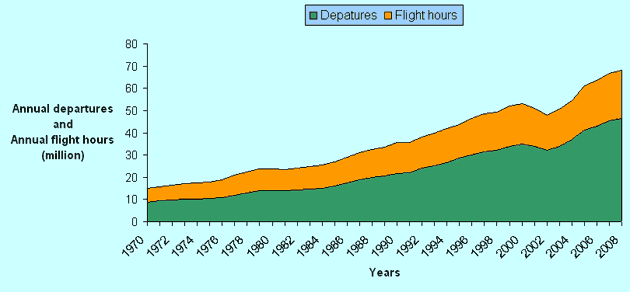
Air traffic increased exponentially between the beginnings of aviation and 2001. After the attack on the World Trade Center, however, many airlines came into financial difficulties and air traffic started to drop. Two years down the line, traffic picked up again.

Air Traffic Growth

Air Traffic Growth

In 2008, airplanes travelled a record 46.3 million flight hours. This is an important to number into remember when interpreting statistics and failure rates. An event may have only a 1 in a million chance of happening, but it will, statistically, occur several times a year.

The following graph shows the total number of certified commercial jet airplanes with a maximum gross weight of over 60,000 pounds. It does not include aircraft manufactured in the former Soviet Union.

Number of aircraft in operation

Number of aircraft in operation

The number or aircraft in operation keeps increasing in a need to meet growing trademand for air travel. Despite congested airspaces, collision risk remains very low due to new technologies that allow for accurate position and altitude measurements, to assist both crews and Air Traffic Controllers to prevent collisions. For example, in order to accommodate all traffic over some oceans, specific airspaces where aircraft are separated vertically by only 1000 ft were created.

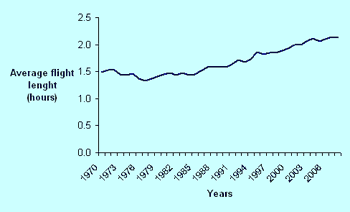
Average Flight Time

Average Flight Time

The graph above shows that the average flight time has also increased with from 1970 to 2008. Modern aircraft can perform 22-hour non-stop flights and fly halfway round the world without landing. These very long-haul aircraft are becoming ever more common and statistically have lower incident rates.

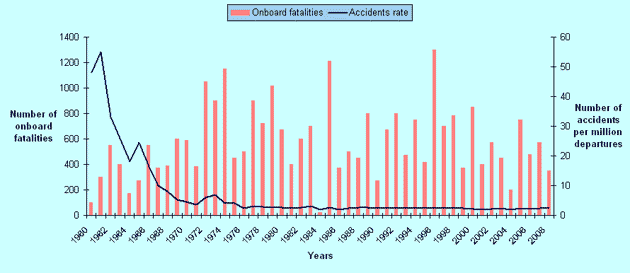
2. Drop in aircraft accident rates
Although the number of accidents per flight has been decreasing with time, the number of fatalities per year has been variable, without a corresponding reduction. in number.

Accidents and Fatalities

Accidents and Fatalities

Aircraft accidents are less likely to occur today than in previous years. Nevertheless, the growing number of aircraft in operation and their increasing capacity means a reduction of onboard fatalities cannot occur.

1959-2008

1999-2008

Number of accidents

1 630

370

Number of onboard fatalities

27 877

4 717

Number of external fatalities (*)

1 171

253

(*)External fatalities include on-ground fatalities as well as fatalities on other aircraft involved.

3. Scheduled passenger flights are less likely to be involved in accidents than other types of flights
Statistically, you are less likely to be involved in an accident when flying a regular scheduled flight than when taking other types of flights (unscheduled passenger flights, charter flights, cargo flights, and all other types of flights). That conclusion is reflected in the following graph:

Scheduled passenger operations and other kind of operations

Scheduled passenger operations and other kind of operations

The above graph also shows that scheduled passenger operations are 5 to 6 times more common than other types of operations.

4. When do accidents occur?
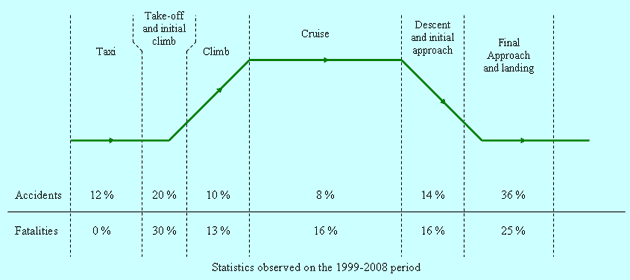
Between the time a passenger boards an airplane and the time they disembark, there are 6 distinct phases:

  • Taxi: the aircraft taxis to reach the runway, or it taxis to the gate after landing.
  • Take off and initial climb: the aircraft accelerates, lifts off and starts climbing.
  • Climb-out: the pilot retracts the slats/flaps, and the aircraft climbs until it reaches cruise altitude.
  • Cruise: the aircraft flies at a more or less constant altitude. This is generally the longest phase of the flight.
  • Descent and initial approach: the aircraft descends for approach to its destination airport. Air traffic control may request the aircraft to hold while earlier arrivals are cleared for landing.
  • Final approach and landing: the aircraft, in landing configuration and aligned with the runway axis, approaches the runway threshold, then lands and slows down.
When do accidents occur?

When do accidents occur?

Over half of all accidents occur during the final approach and landing stages. These aren’t the most devastating accidents, however. A runway overrun may result in only a few injuries, for example.

Fatal accidents are more likely to occur during the climbing stage. If the aircraft leaves the gate with undetected mechanical faults, these may affect the aircraft during the climb, and could prove dangerous. All aircraft systems are under the greatest load during take-off and climb-out. If the crew believe a failure requires the aircraft to land as soon as possible, they will decide to perform an IFTB (In-Flight Turn Back).  This maneuver could prove difficult to execute however, as the aircraft may have already be operationally compromised with failed or reduced control sytems.

Most accidents and fatalities take place during the departure (take off / climb) and arrival (approach/ landing) stages. During these phases aircraft are closer to the ground and in a more vulnerable configuration than during other flight phases: the crew have to deal with a high workload and reduced margins for error.

5. Root causes of accidents
It is quite rare for an accident to be explained by one single cause. Almost every incident is the consequence of a chain of events and accident reports usually identify the main cause and a number of other contributing factors. The following graph shows the distribution of main causes identified in plane crashes.

Root Causes of Accidents

Root Causes of Accidents

The main root cause is human error. This does not necessarily mean pilot error. In order to try and eliminate this as a source of accidents, crews are remandated to follow a strict training routine. Aircraft failures are mext most common cause, but these are less likely in modern aircraft.

6. Aeronautical terrorism
Airport security measures and increased vigilance can protect from aeronautical terrorism (bombing and hijacking). It is without a doubt the safest place in an air journey is in the sterile area in the airport prior to boarding.  Comversely, aircraft are very vulnerable to attacks, because they are defenceless, and because a plane crash is newsworthy highlighting a terrorists cause. Cargo bay containers can be bomb-proof, but not the aircraft itself, as the added weight would make them too heavy to fly.

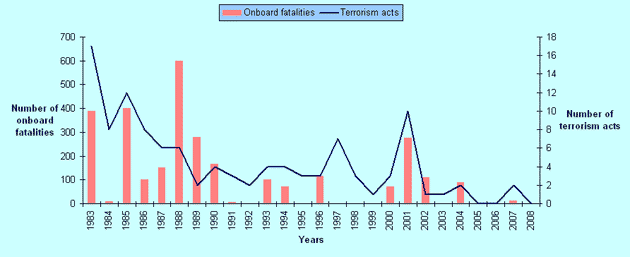
Increased security awareness have seen many measures implemented in a bid to prevent such attacks, with the result that the number of terrorism acts has dropped with time. When it comes to terrorism incidents and fatalities, there can be no trends due to the randomness of these actions. New and larger aircraft carrying a lot of people may become targets of choice for terrorists, which can lead to extremely deadly attacks.

Terrorism in Aviation

Terrorism in Aviation

7. Conclusion
Air travel safety is a data-driven activity. The number of aircraft in operation is constantly on the rise but accident rates continue to fall, making air transport the safest of all means of transportation.

The increase in flight length also contributes to the drop in the number of plane crashes. As accidents are more likely to occur during the take-off and landing phases, a long-haul aircraft which perform only one or two long cycles a day are less likely to be involved in an accident than a short-range aircraft which may perform ten short cycles a day.

The introduction of regulations and checks by authorities and the growing experience of aircraft manufacturers, and increased technology and safety systems all contribute to the improvement in the safety of air transport.

As the number of aircraft now operating continues to grow, even though the rate of accidents per flight may drop, the actual number of accidents will increase. Since aircraft carry an ever increasing number of people, the number of onboard fatalities will also rise.

Disclaimer:
This post doees not include data from aircraft from the former Soviet Union or airlines from countries from former Soviet republics. These aircraft and airlines are statistically more likey to be involved in an aircraft incident.

As of 10/07/2013, airlines from Kazakhstan, Kyrgyz Republic and 287 other carriers world-wide are banned from flight within the European Union for failure to meet accepted safety standards.

MH 370 – What has Happened?

Posted by George Brown on 10/03/2014
Posted in: Aviation, News, Opinion, Safety. Tagged: 9M-MRO, Beijing, Kuala Lumpur, Malaysia Airlines MH-370, MH-370. 4 Comments

The final outcome of what has happened to Malaysia Airlines Flight MH-370 will not be revealed until the aircraft is actually found and the CVR and FDR located and the data read. Meticulous salvage and rebuilding of the aircraft will also assist is determining the cause of the incident.

Flight MH-370, a Boeing 777-200ER – 9M-MRO (cn28420/404) which first flew on 14/05/2002, disappeared off radar at 02:40 on the 8/03/2014 90Nm north-east of Kota Bharu at position 6 55.15N 103 34.43E after leaving Kuala Lumpur International Airport (WMKK) at 12:43 MYT. Malaysian authorities have confirmed that no signs of any wreckage have been found so far, despite numerous rumours that the Boeing B777-200 aircraft had crashed off the coast of southern Vietnam.

Location of the Aircraft
The tracking website FlightAware (http://www.flightaware.com) reports loss of contact with the aircraft near Kota Bharu.  This is a curious situation as 9M-MRO departed WMKK at 12:43,  and disappeared at 02:40 while cruising at 35,000ft. Travelling at 428 nmph the location of the aircraft 2 hours later should have placed it nearly 860 nautical miles from Kuala Lumpur. This would locate the aircraft in the vicinity of Vung Tau in Vietnam. Reports however suggest that 9M-MRO never entered Vietnamese ATC controlled airspace. Radar data suggests a steep and sudden descent of the aircraft, during which the track of the aircraft changed from 024 degrees to 333 degrees.

9M-MRO

9M-MRO – Flight tracking

The aircraft would have run out of fuel by now, and there is no report of a landing of this Boeing 777 on any airport in the area. Search and rescue teams from Malaysia, Singapore and Vietnam are trying to locate the aircraft.

So what would cause a safe aircraft flying straight and level at 35,000 feet to diasppear from radar, without allowing the pilot to alert authorities to their situation?  There are only four scenarios that come to mind.

Catastrophic decompression
The crash of JAL Flight 123 in August, 1985 in Japan was caused by the failure of the aft pressure bulkhead which resulted in the explosive decompression of the aircraft resulting in a crash 34 minutes later.

United Airlines Flight 811 experienced a cargo door failure in flight on Friday, February 24, 1989, after its stopover at Honolulu International Airport, Hawaii. The resulting decompression blew out several rows of seats, resulting in the deaths of 9 passengers.  This aircraft did land safely after returning to Honolulu.

A loss of pressurisation could put the crew and passengers to sleep, as happened with a Learjet, which crashed in October 1999 in South Dakota after the six occupants became incapacitated. However, a loss of pressurisation would cause alarms to sound in the cockpit and allow flight crew to take corrective action. Furthermore, a pressurisation loss would not cause the aircraft to crash immediately.  Theoretically, the aircraft could continue on autopilot, following a programmed route, until the fuel ran out before crashing.  This did not happen.

To suggest this, or something like this, is the cause of the demise of MH-370 is highly speculative at this point and the actual cause will not be confirmed until the aircraft is found.

Mechanical failure
Since its introduction in 1995, there are 1,544 Boeing 777-200s in service, with the ER version introduced in 1997.  It is a remarkably safe aircraft with little history of incidents. Wikipedia reveals that as of March 2014, the 777 has been in only 10 aviation accidents and incidents, which include three confirmed hull-loss accidents. Before 2013, the only fatality involving the B772 occurred in a refueling fire during which a ground worker sustained fatal burns. The aircraft, operated by British Airways, suffered fire damage to the lower wing panels and engine housing and it was later repaired and returned to service.

In an “airfield incursion” at the Shanghai Pudong airport in September 2012, the MAS plane with the registration 9M-MRO collided with a China Eastern Airlines’ Airbus A340-600, registration B-6050, according to the French Office of Investigations and Analysis for the Safety of Civil Aviation (BEA). An “airfield incursion” is the aviation term used to describe an unauthorized aircraft, vehicle or person on the airfield, which can affect runway safety.

The type’s first hull-loss occurred on January 17, 2008, when British Airways Flight 38, a 777-200ER with Rolls-Royce Trent 895 engines flying from Beijing to London, crash-landed approximately 1,000 feet (300 m) short of Heathrow Airport’s runway 27L and slid onto the runway’s threshold. There were 47 injuries and no fatalities. The impact damaged the landing gear, wing roots and engines. The aircraft was written off. Upon investigation, the accident was blamed on ice crystals from the fuel system clogging the fuel-oil heat exchanger. In 2009, air accident investigators called for a redesign of this component on the Trent 800 series engine. Redesigned fuel oil heat exchangers were installed in British Airways’ 777s by October 2009

The type’s second hull-loss occurred on July 29, 2011, when an an EgyptAir 777-200ER, SU-GBP suffered a cockpit fire while parked at the gate at Cairo International Airport. The plane was successfully evacuated without injuries, and airport fire teams extinguished the fire. The aircraft sustained structural, heat and smoke damage. This aircraft was also written off. Investigators focused on a possible electrical fault with a supply hose in the cockpit crew oxygen system

The type’s third hull loss and first involving fatalities occurred on July 6, 2013, when Asiana Airlines Flight 214, 777-200ER HL7742, crashed while landing at San Francisco International Airport after touching down short of the runway. Surviving passengers and crew evacuated before fire destroyed the aircraft. The crash led to the death of three of the 307 people on board. These were the first fatalities in a crash involving a 777.  An accident investigation by the NTSB is underway with its initial focus on the aircraft’s low landing speed.

Given the safety record of this aircraft and being involved in so few accidents and incidents, it would seem that mechanical failure is an unlikely cause of this incident.  Given that the flight crew had no time to send a distress call or “mayday”, it seems likely that whatever ocurred inflight did so with rapid, unrecoverable results.
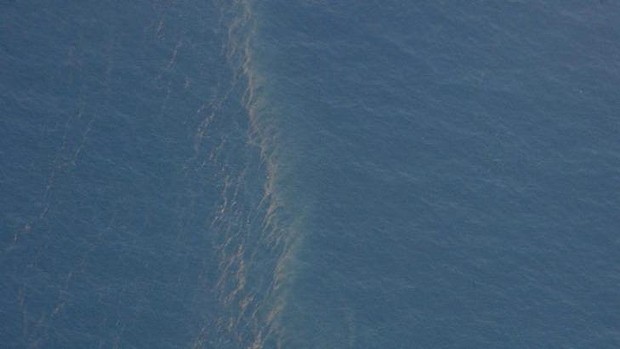
Oil slick

Oil Slick near Tho Chu Island, Vietnam

Pilot Error
The flight crew have between them 21,130 hours flying time and were long time employees of Malaysia Airlines.  The captain, Zaharie Ahmad Shah, is a 53-year-old with 18,365 flying hours experience who joined Malaysian Airlines in 1981. The first officer, Fariq Bin Ab Hamid, is a 27-year-old with 2,763 flying hours, and he has been an employee of Malaysia Airlines since 2007.

In 2009, a Airbus A330-203 flying in straight and level flight unexpectedly crashed into the Atlantic Ocean. The final report stated that the aircraft crashed after temporary inconsistencies between the airspeed measurements which were likely due to the aircraft’s pitot tubes being obstructed by ice crystals. This then caused the autopilot to disconnect, after which the crew reacted incorrectly and ultimately led the aircraft to an aerodynamic stall from which they did not recover.  The Air France Airbus A-330 Flight 447, signaled flight errors to the manufacturer’s headquarters in France. The equipment reported problems with height and airspeed as they were happening in a storm, in fact dozens of warnings in the flight’s final minutes which helped locate where it went down.

This example is by no means suggested as the cause of this incident, but included rather to illustrate that incidents can occur in straight and level flight with fatal outcomes if pilots fail to carry out the correct recovery procedures.

9M-MRO was being flown by a senior and respected flight crew, and nothing written here should be contrued as suggesting that pilot error occurred in this flight, rather than to indicate that pilot error can be a cause of air crashes.

Terrorism
Terrorist activities can result in a rapid and catastrophic loss of airframe. An example is the loss of Pan Am Flight 103 over Scotland in 1988, when an onboard bomb detonated and destroyed the aircraft.

In the case of Flight MH-370, and number of anomolies have occurred with the bonafides of the passengers.  Officials are currently investigating the possibility of terrorism. Four passengers are confirmed to have been flying with false IDs. Two of these passengers are suspected to have boarded the aircraft using Austrian and Italian passports stolen in Thailand, and Malaysian authorities are also checking the identity of the two other passengers. This may be unrelated to the the aircraft loss, but rather a visa avoidance strategy to enter China. US officials said they were checking into passenger manifests and going back through intelligence. The FBI has sent a number of technical experts to Malaysia to assist with the investigation of the disappearance of the aircraft.

Summary
When considering the possible causes of this Malaysian aircraft loss, I had considered that the most likely cause was explosive, catastrophic loss of hull integrity. Aircraft do not just disappear with a trace, with no distress calls from the flight deck as MH-370 has done.

The relative good safety record of this aircraft and it’s senior and experienced flight crew leads me to believe that mechanical failure and pilot error are unlikely.

I had considered that terrorism, while possible, was unlikely, but considering the lack of a distress call suggested the plane either suffered an explosive decompression or was destroyed by an explosive device has led me to reconsider this possibility.

Of course, this is all speculative.  Only the location and recovery of the aircraft and subsequent investigation by authorities will determine the actual cause of the incident. Time will tell.

My thoughts and prayers are with those who have lost loved ones in this incident.

Ladles and Jellyspoons

Posted by George Brown on 09/03/2014
Posted in: Humour, Uncategorized. Tagged: Ladles and Jellyspooons; nonsense rhymes. Leave a comment

I learnt this nonsense rhyme when I was in primary school, and for no known reason it came back into memory recently. I’d like to share it with you:

Ladles and Jellyspoons,
I come before you, to stand behind you,
To tell you something I know nothing about.
Next Thursday, which is Good Friday,
There will be a mothers’ meeting for fathers only.
Wear your best clothes, if you haven’t any,
And if you can come, please stay at home,
Admission is free, pay at the door,
Take a seat and sit on the floor.
It makes no difference where you sit,
The man in the gallery is certain to spit.
I thank you for your unkind attention,
and now present the next act:
The Four Corners of the Round Table.
Early one morning in the middle of the night
two dead boys got up for a fight.
Back to back they faced each other,
drew their swords and shot each other.
A deaf policeman heard the noise
and came and shot the two dead boys.
If you don’t believe this lie that’s true,
ask the blind man; he saw it too!

Missing Malaysia Airlines Flight MH370 crashed in the South China Sea: Official

Posted by George Brown on 08/03/2014
Posted in: Aviation, Emergency Services, News, Safety. Tagged: 9M-MRO, B777-200, Malaysia Airlines. Leave a comment
9M-MRO

9M-MRO – the B777-200 aircraft involved in the crash

A Malaysia Airlines flight carrying 227 passengers — including six Australians — and 12 crew crashed in the South China Sea on Saturday, Vietnamese state media said, quoting a senior naval official. The Boeing 777-200ER had been on a flight from Kuala Lumpur to Beijing and had been missing for hours when Vietnam’s Tuoi Tre news quoted Admiral Ngo Van Phat as saying he had asked boats from an island off south Vietnam to rush to the crash site.

If the report is confirmed, it would mark the U.S.-built airliner’s deadliest crash since entering service 19 years ago.

Malaysia Airlines had yet to confirm that the aircraft had crashed. It said earlier in the day that no distress signal had been given and cited early speculation that the plane may have landed in Nanming in southern China. Flight MH370, operating a Boeing 777-200ER aircraft, last had contact with air traffic controllers 120 nautical miles off the east coast of the Malaysian town of Kota Bharu, Malaysia Airlines chief executive Ahmad Jauhari Yahya said in a statement read to a news conference in Kuala Lumpur.

Malaysia and Vietnam were conducting a joint search and rescue, he said but gave no details. China has also sent two maritime rescue ships to the South China Sea to help in any rescue, state television said on one of its microblogs. “We are extremely worried,” Chinese Foreign Minister Wang Yi told reporters in Beijing before the Vietnamese report that the plane had crashed. “The news is very disturbing. We hope everyone on the plane is safe.”

The flight left Kuala Lumpur at 12.21 a.m. local time Saturday. CEO Ahmad Jauhari Yahya said at a news conference that Flight MH370 lost contact with Malaysian air traffic control at 2:40 a.m. The plane, which carried passengers mostly from China but also from other Asian countries, Canada and Europe, had been expected to land in Beijing at 6:30 a.m. Saturday.

“We deeply regret that we have lost all contacts with flight MH370,” Jauhari said.

Malaysia Airlines said people from 14 nationalities were among the 227 passengers, including at least 152 Chinese, 38 Malaysians, 12 Indonesians, six Australians and three Americans. It also said a Chinese infant and an American infant were on board.

If it is confirmed that the plane has crashed, the loss would mark the second fatal accident involving a Boeing 777 in less than a year and by far the worst since the jet entered service in 1995. An Asiana Airlines Boeing 777-200ER crash-landed in San Francisco in July 2013, killing three passengers and injuring more than 180.

Boeing said it was aware of reports that the Malaysia Airlines plane was missing and was monitoring the situation but had no further comment. The flight was operating as a China Southern Airlines codeshare. An official at the Civil Aviation Authority of Vietnam (CAAV) said the plane had failed to check in as scheduled at 1721 GMT while it was flying over the sea between Malaysia and Ho Chi Minh city. Pham Hien, a Vietnamese search and rescue official, said the last signal detected from the plane was 120 nautical miles (225 kilometers) southwest of Vietnam’s southernmost Ca Mau province, which is close to where the South China Sea meets the Gulf of Thailand. Lai Xuan Thanh, director of Vietnam’s civil aviation authority, said air traffic officials in the country never made contact with the plane. The plane “lost all contact and radar signal one minute before it entered Vietnam’s air traffic control,” Lt. Gen. Vo Van Tuan, deputy chief of staff of the Vietnamese army, said in a statement issued by the government.

The South China Sea is a tense region with competing territorial claims that have led to several low-level conflicts, particularly between China and the Philippines. That antipathy briefly faded as nations of the region rushed to aid in the search, with China dispatching two maritime rescue ships and the Philippines deploying three air force planes and three navy patrol ships to help. “In times of emergencies like this, we have to show unity of efforts that transcends boundaries and issues,” said Lt. Gen. Roy Deveraturda, commander of the Philippine military’s Western Command.

The Malaysian Airlines plane was carrying 227 passengers, including two infants, and 12 crew members, the airline said. It said there were 153 passengers from China, 38 from Malaysia, seven each from Indonesia and Australia, five from India, four from the U.S. and others from Indonesia, France, New Zealand, Canada, Ukraine, Russia, Italy, Taiwan, the Netherlands and Austria.

At Beijing’s airport, authorities posted a notice asking relatives and friends of passengers to gather to a hotel about 15 kilometers from the airport to wait for further information, and provided a shuttle bus service. A woman wept aboard the shuttle bus while saying on a mobile phone, “They want us to go to the hotel. It cannot be good!”

In Kuala Lumpur, family members gathered at the airport but were kept away from reporters.

“Our team is currently calling the next-of-kin of passengers and crew. Focus of the airline is to work with the emergency responders and authorities and mobilize its full support,” Yahya, the airline CEO, said in a statement. “Our thoughts and prayers are with all affected passengers and crew and their family members.”

Fuad Sharuji, Malaysian Airlines’ vice president of operations control, told CNN that the plane was flying at an altitude of 35,000 feet (10,670 meters) and that the pilots had reported no problem. Finding planes that disappear over the ocean can be very difficult. Airliner “black boxes” – the flight data and cockpit voice recorders – are equipped with “pingers” that emit ultrasonic signals that can be detected underwater. Under good conditions, the signals can be detected from several hundred miles away, said John Goglia, a former member of the U.S. National Transportation Safety Board. If the boxes are trapped inside the wreckage, the sound may not travel as far, he said. If the boxes are at the bottom of a deep in an underwater trench, that also hinders how far the sound can travel. The signals also weaken over time.

Air France Flight 447, with 228 people on board, disappeared over the Atlantic Ocean en route from Rio de Janiero to Paris on June 1, 2009. Some wreckage and bodies were recovered over the next two weeks, but it took nearly two years for the main wreckage of the Airbus 330 and its black boxes to be located and recovered.

Malaysia Airlines said the 53-year-old pilot of Flight MH370, Zaharie Ahmad Shah, has more than 18,000 flying hours and has been flying for the airline since 1981. The first officer, 27-year-old Fariq Hamid, has about 2,800 hours of experience and has flown for the airline since 2007.

The tip of the wing of the same Malaysian Airlines Boeing 777-200 broke off Aug. 9, 2012, as it was taxiing at Pudong International Airport outside Shanghai. The wingtip collided with the tail of a China Eastern Airlines A340 plane. No one was injured.

Malaysia Airlines’ last fatal incident was in 1995, when one its planes crashed near the Malaysian city of Tawau, killing 34 people. The deadliest crash in its history occurred in 1977, when a domestic Malaysian flight crashed after being hijacked, killing 100. In August 2005, a Malaysian Airlines 777 flying from Perth, Australia, to Kuala Lumpur suddenly shot up 3,000 feet before the pilot disengaged the autopilot and landed safely. The plane’s software had incorrectly measured speed and acceleration, and the software was quickly updated on planes around the world. Malaysia Airlines has 15 Boeing 777-200s in its fleet of about 100 planes. The state-owned carrier last month reported its fourth straight quarterly loss and warned of tougher times.

The 777 had not had a fatal crash in its 19-year history until an Asiana Airlines plane crashed in San Francisco in July 2013. All 16 crew members survived, but three of the 291 passengers, all teenage girls from China, were killed.

QANTAS Debate: Cheese-Eating Surrender Monkeys of Australian Jobs

Posted by George Brown on 06/03/2014
Posted in: Aviation, Finance, News, Politics, Safety, Travel, Views. Tagged: Alan Joyce, Bill Shorten, foreign ownership, QANTAS, Tony Abbott. Leave a comment


The Coalition’s partial repeal of the QANTAS Sale Act has passed the Australian parliament’s lower house, as the Senate launched a public inquiry into the airline’s finances. MPs voted 83-53 to support the government’s bill, with independent Victorian MP Cathy McGowan siding with the Coalition. At the same time, the Senate with a Labour/Greens majority will vote down the bill, launched an inquiry into QANTAS’ finances and what measures could be used to support the company, including renationalising it or guaranteeing its debts.

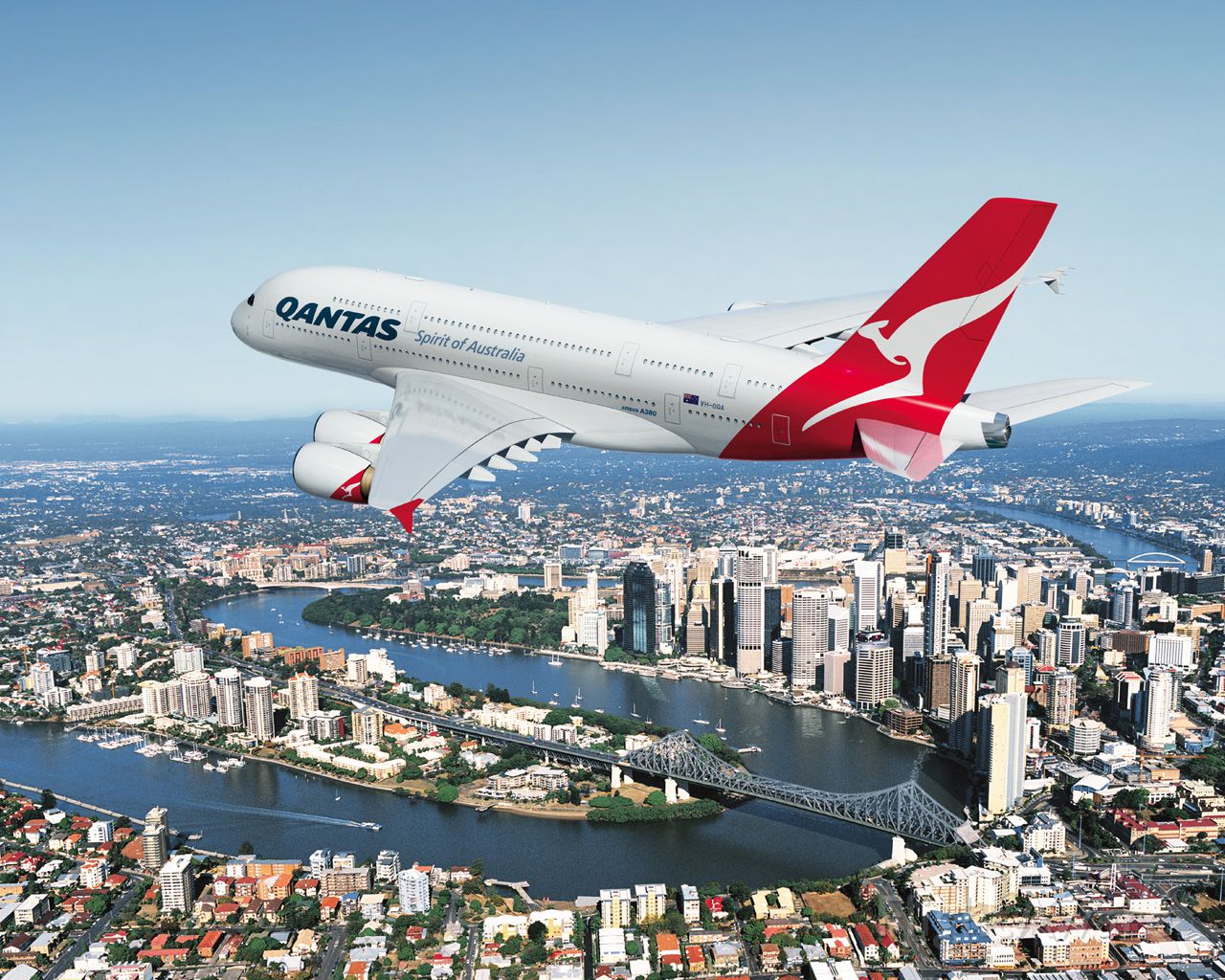
VH-OQA

The debate came after Joe Hockey denied pressuring QANTAS to reverse an earlier position on the carbon tax during a phone call with chief executive Alan Joyce yesterday. Greens senator Lee Rhiannon said she wanted Mr Joyce called to give evidence to the new inquiry and for Qantas’s books to be opened up to examination. “Clearly something has gone wrong with QANTAS — it is vital that we use the Senate inquiry to understand what has happened,” Senator Rhiannon said.

In the House of Representatives, Bill Shorten labelled the Coalition a bunch of “cheese-eating surrender monkeys”, a derogatory term for the French. “It’s taken 94 years to build QANTAS; it’s taken the Abbott government 94 minutes to tear QANTAS down. “Shame,” the Opposition Leader said after the vote.

The government’s bill would open the door for a structural separation of QANTAS’ domestic and international arms, repealing the 49 per cent cap on foreign investment in QANTAS and removing the barrier to foreign airlines buying more than 35 per cent of the company. Deputy Prime Minister Warren Truss told parliament QANTAS’ foreign ownership limits were “regulatory handcuffs” that must be removed if QANTAS is to remain in Australia and “grow”.

“Good government is not about playing favourites or being a banker for major companies when times are tough,” Mr Truss said. In my opinion, good business is not having to come to government expecting bail-outs or debt guarantees. Good business is making a profit while working under the regulatory framework in place at any time.

Mr Shorten said even if the bill passed the Senate, it would take years for QANTAS to overcome new regulatory processes that would allow it to raise sufficient foreign capital. In real terms, the bill has little to no chance of passing the senate.

Tasmanian MP Andrew Wilkie voted with the Labor Party, while Clive Palmer and Greens deputy leader Adam Bandt were not present for the vote. Again on an issue as important as this, key parliamentarians are absent from the house.

Later, in question time, the government attacked Labor for suggesting Qantas’s world-famous safety record could be compromised if maintenance jobs were sent offshore. Mr Abbott described the suggestion as “irresponsible’’ and “reckless’’. “The leader of the opposition is trying to suggest that without the restrictions that exist under the Qantas Sale Act an airline can’t be safe,’’ he said.

Independent Bob Katter also questioned the impact on safety of overseas maintenance. “Surely, this must be one whose maintenance is based in Australia, not one whose market advantage comes from a cut-rate cheap jack overseas-based workforce?,’’ he asked Industry Minister Ian Macfarlane. The minister said QANTAS wasn’t the only airline to have a safe flying record. There are other airlines flying in Australia dont necessarily have their maintenance carried out in Australia. Does that make those airlines less safe?.

The Treasurer earlier revealed he yesterday spoke with Mr Joyce about the company’s apparent change of mind on the impact of the carbon tax on the airline’s profitability. QANTAS yesterday released a statement saying the carbon tax was “among the significant challenges” faced by the airline, apparently contradicting its earlier position that its “current issues are not related to carbon pricing”. Then Mr Joyce dramatically reversed his rhetoric on the company’s wellbeing, saying the airline was “extremely healthy”, just four months after warning of its possible demise.  QANTAS yesterday said it had not been able to recover the carbon cost by increasing fares because of intense competition, while revealing it had cost $59 million in the past six months on top of $106m last financial year. “It is absolutely one of the factors that’s impacting the airline,” Mr Joyce said.

QANTAS is more than just an airline. It is an Australian airline, an Australian icon, with firm place in the Australian psyche. The “Flying Kangaroo” is a logo of special significance to all Australians. It has been stated that boarding a QANTAS aircraft is like “getting home before being at home”. Mr Joyce being Irish, has failed to realise this. He sees QANTAS in terms of aircraft, infrastructure and staff.  As I said before on this web site, Australian business does not support CEOs who lose money and whose comapnies do not turn a profit. They sack them, usually with outrageous severance packages. I believe the axe is about to fall on Mr Joyce, probably sooner than later.

Is this legislation likely to be passed into law? I suspect not. Will QANTAS be allowed to to become more efficient? I believe it must, if it is going to remain a competitive world airline. A compromise position must be found.

In 2013 QANTAS for the first time has secured a place (8th) in the top ten world airlines in terms of service, value for money etc. All efforts must be used to make the airline competitive.

Source: The Australian (as edited)

An Alternative View of the Crimea Crisis

Posted by George Brown on 06/03/2014
Posted in: Defence, History, Legal, Military, News, Politics. Tagged: Crimea, Kiev, Moscow, Ukraine, Vladimir Putin. Leave a comment

While looking through news stories on the crsis in the Crimea, I can came accross this alternate and completely sensible and balanced view on the crisis:

Defiant: Russian President Vladimir Putin.

Contraversial though it is to say so, Russia’s military incursion into Ukraine’s Crimean peninsula does not represent a second Cold War. Instead, it is a rational reaction of a great power into the affairs of an unruly state in its own neighbourhood.

That may sound insensitive, but hyperventilating pundits and politicians ignore an old truth about international relations: great powers are determined to protect what they deem as vital interests in their ”near abroad.” Indeed, a sphere of influence is a key characteristic of any great power, authoritarian or democratic.

Many Americans, guided by a sense of exceptionalism, think they are immune to the historic tendencies of power politics. But when liberals and neo-conservatives slam Russia’s behaviour, they should recall the many US military interventions in the Caribbean and Central America since the Monroe Doctrine in the 19th century. The US sees itself as the global policeman and often exercises that belief.  None of this is extraordinary; it is the way the world works, always has and always will.

Since the end of the Cold War, however, a new orthodoxy has emerged: a belief that power politics no longer works in an era of globalisation. We had arrived at the End of Days: the universalisation of market democracy, the triumph of national self-determination and perpetual peace.

That is why President Obama insists that Russia is ”on the wrong side of history.” But one can agree Vladimir Putin is a thug, you have often heard me refer to him as the “former KGB polkovnik“, and still believe he merely wants to restore Russia’s traditional zone of protection on its borders. After all, he presides over a great power still humiliated by the collapse of the Soviet Union and deeply resentful of the prospect of US missiles in its backyard.

For Moscow, there has long been a geopolitical interest in Ukraine, even under the Tsars. Remember the Crimean War of 1853-56? More recently, Ukraine is a conduit for gas exports to Western markets. Russia’s naval base in Sevastopol hosts the Black Sea fleet. And ethnic Russians comprise nearly 60 per cent of Crimea’s citizens.

Meanwhile, a democratically elected, pro-Russian government has been overthrown. And a Western-backed interim government with no democratic legitimacy includes hard-line nationalists with links to terrorists.

Of course, Putin may overreach by toppling other former Soviet satellites. But if he is as calculating as many Russian experts suggest, he is likely to encourage Kiev to allow the de facto partition of areas largely populated by ethnic Russians – from the Crimea in the south to the industrial heartland in the east.

For the West to ignore Russian susceptibilities and to impose sanctions on and isolate Moscow would, as Putin warns, backfire. It could whet the appetite of hard-line Ukrainian nationalists, including anti-Semites. It could also provoke more chauvinistic elements in Russia to exploit wounded national pride in ways that could be dangerous. We are dealing with a regime whose nuclear arsenal poses a threat to the US and NATO allies.

At a time when Americans are suffering from foreign policy fatigue, and the Europeans have no stomach for a stoush, it would not seem prudent to pick a fight with Russia over a region where no US army has ever even fought before, and is of little political interest to the US. Even those cold warriors, Dwight Eisenhower and Lyndon Johnson, backed away from confrontation with the Soviets when it meddled in Hungary and Czechoslovakia in 1956 and 1968. And when Communists crushed Polish Solidarity in an Ukraine-like emergency in 1981, it was (of all people) Ronald Reagan who showed restraint and caution.

Why then would Barack Obama isolate resource-rich Russia nearly a quarter a century after the fall of the Berlin Wall? And why should Putin believe the West’s warnings are any more than a bluff, something done in the hope that the warning itself would be a deterrent with  no intention of honouring it?

Source: Tom Switzer, research associate at the University of Sydney’s United States Studies Centre.

Welcome to Western Australia

Posted by George Brown on 06/03/2014
Posted in: Opinion, Politics, Views. Tagged: Senator Ludlum, Tony Abbott, WA Greens. 5 Comments

Over the years I have been a follower of the the ALP (Australian Labor Party) and their politics.  Imagine my joy when Gough Whitlam and the ALP was elected to Federal Pariament in 1972, after more than 40 years of Liberal-Country Party Coalition rule.

But they never quite got it right!  Subsequent Labor governments also failed to recognise the errors of their predecessors, and to correct them. This culminated in the Rudd-Gillard debacle, where leadership challenges (or talk of them) took centre stage, and all other policy whitered on the vine.  “Enough”, I said.  I can no longer follow this shambolic rabble that squander every opportunity given to govern.

As I could never follow the Liberal-National Party, as their policies are totally abhorent to my way of thinking, I have have moved my allegiance toward the Australian Greens. This has occurred mostly because of their position on flora/fauna, mining, the environment, fishing limits and their social policies.

But don’t get me wrong.  I have a low opinion of ALL politicians, of any persuasion or colour, whose only and most pressing duty, other than to seek as many paliamentary lurks and perks (legal or otherwise), is to seek re-election every three years.

So when I came across this video on YouTube where WA Greens Senator Ludlum was sticking it to Australian Prime Minister Tony Abbott, I knew I had to give it some air.

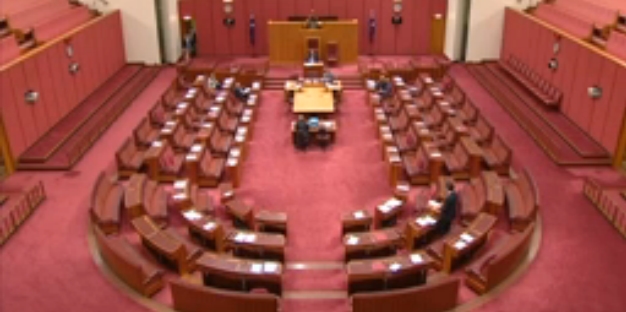
Also, you might note the empty Senate Chamber. No wonder government in Australia is of such a poor standard. There’s nobody at the helm!

Senate

That is Senator Ludlum on his feet in the bottom right of the picture, addressing only 3 other members of a 76 seat Senate!

QANTAS – Still Call Australia Home?

Posted by George Brown on 06/03/2014
Posted in: Aviation, Finance, Media, News, Opinion, Tourism, Travel, Workplace. Tagged: Alan Joyce, job losses, overseas ownership, QANTAS. Leave a comment

20140306-005629.jpg

The Australian Coalition Government strategy of providing assistance to QANTAS is reminiscent of the American strategy during the Vietnam War. Who can forget the chilling phrase from that era, ”Before we save the village , we have to destroy it”?

As a management strategy, that doesn’t have much going for it.

Views
Anthony Inatey, Bathurst
Sounds like QANTAS will go the way of Vegemite. It will be Australian only in name. No doubt they’ll have the nerve though to ”still call Australia home”.

Geoff Gordon, Cronulla
If QANTAS is sold will Messrs Joyce and Clifford be an inclusion? Ed. – But then Joyce is Irish, isn’t he?

Bill Carpenter, Bowral
Market forces across the global economy will ultimately determine the future shape of QANTAS, not the Australian government nor the unions. QANTAS jobs will be lost overseas with or without the government’s changes to the ownership rules because this country is one of the dearest on the planet for the cost of labour. The unions may claim to rely on QANTAS for their future but research proves the flying public would mostly prefer to rely on cheaper airlines that offer comparable standards.

Phillip Regan, Aberglasslyn
If it is good enough for the federal government to provide a debt guarantee for the banks, why not do the same for the airline industry? Or why not let the banks be swallowed by the big boys overseas?

Mike Powter, Leonay
Tony Abbott reckons Virgin Australia is ”as Australian as QANTAS”. How on earth can that be when Virgin is majority-owned by overseas airlines who, when push comes to shove, will ditch Australia like a hot potato.

Russell Mills, Redfern
When you get on a QANTAS plane overseas and are greeted by cheerful Aussies you breathe a sigh of relief. You are home before you get home. QANTAS is not just another business. It’s who we are, and we are a country which needs a flag-raising carrier to show the world we are a strong nation. We need the planes with kangaroos on the tail.

Jill Power, Manly Vale
While I’m normally angered by politicians doing things appropriately falling to the role of the Governor-General, such as farewelling or welcoming our troops, I can think of no better person than Tony Abbott when it comes to ceremoniously lifting the kangaroo off the tail of the plane the day QANTAS ceases to be Australian.

Michael Creswell, Waterloo
If the Prime Minister wishes to allow greater foreign ownership (which will mean controlling ownership), then why not overlay the kangaroo symbol with some gold stars or plaster a striped background on the tailplane? All national airlines are supported by their various governments, so let us not pretend that it will be a national airline any more. The new owners can remove the present board, remove operations to their own country, and we will be free of yet another piece of bothersome industry.

Donald Hawes, Blayney
If there was more foreign ownership of QANTAS perhaps the fares would be reduced, the service improved and more people would once again want to fly with QANTAS.

Carolyn Wills, Cremorne
I don’t know whether a level playing field can be achieved when you are in the air but I do wonder why the words chief executive Joyce used about the 5000 jobs do not appear to have been accurately reported in print, let alone discussed. What he said on TV was ”the equivalent of 5000 full-time jobs”. Does that mean 10,000 part-time? Get your parachutes on!

Comment:
QANTAS was always at risk of overseas ownership when Alan Joyce was appointed as CEO. Here’s a Irishman who claim to fame was that he has worked for Aer Lingus. From the moment of his appointment to QANTAS, he has slashed jobs, sent maintenance work off-shore all in a glorified and yet vain attempt to make QANTAS more profitable. Has he succeeded? No! Oh sure, he has pulled QANTAS into one of the world’s top ten airlines, and JetStar into one of Asia’s best budget carriers and brokered a deal with Emirates on long haul flights to the UK, but the airline is still haemorrhaging money.

Sadly he has not grasped the concept that to most Australians, QANTAS is more than an airline, it’s an Australian icon, an essential part of the Australian psyche. Russell Mills (above) quite rightly described boarding a QANTAS aircraft as “you are home before you get home”. Mr Joyce has no concept of this.

Also, don’t forget that a QANTAS’ majority shareholder is British Airways, so in a way, QANTAS is already overseas owned. So the Irishman thinks, what’s a little bit more?

There’s only one way to ensure that QANTAS remains Australian, and that for it to have government ownership. But it still has to be profitable. It’s not doing that now, and foreign ownership will not change that.

Lastly, what do Australian companies do with CEOs that don’t perform? Sack them with outrageous severance packages. Goodbye Mr Joyce! You’re not long for QANTAS!

Source: Sydney Morning Herald

Posts navigation

← Older Entries
Newer Entries →
  • Calender

    January 2026
    S M T W T F S
     123
    45678910
    11121314151617
    18192021222324
    25262728293031
    « Nov    
  • Visitors

    • 29,730 hits
  • Enter your email address to follow this blog and receive notifications of new posts by email.

    Join 167 other subscribers
  • Currently Reading

  • My Flickr

    VH-JQG
    More Photos
  • George’s Tweets

    Tweets by georgebrown99
  • Blogs I Follow

    • Ambulance Visibility Blog
    • ryanbreeding's Blog
    • As My Camera Sees It
    • Writings of a Mrs
    • Australian Emergency Law
    • Emerging
    • World Of Alexander The Great
    • Psyche's Circuitry
    • European Scientist
    • Macedonian Orthodox Church Property Trust Bill 2010
    • philosoffer
    • Permalife: an FPS
    • Fortyteen Candles
    • Jeyna Grace
    • About Film
    • onethousandsingledays.wordpress.com/
    • SimplePolitiks
    • retireediary
    • Semper Quaerens
  • This Is Me

    George Brown is a decorated soldier and health professional and 40 year veteran in the field of emergency nursing and paramedical practice, both military and civilian areas. He has senior management positions in the delivery of paramedical services. Opinions expressed in these columns are solely those of the author and should not be construed as being those of any organization to which he may be connected.

    He was born in the UK of Scottish ancestry from Aberdeen and a member of the Clan MacDougall. He is a member of the Macedonian community in Newcastle, and speaks fluent Macedonian. While this may seem a contradiction, it is his wife who is Macedonian, and as a result he embraced the Macedonian language and the Orthodox faith.

    His interests include aviation and digital photography, and he always enjoys the opportunity to combine the two. Navigate to his Flickr site to see recent additions to his photo library.

    Me

    Џорџ Браун е украсени војник и професионално здравствено лице и 40 годишен ветеран во областа на за итни случаи старечки и парамедицински пракса, двете воени и цивилни области. Тој има високи менаџерски позиции во испораката на парамедицински услуги. Мислењата изразени во овие колумни се исклучиво на авторот и не треба да се толкува како оние на било која организација тој може да биде поврзан.

    Тој е роден во Велика Британија на шкотскиот потекло од Абердин и член на Kланот MacDougall. Тој е член на македонската заедница во Њукасл, и зборува течно македонски. Иако ова можеби изгледа контрадикција, тоа е неговата сопруга кој е македонски, и како резултат научил македонскиот јазик и ја примија православната вера.

    Неговите интереси вклучуваат авијација и дигитална фотографија, и тој секогаш ужива во можност да се комбинираат двете. Отиди до неговиот Фликр сајт да видите последните дополнувања на неговата слика библиотека.

  • My Community

    • fatgirleatsout's avatar
    • texaslawstudent's avatar
    • Unknown's avatar
    • Emma's avatar
    • Unknown's avatar
    • Michael Lai's avatar
    • fitrichbitch's avatar
    • kamalathompson's avatar
    • Unknown's avatar
    • five experts's avatar
    • Unknown's avatar
    • Unknown's avatar
    • Andrea Giang | Cooking with a Wallflower's avatar
    • Port Canaveral Transportation's avatar
    • Alex Markovich Art's avatar
    • Unknown's avatar
    • danetigress's avatar
    • honeypotted's avatar
    • throughopenlens's avatar
    • Copiousmorsels's avatar
    • Unknown's avatar
    • Unknown's avatar
    • Unknown's avatar
    • Unknown's avatar
    • Unknown's avatar
    • Erica's avatar
    • Ruben Arribas | Gamintraveler's avatar
    • Lilly's avatar
    • Unknown's avatar
    • legalandimportant's avatar
    • Gem Kalaw's avatar
    • Unknown's avatar
    • Unknown's avatar
    • Unknown's avatar
    • Unknown's avatar
    • Unknown's avatar
    • Unknown's avatar
    • feynman's avatar
    • Unknown's avatar
    • ScienceSwitch's avatar
    • Unknown's avatar
    • MaitoMike's avatar
    • Noah's avatar
    • Unknown's avatar
    • Cristian Mihai's avatar
    • Unknown's avatar
    • Unknown's avatar
    • Unknown's avatar
    • Unknown's avatar
    • Unknown's avatar
Blog at WordPress.com.
Ambulance Visibility Blog

Emergency vehicle visibility and conspicuity research & comments for the Police, Fire, EMS and Ambulance: The AV Blog is written by John Killeen

ryanbreeding's Blog

Smile! You’re at the best WordPress.com site ever

As My Camera Sees It

Focus, Fun, and Creativity

Writings of a Mrs

I write, blog, vlog and poet...I wander, I ponder and I recollect ...DIGITAL NOMAD & PHILOSOPHER

Australian Emergency Law

Discussion on the law that applies to or affects Australia's emergency services and emergency management, by Michael Eburn, PhD, Australian Lawyer. Email: meburn@australianemergencylaw.com

Emerging

The Butterfly counts not months but moments, and has time enough.

World Of Alexander The Great

"Everything is possible to him who will try"

Psyche's Circuitry

Thoughts on growing up and growing old in the digital age

European Scientist

Blog with Journalistic and Historical articles

Macedonian Orthodox Church Property Trust Bill 2010

Macedonian Orthodox communities in Australia

philosoffer

EVERYTHING AND ANYTHING

Permalife: an FPS

a Feminist Phenomenology (or something)

Fortyteen Candles

Oh, let's see...distinguished Gen-X'er, frustrated writer and mom living in the confines of a small town that thinks it's a big deal. And have I mentioned Walmart yet?

Jeyna Grace

A Story Begins

About Film

Film, Life and Culture

onethousandsingledays.wordpress.com/

SimplePolitiks

retireediary

The Diary of a Retiree

Semper Quaerens

Words, By George!
Create a free website or blog at WordPress.com.
Privacy & Cookies: This site uses cookies. By continuing to use this website, you agree to their use.
To find out more, including how to control cookies, see here: Cookie Policy
  • Subscribe Subscribed
    • Words, By George!
    • Join 167 other subscribers
    • Already have a WordPress.com account? Log in now.
    • Words, By George!
    • Subscribe Subscribed
    • Sign up
    • Log in
    • Report this content
    • View site in Reader
    • Manage subscriptions
    • Collapse this bar
 

Loading Comments...