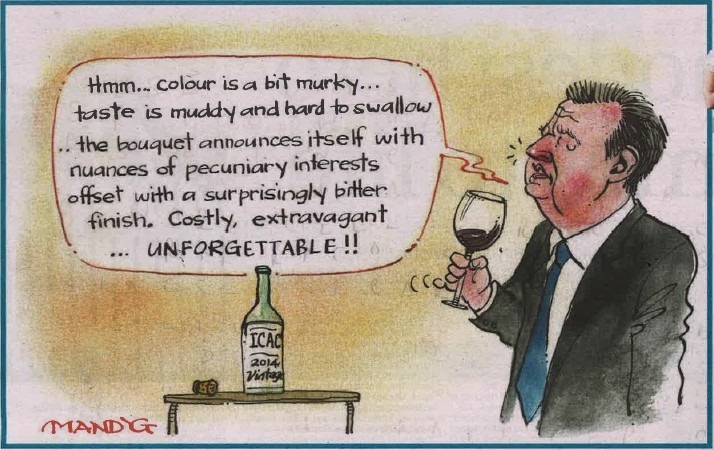
Celebrated vigneron Nick Di Girolamo has excelled himself with this rare and striking Premier Grand Cru.
Selected from old grapes of wrath vines at the Obeid family’s Mt Corruption vineyard in NSW and cellared in Rum Corps oak casks, the wine reveals hidden gifts of subtle complexity. The brown nose offers a concentrated aroma of decaying cattle dung, complexed by persistent spice notes of rotten fish and more than a hint of unsavoury greased palm. An intense palate of bitter fruits displays weak backbone and piss-in-pocket acidity, with a lingering after-palate heightened by a signed “thank you” note of unmistakeable provenance.
Has Prime Minister Abbott and his office been misleading the public about his decision to restore imperial honours, compromising – and also offending – the Queen. Senior correspondent Barry Everingham suggests they have.
Yesterday, Jonathan Swan and Peter Hartcher threw doubt over Prime Minister Tony Abbott’s dealings with the Queen over the knights and dames issue in a piece published in the Sydney Morning Herald.
At the same time they were investigating this topic, I was also independently looking into this same issue and can now provide more information.
In summary, it doesn’t look good for Abbott.
Swan and Hartcher summarised the background as follows:
Tony Abbott announced last week that Quentin Bryce had been made a dame and Peter Cosgrove a knight. But had they really?
The Prime Minister’s surprise statement began: “On my recommendation, Her Majesty the Queen has amended the Letters Patent constituting the Order of Australia.”
Letters Patent are the official instrument, the parchment signed by the Queen’s own hand with her distinctive “Elizabeth R”, that give force to her decisions.
But, mysteriously, although they are public documents published in the Government Gazette, no one has been able to provide evidence that one was signed.
Or show that the Queen had signed the parchment at the time of the Prime Minister’s declaration.
This raises an awkward question. When Mr Abbott publicly pronounced Ms Bryce a dame in time for her official reception on March 25, was she? General Cosgrove started using the title Sir on March 28 after his swearing-in as Governor-General, but again was he officially allowed to claim that title?
The PM seemed to imply by his statement he had conferred directly with the Queen, however when Abbott called the Palace, my sources say he did not speak to the Queen but rather to one of her senior aides.
Abbott allegedly advised the aide that he was “restoring” a “truncated” (his words) part of the Order of Australia.
And, despite Abbott’s announcement, the subject of the Letters Patent was apparently not mentioned at that time but arose later, when the legality of his unilateral decision had time to sink in.
When I contacted the PM’s press office – the most arrogant, secretive and insulting PM’s office I have ever had the misfortune to deal with in my several decades as a journalist – they refused to comment and, indeed, slammed their phone down in my ear.
Hartcher and Swan did manage to speak the PM’s office:
After repeated requests over several days, neither the Prime Minister’s office nor Buckingham Palace would give Fairfax Media the exact date on which the monarch signed the official instrument.
On Wednesday afternoon – after Fairfax Media published this story online – a spokeswoman for the Prime Minister said “the documents” had been signed by the Queen on March 19.
But the Prime Minister’s office continued to refuse to release the signed parchment, saying the Letters Patent, which are public documents, would be published “in due course”.
Government House was unable to shed any light on the mystery. An official said Government House had not seen the Letters Patent or any copy of them.
My enquiries strongly suggest Tony Abbott bypassed the usual channels when he announced he had decided to reinstate imperial titles in the Order of Australia.
The normal accepted practise in such matters is that a joint announcement would come from the PM’s office and the Palace and they would issue a simultaneous release.
This would be followed up by a confirming announcement in the Government Gazette, which it did, but in this case no one seems to know if the Queen signed the necessary papers — and, if she did, when did she sign and where is the original?
When I called Government House, they refused to comment. In my experience, this means they were left totally out of the loop.
I then called the Palace to ask about Abbott’s decision. I received a similar response — though the anger in the royal aide’s voice was palpable.
I asked the Palace whether the titles conferred by Abbott were legal at the time he made his announcement.
I was coldly told that Abbott doesn’t confer titles, the Queen does, so I should ask Mr Abbott whether everything was legal.
Swan and Hartcher’s enquiries suggest it was not legal:
The spokeswoman had earlier said that an “electronic version” had been sent and signed in mid-March and that the signing of the paper version was “under way”.
However, there is no electronic version of Letters Patent, according to people familiar with Palace workings, and only the parchment bearing the monarch’s signature has any force.
An email exchange, in other words, may be no substitute, nor carry any official weight.
According to my sources, when the Prime Minister Tony Abbott grandly announced he was restoring knights and dames on 25 March, nothing was set in stone. In short, he lied about the Letters Patent.
And there is no such thing as an “electronic” Letters Patent — like the honours themselves, the “Letters” are a relic of another day and age.
Abbott has second guessed the Queen, which would be, in the eyes of the Palace, simply unforgiveable.
His office is now spinning desperately to try to get him out of trouble, but this merely illustrates what a mess this impetuous prime minister creates by going it alone — as he so often does.
The damage he has wrought is significant.
Firstly, his arrogance in bypassing Government House in Canberra, which he obviously did, will cause unnecessary frostiness there.
As for his Liberal Party colleagues, some 40 per cent of whom are republicans, most are privately furious he did not consult them about this move.
Despite being an avowed – one may say, obsessed – monarchist, Abbott has caused major ripples in the Queen’s office. It is a brave – indeed insane – prime minister of any country who would try to second guess Queen Elizabeth II; when it does happen, the offending politician is usually soon put back in their box.
And as to whether former Governor-General Quentin Bryce is really now a dame and Peter Cosgrove a knight?
Resigning with Style, or Beware the Shonk bearing Plonk.
Of all the judgment calls political leaders make in their careers, the last one – how to quit – is the one they most regularly bungle.
Most of the time they stay around too long, their brains so encrusted with the scar tissue of blunt political trauma that – like broken-down boxers or creaking footy players – they demand to play on, incorrectly believing they’ve still got it in them.
This happens both in leaders who have genuinely aged (Howard) and those who have aged prematurely (Gillard, Rudd).
But every now and again, someone resigns. Resignations are a science all their own. There are thousands of variables intricately woven into the formula that determine whether a resignation will be a good one or a bad one.
Don’t get me wrong. A “good” resignation is still a career-ender. “Operation a complete success, patient still dead” is the best you can hope for in these circumstances, but legacy is important in politics. If you are young – like Barry O’Farrell – it’s much nicer, when later going about your business as a private citizen, to be slapped on the back by people who thought you went too soon than slapped in the face by people who still can’t forgive you for sticking around.
The first point in the discipline of successful resignation is deciding whether it’s absolutely necessary. The sweet spot you’re looking for here is the point at which it’s very nearly necessary, but not quite. That way, the element of heroic sacrifice is preserved: He resigned, as a matter of honour.
Here again, the elements are famously slippery. Was, for instance, Barry O’Farrell’s resignation necessary? Technically – no, not at all. Of all the public figures who have trooped through Sydney’s Independent Commission Against Corruption in recent months, Mr O’Farrell is firmly and obviously one of the good guys.
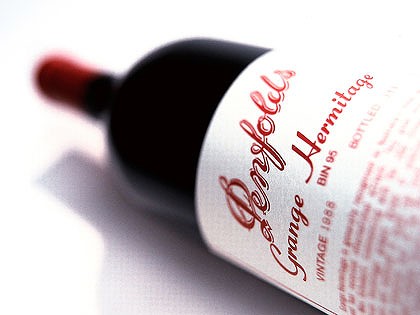
But in this field, the tiniest detail can throw you. A bottle of Grange from your birth year is a horribly memorable gift, and thus twice-cursed; not only is it hard for anyone to believe you can’t remember getting it, but it also makes it harder for anyone to forget that the whole thing happened. It’s as sticky as a Wiggles chorus, and Mr O’Farrell would be in much less trouble had the thoughtful Mr Girolamo just sent him a horrible print worth $3000 instead, or a framed Wallabies jersey, or any one of the other overpriced trinkets that people like Mr Di Girolamo regularly flog off at party fundraisers.
Plus, booze is troublesome; it just is. Whether you drank too much of it and drove into a gate, like former WA treasurer Troy Buswell, or stuck your willy in a glass of it, like the Queensland MP Peter Dowling, or nicked two bottles of the stuff like former Democrats leader Andrew Bartlett, liquor is a leading cause of politicians deciding to spend more time with their families.
Punctuation is important. In the thank-you note – written, damningly, in the Premier’s own corpulent hand – Mr O’Farrell thanks Mr Di Girolamo for “all” his help. To a later reader, that single pen-stroke conjures a multitude of further gifts, the dancing girls and Faberge eggs of the imagination sketched out in the sickeningly rich colours of the ICAC palette. Personally, I think the whole thing was survivable but for the underscore, but I am especially interested in punctuation and thus possibly an unreliable adjudicator.
The most important factor by far, though, in a successful resignation, is timing. You have to do it early; ideally, before anyone has called for it. A voluntary resignation is surprising, affecting and heroic. A resignation offered by a quarry who has been bailed up in their own home for three days by a crowd of angry people carrying torches made of petrol-soaked rags is less of a good look.
By these and most other standards, Mr O’Farrell has had a good resignation.
But that’s the tragedy of the week, too. The very fact that a spectacle like this is so rare and shocking – a public figure deciding not to give himself the benefit of the doubt – is in itself depressing. And the resultant cry for more regulation, a “crackdown” on lobbying and so on, ignores the basic, awful lesson of ICAC, Craig Thomson and all the collected murk of recent years.
Some people won’t take an ounce of responsibility even when caught absolutely bang to rights. Others will resign even when they could probably have got away with sticking around. It’s impossible to legislate for that kind of thing.
In fact, the answer more probably lies in less regulation. Less of the centralised party controls that kept Eddie Obeid and Craig Thomson in Parliament for so long, and nurtured operators like Nick Di Girolamo. More involvement from ordinary people who know a shonk when they see one. Especially if he’s a shonk bearing plonk.
“Abbott !” said the Queen sharply. “Off the sofa, please. Sit there by the fire with Thatcher and Blair.”
The corgi glared balefully at the monarch and gave a sullen little yap, but then waddled over to join the other dogs on the hearth. The Duke of Edinburgh raised his head from his customary breakfast fare of kippers and Horse & Hound magazine.
“Did I hear you call that dog Abbott?” he said. “I thought you named them after your prime ministers.”
“We’ve run out of British PMs, dear. Abbott is the new Australian Prime Minister. Terry Abbott. Or is it Tony? One or the other.”
Philip forked another fishy blob onto the ducal plate.
“Abbott,” he said. ” Abbott…..Abbott…..Abbott? Terry Abbott? Can’t say I’ve ever heard of him.”
The Queen gave a light sigh.
“Of course you have, Philip,” she said. ” We had him to lunch at Windsor last year. You said it was the most excruciatingly dull occasion you’d endured since the state dinner for George Bush.”
“Ah yes. He kept banging on about being a Rhodes scholar.”
“And told us some of the colleges at Oxford were very old and historic,” said the Queen with a wry smile. “Who’d have thought it ?”
She poured herself another cup of tea. Spode china, milk and one, a tinkle with the teaspoon. The Duke lowered Horse & Hound.
“I suppose he’s one of those Australian republican chappies, is he? Can’t wait to get rid of us.”
“Oh Lord no, ” said the Queen. “Quite the opposite. He’s more Tory than we are. He’s just asked me to reintroduce knighthoods. Sir This and Dame That in the Order of Australia. Ridiculous, but one had to go along with it, of course. ”
Philip snorted. “Some of your colonials still love the baubles,” he said. ” I suppose that means we’ll have to fly out there for another bloody tour. ”
“No dear. Been there, done that. Too old now. William and Kate are going out in a few weeks. Good practice for ’em.”
“Thank Christ for that.”
The Duke returned to his magazine. His wife selected a triangle of toast and spread it liberally with best Welsh butter and chunky Dundee marmalade.
“Here, Abbott,” she said. “Come to mummy.”
The dog stirred from the fireplace and positioned itself by the royal chair, eyeing the toast proffered in the royal hand.
“Now beg!”
The animal settled back on its haunches, front paws raised, mouth open. In went the morsel. Snap went the jaws.
“Good boy, Abbott,” said the Queen. “Good boy.” Source: Mike Carlton http://www.smh.com.au
Based on this list of gaffes since August 2010, it appears that Tony Abbott is no more fit to be Prime Minister or to represent Australia on the world stage. Between August 2010 and August 2013, Abbott has managed to insult, offend or annoy to varying degrees Africans, Irish, Indonesians, Chinese, Finns, Papua New Guineans and Luxembourgers. Abbott was elected as PM on 7 September 2013.
Abbott’s creepiness is evident in a pre-election video to Big Brother housemates in which he appeared with two of his daughters, asking for votes because his ‘daughters are hot’.
Questions have been asked about expenses Abbott claims for days he swims, runs, cycles and volunteers.
Taxpayers paid $336 in taxi fares for him to attend church on Good Friday.
And $23,560 to charter a plane for two days in 2012 to visit Bendigo and Horsham.
In 2009 Abbott used $9,400 of taxpayers’ money to promote his book which he repaid in 2010 after being caught out. Compare with Peter Slipper, who has faced court over alleged misuse of Cabcharge vouchers worth $964.
It’s the launch of Abbott’s paid parental leave policy in the lead up to the 2010 election. Mums and toddlers are present. While commenting on the to-ing and fro-ing between him and then PM Gillard about the number of televised debates, Abbott uses wording associated with campaigns against rape to criticise Julia Gillard. “Are you suggesting to me that when it comes from Julia, ‘No’ doesn’t mean ‘No’.” Abbott repeated this phrase a number of times. He later rejected suggestions that some women might find his comments offensive.
Abbott offended thousands of people with disabilities by suggesting that discussions in parliament about accessibility were a waste of time.
Abbott makes himself the butt of jokes after saying he would personally take the decision for asylum seeker boats to be turned around. “ Mr Abbott said the phone call from sea would come to him – on the boat phone – and it would be his choice whether or not to turn a boat back if it was safe to do so.
Abbott misread Andrew Wilkie during the post-election negotiations about which party the independents would support to form government. Wilkie rejected a billion dollar offer from Abbott to build a hospital, labelling it as over the top and irresponsible.
Abbott turned down an offer by then PM Gillard to visit troops in Afghanistan with her on his way to UK. He said that he wanted to arrive fresh in the UK for meetings with the UK Conservative government which drew criticism from many, including the mother of a soldier who died in Afghanistan. She said of Abbott “It’s all about him”.
Abbott went to Afghanistan later in October. Despite him asking the ADF not to do so, photos of him firing machine guns were released. Neil Mitchell labelled him a dill, adding: “He looks like a schoolboy playing with guns… This is not a game. This is war and Australians have died. Guns are dangerous and our soldiers carry them to protect themselves. Tony Abbott didn’t need a gun.”
At a press conference, Tony Abbott refers to the National Broadband Network (NBN) as “essentially a video entertainment system.”
At the time of the QLD flood crisis, Abbott rejected then PM Gillard’s proposal for a flood levy, a decision seen by some Liberals as ”ham-fisted and half-cocked”. To make it worse, on the day that cyclone Yasi bore down on North QLD, Abbott emailed Liberal party members to ask them for campaign contributions to fight the ALP’s proposed flood levy.
Mark Riley interview with the bizarre sight of Abbott speechless and with his head nodding for an extended period of time after being asked about his ‘shit happens’ remark in Afghanistan.
Abbott, having called for a ‘people’s revolt’, was reluctant to address assembled crowds displaying signs saying “Ditch the Witch” and the like, for fear of being judged by keeping such company. But he did address them and has been judged accordingly. Abbott claimed he didn’t see the worst of the signs but he was standing alongside them in some pics
While in Whyalla, Abbott claims it will be wiped off the map by the introduction of carbon tax; and that it risks becoming a ghost town and an economic wasteland.
Reports of tensions in the Liberal party, caused by Abbott making announcements that embarrassed and undermined Joe Hockey in the lead up to the budget and ending up with a slanging match between them
NZ Prime Minister Key visited Australia and Abbott breaks convention by inserting domestic politics into his welcoming speech; he congratulated Key for ”dramatically watering down” the emissions trading scheme the NZ government inherited.
Ireland’s ambassador to Australia and leading members of the Irish community complained after Abbott told a not very funny Irish joke during a speech. Prof Ronan McDonald, Chair in Modern Irish Studies at the University of New South Wales said “The ‘stupid Irish’ joke might get a laugh in a Bradford comedy club circa 1973, but seems astoundingly ill- judged coming from an aspiring world leader in 2011”. Abbott apologised to the ambassador.
Abbott wins the Sans Science comment of the month award for his ignorant comments (he said much the same thing on different occasions) in relation to how CO2 emissions are calculated: “It’s actually pretty hard to do this because carbon dioxide is invisible and it’s weightless and you can’t smell it.”
President Obama visits Canberra. Abbott makes a speech in parliament and cannot resist taking a swipe at the government rather than remain apolitical as per convention on such occasions. “Some Liberal MPs were… unhappy.’ We were squirming in our seats,’ one said.”
Abbot t jokes on radio ‘ Well, that was one boat that did get stopped, wasn’t it” about the Costa Concordia. Somewhat insensitive, as 11 people were dead and 21 people missing. He later apologises but qualifies it by saying ALP should recognise banter.
Abbott apologises for saying in question time that then PM Gillard has a target on her forehead.
Abbott claims in a press release that in 100 days “the world’s biggest carbon tax will commence .” According to a January 2013 OECD report: “The highest overall effective tax rates tend to be in European countries… The lowest effective tax rates on carbon are found in Australia, New Zealand and the Americas (Chile, Canada, Mexico and the United States).” Abbott’s claim is perhaps more accurately characterised as a lie, rather than a gaffe.
Abbott is criticised for comments made following the death of Margaret Whitlam, aged 92 years old. ‘He said she was a ”woman of style and substance” and ”a marvelous consort to a very significant Labor leader and an epochal Australian prime minister…There was a lot wrong with the Whitlam government but nevertheless, it was a very significant episode in our history…”. His comments were perceived as ‘inappropriately scoring a political point, of being vindictive, and an affront to basic decency’.
When in WA, Abbott agrees with WA premier that WA gets too little of the GST pie. In response to outcry that ensues from elsewhere in the country, in particular Tasmania, he has to backtrack.
Tony Abbott distinguishes himself by running out of parliament to avoid his vote being counted, after Craig Thomson – he of the so-called ‘tainted vote’ – indicated he would be voting with the Coalition.
Abbott says effect of carbon pricing will be a python squeeze rather than a cobra strike on the economy. This was of course utter nonsense as has become obvious over time, adding to the perception that what he says can’t be believed.
Abbott makes a speech in China which is widely criticised. A Herald Sun article by Steve Price is headlined ‘Abbott’s visit like a bull in a china shop’. It takes weeks of ‘clarification’ to calm it down.
Leigh Sales interview during which Abbott denied reading statement from BHP chief executive Marius Kloppers despite commenting on BHP, and falsely claiming that carbon tax was the reason BHP was reducing investments.
Lisa Wilkinson interview where Abbott says then PM Gillard still has questions to answer on the AWU/Slater & Gordon issue from about 1995. He can’t articulate any questions , didn’t watch the marathon presser where Julia Gillard took questions for almost an hour and didn’t read its transcript.
Then PM Gillard was in New York attending UN meetings. On 2GB radio Abbott says “our Prime Minister should not be swanning around in New York talking to Africans, she should be in Jakarta, right now, trying to sort out the border protection disaster”. He named Indonesian President Yudhoyono as one of the people she should be talking with. Both the Indonesian President and his Foreign Minister were attending the same UN meeting in New York as Julia Gillard. Abbott’s comments were offensive to African nations as well as plain stupid.
Abbott says what he offers the Australian people is “a return to economic growth” ignoring the fact that Australia has had 21 consecutive years of economic growth.
Australia wins a seat on UN’s Security Council. Before the ballot Tony Abbott says “If Australia can’t come first or second in a three-horse race involving Finland and Luxembourg, there’s something wrong with us…Let’s face it, it shouldn’t be too hard to win a race against Finland and Luxembourg.” Hardly appropriate words for someone seeking to represent Australia in international forums with world leaders
In question time during a speech about Peter Slipper, Abbott says that the ALP government should be dying of shame, echoing Alan Jones’ widely condemned comment of the previous month that then PM Gillard’s father died of shame. Maybe not said purposely but if not, where is Abbott’s presence of mind, acuity, that he used the phrase at all?
Abbott demonstrates his inability to understand a WA electricity bill, claiming carbon price led to more than doubling of cost of electricity. It was obvious from a bar chart on the bill that the person’s power usage had doubled.
Visiting a family home in Indonesia, Abbott puts his foot, complete with shoe, on the table near a bowl of food. So rude it’s hard to know where to start:
BODY LANGUAGE AND BEHAVIOR -Many western modes of behavior and body language are taboo in Indonesia. Be very aware of how you act in the presence of Indonesians in all situations. Some general rules to follow:
Never show the sole of your foot or point your toe at someone.
Keep both feet on the floor when sitting, don’t cross your legs
Lisa Wilkinson interview where she challenges Abbott on his strident claims that he can bring power prices down. Soon becomes clear that he’s repeating slogans about getting rid of carbon tax which would have minimal effect, and has no idea how to bring down power prices in any significant way.
Abbott is understood to imply ‘authentic’ Aboriginal people are those who live in the bush rather than elsewhere: “I think it would be terrific if, as well as having an urban Aboriginal in our parliament, we had an Aboriginal person from central Australia, an authentic representative of the ancient cultures of central Australia in the parliament”. A reporter who was there said that he has been misrepresented which then begs the question – why did Abbott not express himself more clearly.
Abbott endorses, defends, and backs Mal Brough while admitting he has not read Justice Rares’ scathing findings about Brough.
At an Australia Day Awards and Citizenship Ceremony in Adelaide, reading from a prepared speech, Abbott completely disregards and disrespects Indigenous people, by saying “The first lot of Australians were chosen by the finest judges in England, not always for good reasons…”.
Abbott was at a press conference at Salvation Army premises in Brisbane, praising the good work of organisations like the Salvation Army. In response to media questions he took the opportunity to put the boot in to asylum seekers, vilifying them, even though they are one of the groups the Salvos assist. Being apolitical and unlikely to comment, one can only assume that the Salvos did not appreciate being associated with such sentiments
Abbott talks about Coalition policy and GETS IT WRONG! (Sorry for shouting.) At 55 seconds, he says “I couldn’t put a strict time frame on abolishing the health insurance rebate”. The policy is to restore it. The official transcript of the presser was doctored so there is no record of his mistake. Does he know his own policies?
Abbott claims the GFC finished 4 years ago, as US and Europe struggle to recover, and Cyprus experiences a banking crisis.
Hamish McDonald interview, Channel Ten late news. Abbott says he does not do deals, seemingly forgetting the 17 days of negotiation with independents following the 2010 election.
Tony Abbott was heckled at Forced Adoption apology for using terms some find offensive, such as ‘birth mothers’ and ‘relinquish’. If he had read first few pages of Senate Report he would have known that. Interviewed by Sabra Lane the next day he didn’t acknowledge he was at fault in any way. His words: “…it was quite an emotional group in Parliament House yesterday”.
As he did almost a year ago, Abbott tells WA one thing about its allocation of GST and tells Tasmania another. Maybe this time he’s overreached as there’s an article in the Daily Telegraph calling him out on lying. “But that doesn’t mean that he should get away with telling porkies on the campaign trail” and “he tells people what they want to hear”.
When asked about proposed changes to superannuation, Abbott said “it shows that this is a Government which is prepared to tax the people to fund its own spending”. Maybe Abbott has not understood to this point that governments collect taxes to fund their spending. Why else would there be taxes?
At the joint press conference with Malcolm Turnbull announcing Coalition broadband policy, Abbott said “… at 25 megs, you can simultaneously be downloading four HD TV programs. So you can have four people in four different parts of the standard house watching the sport, a movie, whatever you might be doing. So we are absolutely confident that 25 megs is going to be enough, more than enough, for the average household.” His comments were met with ridicule as exampled by these tweets on same day. @z3n_: Abbott said you can download 4 HD movies on the Coalitions broadband policy at same time…Moron never said it would take 200+ hrs @zackster: Just told my colleagues in the office about @TonyAbbottMHR and 4 HDTV movies over 25mps… everyone burst out laughing.
Abbott’s statements about returning asylum seeker boats to Indonesia have drawn strong criticism from Indonesian authorities, again indicating that Abbott is not equipped to deal with international affairs.‘ Mahfudz Siddiq, the head of Indonesia’s parliamentary commission for foreign affairs, said Mr. Abbott’s comments demonstrated that the opposition leader “doesn’t understand the problem…This kind of opinion disrespects the talks we have already had which have been very productive. With wrong perception, even Indonesia could pull out from these cooperative agreements regarding people smuggling,” Mahfudz told AAP.’
An asylum seeker boat carrying 66 Tamils arrived at Geraldton, WA. Two weeks later Abbott was in Perth with local MP Michael Keenan. He unveiled a billboard asking the question ‘How many illegal boats have arrived since Labor took over?’ Below was the answer – 639 illegal boats.
This sparked widespread condemnation. The billboard was vandalised – 639 was changed to zero and a sentence added that it was no crime to seek asylum. It also inspired numerous spoof billboards eg ‘How many times do you need to tell racists there is nothing illegal about seeking asylum?’ ‘How many lies has Abbott told in the last year?’ and tweets such as ‘If Abbott can’t control billboards, how can he control borders.’ The billboard was taken down within 24 hours.
Alan Jones of 2GB is supporting farmers by campaigning against coal seam gas. On his program, Abbott indicated that if he was PM he would intervene to help farmers. This brought a complaint from the industry that Abbott was supporting Jones rather than energy development. Opposition resources spokesman Ian McFarlane clarified that this was a state issue. Two years ago, Abbott made similar comments defending farmers against energy developers which (a) ignored federal/state split of responsibilities and (b) required later ‘clarification’.
Abbott says in relation to his paid parental leave policy “We do not educate women to higher degree level to deny them a career…If we want women of that calibre to have families, and we should, well we have to give them a fair dinkum chance to do so. That is what this scheme of paid parental leave is all about.” Abbott’s comments, described by some as patronising and insensitive, raise questions yet again about his views on women, especially those who may not be well-paid and/or well-educated. His poor choice of words meant that the ensuing debate focused on Abbott’s attitudes rather than the merits or otherwise of the policy.
Abbott, while announcing the Coalition’s industrial relations policy , said that he understood and respected unionists. He also said “I ask the people of Australia, the workers of Australia, the unionists of Australia to look at my record as a Minister in this area.” Why did Abbott draw attention to what he did ten years ago? Within 24 hours a 2010 article written by then-Assistant Secretary of the ACTU was linked to via social media. The article summarised decisions taken by Abbott between 2001 and 2003 when he was Minister for Workplace Relations which were distinctly anti-worker and anti-union.
A gaffe or not a gaffe? On the eve of budget day Abbott, accompanied by Joe Hockey and Jamie Briggs, addressed the media to draw attention to what he described as a significant book – The Little Book of Big Labor Waste. I felt embarrassed for him as he held up what looked like a children’s book with BIG writ large on the cover. Was this the best Abbott could do on the day before the government brought down a budget for a trillion dollar economy?
Despite what seemed to be a well-attended Canberra press conference at which the book was spruiked, there has been little media coverage of it and it appears that Abbott and co are no longer waving the book around.
Abbott wrote a letter to the government confirming Coalition support for reforms to taxpayer funding of political campaigns. As the bills were about to be introduced into parliament, his backbenchers objected and Abbott withdrew his support. Abbott first claimed that he had never committed to the reforms and had not seen the legislation. ALP then released a letter dated the previous week in which Abbott wrote that he was satisfied with the agreement reached between the two major parties. Only a few senior Liberals were aware of the agreement. Then, when “news of the ‘secretly’ negotiated agreement was announced at the beginning of the week, Abbott’s office has misled and obfuscated”. Abbott’s initial response was to lie until caught out. “The fact that the alternative prime minister openly pretended to be uninvolved, and then simply reneged on a signed agreement, raises genuine questions of trust and reliability.”
Abbott addresses a small forum in Nowra in support of the local Liberal candidate and takes questions from the floor. When asked a question about local roads and rail, he responds “Well, in the case of the Federal Government we are going to have this organisation, Infrastructure Australia, which will do its best to rationally and as scientifically as you can look at various infrastructure projects and rank the best on public cost benefit – then all levels of governments will be able to fund what they choose to be the one that makes most sense”. He fails to say that Infrastructure Australia was introduced in 2008 by the ALP government and already does exactly that. This may not be a gaffe but a Coalition tactic. In a letter to voters a local candidate claims that under a Coalition government, age pensions will increase. He was in fact referring to twice yearly increases which would occur whichever government is in power.
Abbott at a doorstop interview: “I have applauded the Prime Minister’s overseas trips. For instance, I thought it was good that she went to New York for five days to try to lobby for Australia’s bid to become a temporary member of the Security Council. ” An outright lie – see gaffes made in September 2012. Why did he bother to lie, it was unnecessary? And it was noticed. During June 2013’s Question Time, as it became obvious then PM Gillard was about to bring up Abbott’s September 2012 gaffe, Warren Truss jumped up with an excuse for a point of order, to no avail.
Abbott says that Malcolm Turnbull “virtually invented the Internet in this country.” Maybe it was intended to be a joke but was not interpreted that way, perhaps
because it echoes what Abbott said in April 2013 at the launch of #Fraudband; that Turnbull was “one of Australia’s internet pioneers, as one of the founders of OzeMail”.
At a doorstop, Abbott told a persistent female journalist to ‘calm down’. Bridie Jabour was asking Abbott about expenses of $9,400 he had to pay back as they related to the promotion of his book. The incident set off the hashtag #calmdownbridie and more debate about his attitude to women.
At a presser, Abbot described an emissions trading scheme as a “so-called market in the non-delivery of an invisible substance to no one” for which he was derided. It was also taken to be a clever dog whistle to climate change denialists. His comment was remarkably similar to a phrase used by Mark Schapiro in 2010: “the carbon market is based on the lack of delivery of an invisible substance to no one”.
Following K Rudd’s announcement of an agreement with Papua New Guinea about asylum seekers, Abbott said that the Rudd government seemed to have “subcontracted out to PNG the management of our aid program at least in that country…Now it seems we are basically just handing over cash to the PNG government. Australian aid should never be a free gift to a foreign government.” The High Commissioner of Papua New Guinea based in Canberra issued a statement in which it “warned Australian politicians to observe international protocols and courtesies when discussing relations with other friendly sovereign nations and not impugn the dignity of our leaders who are attempting to assist Australia in this very complex regional and international issue of Asylum Seekers”. This was taken to be a response to Abbott’s comments which implied PNG leaders would spend aid money without any accountability or prudence.
August 2013 was a busy month for gaffes, so only the main ones. This, from The Australian, left me speechless. ‘In promoting Indigenous affairs to one of his top priorities, Mr. Abbott said there was no longer institutional racism in Australia and he believed most Australians saw Aborigines and Aboriginal culture as an “adornment” to the nation.’ Abbott attended the Garma Festival where he announced his new Indigenous advisory body. According to Louise Taylor (Aboriginal woman and barrister/lawyer) ‘Tony Abbott’s plan for Indigenous Australians is fatally flawed’. His speech was described (by Elly Michelle Clough) as a ‘foul potpourri of racism, paternalism and sexism’ which ‘has been completely ignored by the mainstream media, with the notable exception on Louise Taylor in The Guardian’. Abbott said “Here in the Territory, we’ve had a lost generation … kids didn’t go to school, adults didn’t go to work. The ordinary law of the land didn’t apply. Women cowering in their houses, or in their huts, in fear of what some drunken relative might do.” About this statement, it ‘is redolent with paternal colonialism. It demeans Indigenous women and it demonises Indigenous men.’
“No one,” Tony Abbott told a Melbourne gathering of Liberal Party faithful, “however smart, however well-educated, however experienced … is the suppository of all wisdom”. Ok, so everyone gets a word wrong now and again. This quickly went global, with Abbott the butt of numerous jokes, many listed under #suppository But it turns out it wasn’t even original. First said by US politician Bill Schuette from Michigan.
The following day on the campaign trail, Abbott was asked by a reporter what Liberal candidate, Fiona Scott, had in common with former Liberal MP Jackie Kelly. With his daughter next to him, Abbott replied: “They’re young, feisty and, I think I can probably say have a bit of sex appeal and they’re just very connected with the local area.” No mention was made of Scott’s achievements or competencies. She is a university-educated small business owner. Abbott’s ‘sex appeal’ comment was widely condemned and seen as one more in a pattern of sexist comments over many years, although he and colleagues sought to shrug it off as a ‘daggy dad moment’. Like ‘suppository’, it went global.
One more day, one more gaffe. When asked on radio about the issue of gay marriage, Abbott reiterated his view that marriage is between a man and a woman and spoke of the importance of tradition in the debate. “My idea is to build on the strength of our society and I support, by and large, evolutionary change,” he said. “I’m not someone who wants to see radical change based on the fashion of the moment.” Later in the day Abbott said that he was “not suggesting” gay marriage was a passing fad. If not, then (a) why did he not express himself more clearly and (b) what did he mean, if not that the widespread support of same sex marriage was the ‘fashion of the moment’?
Abbott announces a new policy while in full election campaign mode to a group of journalists – that of buying boats from Indonesian fishermen to stop the people smuggling trade. It is met with so much ridicule that after the day of the announcement, Abbott doesn’t mention it and he gets few questions about it. Reminiscent of the pre-budget and equally embarrassing “The Little Book of Big Labor Waste” (see above) which was announced with great fanfare, but little follow up. However it did not go unnoticed in Indonesia where it was described as insulting to Indonesians and shows ‘poor knowledge about the situation in Indonesia’.
Abbott announced that he would ‘offer retrospective compensation to Australian victims of terrorism abroad, similar to that of compensation to domestic crime victims.’ In response to a question from a journalist, Abbott said “If you are walking down the street at 2am in Kings Cross in Sydney and you get king hit, maybe you shouldn’t be there”. Abbott’s comments were described as offensive and irresponsible by the father of Thomas Kelly, an 18-year-old who was killed after being king hit in Kings Cross in 2012.
Abbott causes controversy while posing for a photo with school girls in netball gear. He encouraged them to “make body contact” while adding that a bit of body contact never hurt anyone and that he wished he was younger. This was three days after Abbott visited a factory that fits out fire engines amongst other vehicles and said to a female apprentice, “you’d be the most popular girl in the place I suppose wouldn’t you?” perceived again as an inappropriate and cringe worthy comment to a young woman that’s out of place in this day and age.
Finally, Abbott appears on Insiders. It is a few days before Australia is to take its turn as chair of the UN Security Council and at a time when there is the prospect of the US launching a military strike on Syria. Asked about that conflict, Abbott responded “It is not goodies versus baddies, it is baddies versus baddies”. Abbott’s comments go global with more questions raised as to whether he is capable of operating on the world stage without causing embarrassment to Australia.
The Prime Minister is at it again, refusing to answer questions that he doesn’t like. And in typical fashion he went on the offensive when responding to a perhaps inappropriate question from a member of the media.
Readers will know my opinion of the media and their attempts to influence government policy, but in this case the question was inappropriate for the occasion, but the response by the Prime Minister was equally inappropriate.
The hostile response, and the demeaning manner in which he addressed the member of the media, was inappropriate for a Prime Minister. Perhaps it would have more appropriate to ignore the question, or reject it as being inappropriate, and move on. No. Not Tony Abbott. He embarks on a tirade of opinion on his perception of a “decline in standards” by the media. Perhaps the question was inappropriate, but Tony Abbott should have identified it as such, and treated the question accordingly. His reaction was unbecoming a holder of high political office.
If the Prime Minister would like to see an improvement in standards, he has to look no further than his own repeated gaffes in public and parliament. To stem the “decline in standards”, Tony Abbott needs to address the way he interacts with the Australian media and public. Behaviour such as this by a Prime Minister is inappropriate, unprofessional and questions his suitability for high office. The behaviour of politicians both on state and federal level is partly responsible for the “decline in standards!”
As a student of history, I have often noted that in times of warfare, the actions of the military are too often influenced by the politicians of the time. Often, those politicians have little or limited military knowledge, limited local intelligence or an understanding of how the situation actually is on the battle field, but always believe that they know better.
So it was in 1941 when General Archibald Wavell, the C-in-C Middle East, was overly influenced by Winston Churchill in London, to commit to dubious military actions, as part of the North Africa campaign against Rommel’s Afrika Korps.
In February, Wavell was ordered to halt his advance into Libya and to send troops to Greece where the Germans and Italians were attacking. He disagreed with this decision and told Churchill so, but still followed his orders. The result was an unmitigated disaster. The Germans were given the opportunity to reinforce the Italians in North Africa with the Afrika Korpsresulting in the weakened Western Desert Force being pushed all the way back to the border of Libya and Egypt, and leaving Tobruk under siege. In Greece, General Wilson’s Force W could not set up an adequate defence on the Greek mainland and was forced to withdraw to Crete, suffering 15,000 casualties and leaving behind their heavy equipment and artillery. Crete was subsequently attacked by German airborne forces on 20th May 1941 and as in Greece, the British and Commonwealth troops were forced once more to evacuate.
Events in Greece led an Axis faction to take over the government of Iraq. Wavell, hard pressed on other fronts, was unwilling to commit precious resources to Iraq and so General Claude Auchinleck’s India Command sent troops to Basra. Winston Churchill, the British Prime Minister, saw Iraq as vital to Britain’s strategic interests and in early May, under heavy pressure from London, Wavell agreed to send a division-sized force across the desert from Palestine to relieve the besieged British air base at Habbaniya and to assume overall control of troops in Iraq. By the end of May, Quinan’s forces in Iraq had captured Baghdad and the Anglo-Iraqi War had ended with troops in Iraq once more reverting to the overall control of GHQ in Delhi. However, Churchill had been unimpressed by Wavell’s reluctance to act.
Wavell sent a force to invade Syria and the Lebanon but hopes of a quick victory faded as the Vichy French put up a resolute defence. However, Churchill was determined to relieve Wavell and after the failure in mid June of Operation Battleaxe which was intended to relieve Tobruk, Churchill told General Wavell on 20 June that he was to be replaced by General Auchinleck, whose performance during the Iraq crisis had impressed Churchill. General Erwin Rommel had high regard for Wavell, despite Wavell being beaten at Tobruk. It is said that Rommel carried a copy of Wavell’s book “Generals and Generalship” throughout the North Africa campaign.
By the end of the war, Wavell had been promoted to the rank of Field Marshal, he had led British forces to victory over the Italians in western Egypt and eastern Libya during Operation Compass in December 1940, then to be defeated by the German army in the Western Desert in April 1941. He was made Earl Wavell in 1947. Wavell died in 1950 following complications of abdominal surgery, and is buried in Winchester.
Churchill did not attend his state funeral.
I have never understood why politicians think they know more than professional career soldiers when it comes to prosecuting a military action. This is not the first time that decisions made by Churchill resulted in delayed and costly military outcomes.
However, it not just Churchill who failed to heed the advice of their military General staff. History is littered by politicians who chose to ignore the prudent advice of their military leaders.
Indeed it may have been. But it was enough to bring down the premiership of the NSW Premier, Mr Barry O’Farrell.
Penfolds Grange Hermitage (not 1959)
The NSW Liberal Party who came to office with Mr O’Farrell pledging honesty, transparency and openness in government was forced to resign his position after it was revealed that he had received a bottle of 1959 Penfolds Grange Hermitage valued at AU$3,000, from a key player in the ICAC inquiry into the Australian Water Holdings and Eddie Obeid. It now appears that the parliamentary Liberal Party is just as susceptable to venality as the one it replaced.
On Tuesday, the Independent Commission Against Corruption heard that Mr O’Farrell was sent the Penfolds Grange Hermitage by Nick Di Girolamo as a congratulatory gift following his March 2011 election victory. Mr Di Girolamo, a Liberal Party fund-raiser and key player in the ICAC’s inquiry into Obeid-linked company Australian Water Holdings, revealed to the inquiry yesterday that the wine was couriered to Mr O’Farrell’s home in Roseville and later received a thank-you call from him. However, under oath Mr O’Farrell denied ever receiving the wine or making the call. This was despite telephone records showing Mr O’Farrell called Mr Di Girolamo at 9.30pm on the day the wine was purchased. Furthermore, documents were tendered to the ICAC from the courier company, Direct Couriers, which shows the Grange was picked up from Australian Water’s offices at 3.38 pm on April 20, 2011 and delivered to Mr O’Farrell’s home at 4.31 pm the same day.
The thank you from Barry O’Farrell, acknowledging the receipt of the bottle of wine.
When the note was tendered there was quiet and shock in the inquiry chambers as it was realised that this would be the end of Mr O’Farrell’s premiership and perhaps his parliamentary career.
In a statement, Mr O’Farrell said, “I still can’t recall the receipt of a gift of a bottle of 1959 Grange, I can’t explain what happened to that bottle of wine.” He added, “But I do accept that there is a thank-you note signed by me and, as someone who believes in accountability, in responsibility, I accept the consequences of my action.” “The evidence I gave to the independent commission against corruption yesterday was evidence to the best of my knowledge”. “I believe it to be truthful and as I said yesterday it’s important that citizens deal with police, deal with the courts and deal with watchdogs like ICAC in a truthful fashion.” “In no way did I seek to mislead, wilfully or otherwise, the Independent Commission Against Corruption. But this has clearly been a significant memory fail on my part, albeit within weeks of coming to office, but I accept the consequences of my actions.”
He went on to say, “And that is that, as soon as I can organise a meeting of the parliamentary Liberal Party for next week, I will be resigning the position of Premier and enabling a new Liberal leader to be elected, someone who will then become the Premier of NSW.”
There has been no suggestion Mr O’Farrell acted corruptly or gave an advantage to Australian Water and midlead the ICAC inadvertantly , however the gift should have been declared on the pecuniary interests register, but it was not.
Late Thursday afternoon it was revealed that Mr Mike Baird had won the ballot and has been elected therefore as the next Premier of NSW.
Commercial aircraft manufacturers have been using composite materials in transport aircraft components for decades. But since 2011, new large transport aircraft built mostly in composite have started commercial service. This is the case with the Boeing 787, and later the Airbus A350. Some industry observers have raised concerns about the state of the science underpinning the expanded use of these composite materials in commercial transport category aircrafts and Aviation Authorities (FAA and EASA) preparedness for this transition. European and US Aviation Authorities are taking actions to address safety-related concerns linked to the use of composite structure, and the GAO (Government Accountability Office) has issue a report in October 2011 to raise its concerns.
1 – Increasing use of composites in commercial aircraft
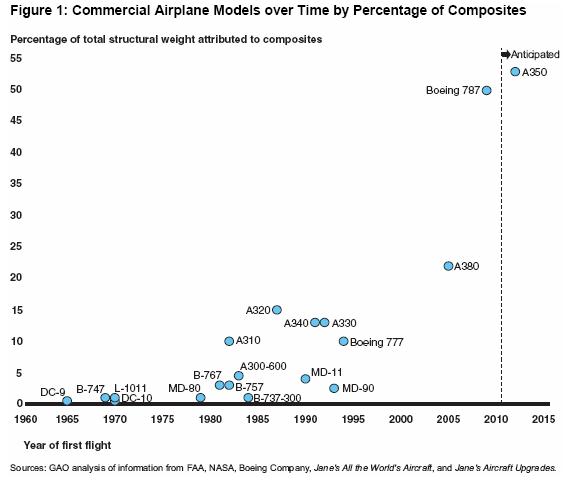
Composite materials in transport aircraft components have been used for decades. Prior to the mid-1980s, aircraft manufacturers used composite materials in transport category aircrafts in secondary structures (e.g., wing edges) and control surfaces. In 1988, Airbus introduced the A320, the first aircraft in production with an all-composite tail section and, in 1995, the Boeing Company introduced the Boeing 777, also with a composite tail section.
Composite materials used in commercial aircrafts typically are produced by combining layers of carbon or glass fibres with epoxy.
In recent years, manufacturers have expanded the use of composites in the fuselage and wings because these materials are typically lighter and more resistant to corrosion than the metallic materials that have traditionally been used in aircraft.
Commercial aircraft models over time by percentage of composite
The Boeing 787 is the first mostly composite large transport aircraft in commercial service. The Boeing 787 is about 50 percent composite by weight (excluding the engines). It will carry 210-290 passengers on routes of 7650 NM to 8500 NM.
It will soon be followed by the Airbus A350, having composite material roughly in the same proportion as its Boeing competitor. The A350 family provides true long-range capability of flying up to 8500 NM, with seating capacities from 250 to 400-plus passengers.
2 – Who is responsible for the safety of composite structure
The responsibility of the safety of an aircraft, and subsequently of the safety of composite structure, is shared between three parties:
The Airworthiness Authorities (e.g: FAA in US, EASA in Europe) are responsible for setting the certification standard and certifying that the aircraft manufacturers and parts suppliers meet their standards. They also conduct periodic inspections of manufacturing facilities to ensure continued compliance with regulations, and oversee aircraft repair facilities to ensure they follow the proper maintenance and training procedures.
The aircraft manufacturers are responsible for showing compliance with those regulations and building safe aircraft. They are also developing aircraft maintenance programs and repair manuals and provide requested on-site technical assistance.
The operators are responsible for operating aircraft according to Airworthiness Authority rules and the manufacturer approved manuals. This includes performing adequate maintenance action when appropriate. Aircraft operators also help by maintaining the airworthiness of their aircraft fleets by tracking their aircraft service history and reporting relevant repair and incident data to the Authorities and the manufacturers.
Material used in the Boeing 787
3 – Safety concerns with composite structure
Some concerns have been raised related to the use of large proportion of composite on an aircraft structure. These concerns mainly originated from the state of the science underpinning the expanded use of composite materials in commercial transport category aircrafts, and the lack of experience with such design. While the GAO did not make any recommendations, it found four safety-related concerns:
The first concern is the limited information on the behaviour of composite airframe structures. These concerns focus on how composite airframe structures behave when damaged and as they age. These concerns are partly attributable to the limited in-service experience with composite materials used in the airframe structures of commercial aircrafts and, therefore, less information is available on the behaviour of these materials than on the behaviour of metal. Designers rely on models to predict the behaviour of composites part.
The GAO also found challenges related to the detection of damage in composite materials and related to the unique properties of composite materials. “Impact damage to composite structures is unique in that it may not be visible or may be barely visible, making it more difficult for a repair technician or aviation worker to detect than damage to metallic structures,” the GAO said. “Making a repair is also a concern partly because composite repairs are more susceptible to human error than metal repairs since the quality of a composite repair is highly dependent on the process used.”. Experience have already shown that aircraft can be grounded several days for a repair on a composite structure, while a few hours would have been needed on a metallic part. This can be a severe drawback particularly because of the frequent damages done on aircraft by ground handling operations.
In addition, there is limited standardisation of composite materials and repair techniques, compared to metal materials and repairs. This is partly due to business proprietary practices and the “relative immaturity” of the use of composite materials in aircraft structures. “A repair technician could confuse materials or processes, which may result in improper repairs,” the GAO said. This can also have negative economic impact for airlines and repair stations because a repair facility might have to keep a large stock of repair materials and parts in house. Also, composite materials generally need to be stored at a specific temperature, and the materials also have shelf lives (i.e., expiration dates).
The organisation also identified concerns related to the level of training and awareness of workers handling composites. “Aircraft repair technicians and designees that have worked with metal materials for decades generally may not be as familiar with composite materials, whose application in aircrafts is relatively recent and whose unique characteristics are associated with technical challenges.” it said.
Many efforts are ongoing or planned by the Airworthiness Authorities to help address these areas of safety-related concerns. Efforts to address these concerns include issuing new or modified guidance and policy, conducting research, developing and implementing training and collaborating with industry stakeholders.
However, “It is too early to fully assess the adequacy of [Authorities] and industry efforts to address safety-related concerns and to build sufficient capacity to handle and oversee composite maintenance and repair, given that composite airframe structures in currently in-service aircrafts are mostly limited to the secondary structures” says the GAO.
Finally, “Several experts reiterated that while not every risk can be known, the use of composites is not revolutionary; rather, it is a new application of technology that has a history in military and general aviation applications.” says the GAO.
A Boeing 787 frame
4 – Conclusion
Composite technology is not a revolution in aviation, and it was already used in the past for some aircraft parts. However, since 2011, large commercial aircraft built mostly in composite have started commercial service, and this creates many safety concerns in the aviation community, mainly because of the lack of experience with such design and the huge differences between the safety-proven metal and the composite.
Also, the adaptation of operational and maintenance procedures to fit with composite particularities may have a negative economic impact.
Commercial aviation has grown in history thanks to successive jumps toward unknown areas. At each jump, many questions and worries arose, we eventually made the necessary progress, suited to the new technology and made it safe. Sadly, many accidents also happened further to these jumps, and this was the price to pay.
Large commercial plane built mostly in composite is another jump, and this is probably the future of aviation as it allows designing lighter, more efficient and greener aircraft. But today, an aircraft accident due to the use of composite is not an option, and the public opinion cannot accept to pay such a price anymore.
George Brown is a decorated soldier and health professional and 40 year veteran in the field of emergency nursing and paramedical practice, both military and civilian areas. He has senior management positions in the delivery of paramedical services. Opinions expressed in these columns are solely those of the author and should not be construed as being those of any organization to which he may be connected.
He was born in the UK of Scottish ancestry from Aberdeen and a member of the Clan MacDougall. He is a member of the Macedonian community in Newcastle, and speaks fluent Macedonian. While this may seem a contradiction, it is his wife who is Macedonian, and as a result he embraced the Macedonian language and the Orthodox faith.
His interests include aviation and digital photography, and he always enjoys the opportunity to combine the two. Navigate to his Flickr site to see recent additions to his photo library.
Џорџ Браун е украсени војник и професионално здравствено лице и 40 годишен ветеран во областа на за итни случаи старечки и парамедицински пракса, двете воени и цивилни области. Тој има високи менаџерски позиции во испораката на парамедицински услуги. Мислењата изразени во овие колумни се исклучиво на авторот и не треба да се толкува како оние на било која организација тој може да биде поврзан.
Тој е роден во Велика Британија на шкотскиот потекло од Абердин и член на Kланот MacDougall. Тој е член на македонската заедница во Њукасл, и зборува течно македонски. Иако ова можеби изгледа контрадикција, тоа е неговата сопруга кој е македонски, и како резултат научил македонскиот јазик и ја примија православната вера.
Неговите интереси вклучуваат авијација и дигитална фотографија, и тој секогаш ужива во можност да се комбинираат двете. Отиди до неговиот Фликр сајт да видите последните дополнувања на неговата слика библиотека.
Discussion on the law that applies to or affects Australia's emergency services and emergency management, by Michael Eburn, PhD, Australian Lawyer. Email: meburn@australianemergencylaw.com
Oh, let's see...distinguished Gen-X'er, frustrated writer and mom living in the confines of a small town that thinks it's a big deal. And have I mentioned Walmart yet?





 Words, By George!